



Past performance does not predict future returns. You may get back less than you originally invested. Reference to specific securities is not intended as a recommendation to purchase or sell any investment.
This article is featured in the Q1 2026 Future Strategist newsletter, you can read the rest of the newsletter here.
The first quarter of 2026 has delivered two key change drivers that clearly impact the outlook and the way we are looking at investment positioning from here.
The first is the impact of the Iran war that has driven up energy prices and thus potential inflation numbers. This in turn has lowered the likelihood of rate cuts on the scale that was foreseen at the start of the year. This acts as a drag on growth and the discount rates applied to growth equities in particular.
The second factor is the dynamic shift in perception of AI winners and losers, and the software impact witnessed in the first quarter. Looking at the Goldman Sachs thematic baskets, Expensive Software fell 22% in the first quarter while Capex Beneficiaries rose 16%. The Mega Cap basket fell 10%, highlighting that rotation has been severe compared to previous periods. In short, it was hard to make progress in equities without owning hardware and AI-related capex names.
This trend is likely to continue into the second quarter, and the revenue from all this capex spending is starting to deliver meaningful revenues. We see this as an opportunity to expand the horizon of names that will directly benefit from the spending to include the key hyperscalers, Amazon and Google in particular.
In addition, we remain positive on bottleneck supply chain names like memory and hard disk drives while avoiding the most frothy parts of the theme such as optical networking. If there is anywhere that bears some resemblance to 2000, it is probably here. Cienna was around in the dotcom boom/bust. It traded at $37 in 1998, peaked at over $1,000 in 2000 and by October of that year was trading at around $20! The shares did little for the next 25 years, but a new ramp has kicked in. From a share price of around $50 in 2025, the shares have jumped 10 times to trade close to $500. What are the chances of another year like 2000 in this sub-segment of the market?
Software remains a difficult area for investment with our proprietary technical system flagging most names as sell/avoid. The debate will rage for a long time over the disruptive nature of AI to the traditional software industry. It is likely that the final outcome will sit in between those who say this is Software 2.0 and nothing survives from the SaaS (Software as a Service) era and those that think the moats existing today are sufficient to protect large scale software names. Getting the investment strategy right in this sector, as well as related names that have been sold aggressively, will matter as the year goes on.
Outside the tech space, we continue to promote diversification. The structural trend for the US dollar is likely to be lower and this favours emerging markets. This also supports non-US dollar investors taking advantage of likely currency tailwinds outside the US.
We do not believe that the gold trade is over yet. There is still a great deal of uncertainty in the world, and this asset class provides good diversification. The gold miners in particular still trade at significant discounts to the gold price itself, and we continue to like these names as portfolio diversifiers.
Economic data around the world have remained robust for now and this is supportive of equities. The Bank of America global wave indicator has turned positive, reflecting the strengthening of economic conditions, and traditionally this has been a good lead indicator for equity performance.
Bank of America global wave indicator
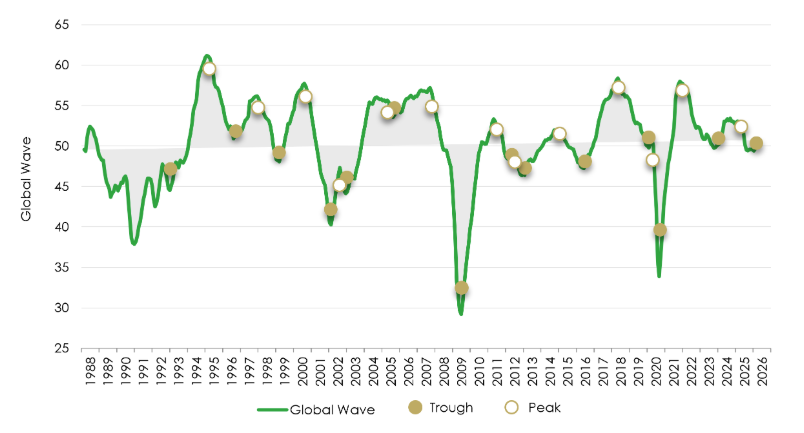
Source: Bank of America, April 2026.
Following previous trough signals in the wave, the MSCI World index median performance over the following 12 months has been +16.5%, with emerging markets and Europe leading from a geographical perspective, which is again in line with our thinking on diversification. There are also clearly significant cash resources on the sidelines to buy the dip. We remain constructive overall, but with diversification as the price to pay for managing risk effectively.
Read, watch and listen to more insights from Liontrust fund managers here >
KEY RISKS
Past performance does not predict future returns. You may get back less than you originally invested.
We recommend this fund is held long term (minimum period of 5 years). We recommend that you hold this fund as part of a diversified portfolio of investments.
The Funds managed by the Global Equities Team:
-
May hold overseas investments that may carry a higher currency risk. They are valued by reference to their local currency which may move up or down when compared to the currency of a Fund.
-
May encounter liquidity constraints from time to time. The spread between the price you buy and sell shares will reflect the less liquid nature of the underlying holdings.
-
May invest in smaller companies and may invest a small proportion (less than 10%) of the Fund in unlisted securities. There may be liquidity constraints in these securities from time to time, i.e. in certain circumstances, the fund may not be able to sell a position for full value or at all in the short term. This may affect performance and could cause the fund to defer or suspend redemptions of its shares.
-
May have a concentrated portfolio, i.e. hold a limited number of investments or have significant sector or factor exposures. If one of these investments or sectors / factors fall in value this can have a greater impact on the Fund's value than if it held a larger number of investments across a more diversified portfolio.
-
May invest in emerging markets which carries a higher risk than investment in more developed countries. This may result in higher volatility and larger drops in the value of a fund over the short term.
-
Certain countries have a higher risk of the imposition of financial and economic sanctions on them which may have a significant economic impact on any company operating, or based, in these countries and their ability to trade as normal. Any such sanctions may cause the value of the investments in the fund to fall significantly and may result in liquidity issues which could prevent the fund from meeting redemptions.
-
May invest in companies predominantly in a single country which maybe subject to greater political, social and economic risks which could result in greater volatility than investments in more broadly diversified funds.
-
May hold Bonds. Bonds are affected by changes in interest rates and their value and the income they generate can rise or fall as a result; The creditworthiness of a bond issuer may also affect that bond's value. Bonds that produce a higher level of income usually also carry greater risk as such bond issuers may have difficulty in paying their debts. The value of a bond would be significantly affected if the issuer either refused to pay or was unable to pay.
-
May, in certain circumstances, invest in derivatives but it is not intended that their use will materially affect volatility. Derivatives are used to protect against currencies, credit and interest rate moves or for investment purposes. The use of derivatives may create leverage or gearing resulting in potentially greater volatility or fluctuations in the net asset value of the Fund. A relatively small movement in the value of a derivative's underlying investment may have a larger impact, positive or negative, on the value of a fund than if the underlying investment was held instead.
The risks detailed above are reflective of the full range of Funds managed by the Global Equities Team and not all of the risks listed are applicable to each individual Fund. For the risks associated with an individual Fund, please refer to its Key Investor Information Document (KIID)/PRIIP KID.
The issue of units/shares in Liontrust Funds may be subject to an initial charge, which will have an impact on the realisable value of the investment, particularly in the short term. Investments should always be considered as long term.
DISCLAIMER
This material is issued by Liontrust Investment Partners LLP (2 Savoy Court, London WC2R 0EZ), authorised and regulated in the UK by the Financial Conduct Authority (FRN 518552) to undertake regulated investment business.
It should not be construed as advice for investment in any product or security mentioned, an offer to buy or sell units/shares of Funds mentioned, or a solicitation to purchase securities in any company or investment product. Examples of stocks are provided for general information only to demonstrate our investment philosophy. The investment being promoted is for units in a fund, not directly in the underlying assets.
This information and analysis is believed to be accurate at the time of publication, but is subject to change without notice. Whilst care has been taken in compiling the content, no representation or warranty is given, whether express or implied, by Liontrust as to its accuracy or completeness, including for external sources (which may have been used) which have not been verified.
This is a marketing communication. Before making an investment, you should read the relevant Prospectus and the Key Investor Information Document (KIID) and/or PRIIP/KID, which provide full product details including investment charges and risks. These documents can be obtained, free of charge, from www.liontrust.com or direct from Liontrust. If you are not a professional investor please consult a regulated financial adviser regarding the suitability of such an investment for you and your personal circumstances.
Understand common financial words and terms See our glossary