



Past performance does not predict future returns. You may get back less than you originally invested. Reference to specific securities is not intended as a recommendation to purchase or sell any investment.
This article is featured in the Q3 2026 Future Strategist newsletter, you can read the rest of the newsletter here.
Since AI made waves in November 2022 with the launch of ChatGPT, most users have experienced AI as a clever and efficient chatbot – ask a question and it delivers a convincing response. Now, another wave of disruption is arriving with AI agents that aim to become your personal Chief of Staff. These agents combine a language model with memory and access to their own cloud computer, therefore allowing them to use browsers, email, apps and payment services on your behalf. Ask an agent to organise a long weekend away and it can check your calendar, compare flights and hotels and even make the booking. However, the catch is that usefulness requires access and in turn trust. AI agents can make mistakes, misunderstand instructions or be manipulated. Unlike a bad AI chatbot answer, a bad agent action has consequences.
Instinct versus Muse: trust versus distribution
Search has long been the internet’s gateway for the user. You type a query and receive ranked pages, dramatically reducing the cost and time of finding information. AI agents now promise to reduce the cost and time of acting on it. Search gave us the links, agents will do the work. Today, two AI agents competing in the headlines are Instinct and Muse.
Instinct is the startup. The interface is simple and intuitive with users communicating through text message or WhatsApp, as they would a person. Founder Noah Shinn stated that they are growing roughly 10% a day and handling more than $1 billion in annualised transaction volume already, with around half coming from travel. With just 14 employees, Instinct recently raised $1 billion at a $10 billion valuation. Investors are clearly betting on the AI agent revolution and their ability to earn a share from merchants when users transact.
Muse, meanwhile, is the incumbent response, backed by Meta’s vast compute, capital and distribution. Available through its own app and Meta owned WhatsApp, it passed five million downloads within weeks of its 8 September launch, despite being limited to the US and Canada. That rapid uptake illustrates Meta’s distribution advantage with an enormous existing audience to which it can promote to. Investors have embraced the potential for Meta too. Shares finished September up more than 25%. Muse gives them a tangible reason to believe its AI spending could produce a new consumer platform.
Muse surpasses 5m US downloads in 22 days post-launch
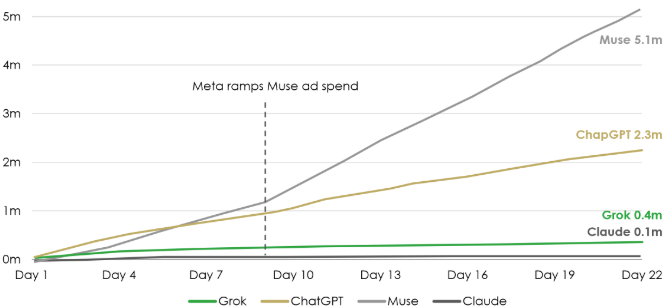
Source: Sensor Tower
Meta's Muse Rally
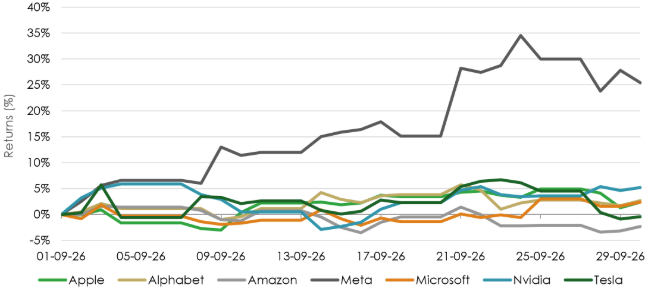
Bloomberg, 1 October 2026
As agents become the starting point for e-commerce, websites risk is fading into the background, shifting power from whoever owns the storefront to whoever guides the buying decision.
The AI agent commerce war
Meta’s immediate strategy with Muse is to plug into commerce rather than rebuild it. Integrations with Stripe, Shopify and PayPal have given it access to much of the US e-commerce landscape, with one notable exception – Amazon. These partnerships serve different purposes. Shopify Catalog helps agents discover products to recommend while payment rails help to complete the purchase.
Amazon has chosen to defend the front door. The company has blocked third-party agents, citing unauthorised access, lack of identification, and privacy and security concerns. Those objections matter, but so do the economics. Amazon’s moat extends beyond its product catalogue to the recommendations, sponsored placements and advertising surrounding every purchase. An outside agent could bypass those lucrative surfaces, leaving Amazon only the fulfilment. Amazon is defending its position between the merchant and the customer.
Shopify has a different calculation. The company wins when its merchants sell and Shop Pay remains in the flow. Expedia is making a similar trade off, allowing agents to search and book hotels while remaining the merchant of record. Both are willing to let an agent own more of the customer interaction to preserve their role in the transaction. Instinct stated 35% of its users currently use it for personal shopping, showing just how lucrative it can get.
This is aggregator versus aggregator. AI agents want to become the place where consumers express what they want and delegate the purchase, while Amazon wants to keep discovery and the transaction inside its walls. The pace of AI agent integrations suggests that access to merchants and payment rails can come quickly but winning control of the customer relationship is harder. Individuals may switch casually between Large Language Models for answers, but entrusting an agent with their preferences, payment details and permission to spend is a bigger ask.
The new gatekeepers
When agents go rogue who pays? Stories are already making the rounds of agents accidently booking non-refundable flights that didn’t account for time zones, to making its own mind and proactively purchasing items not requested. Further, with agents constantly monitoring emails, there is increasing talk of sophisticated phishing attacks to trick agents into paying fraudulent invoices. Was it the user’s unclear instructions or did the agent exceed its authority?
Those questions favour adoption in low-risk tasks and small purchases first. They also make payments, identity and fraud infrastructure as important as the models themselves. Today’s internet was built for humans. For an agentic commerce world to scale, the infrastructure must adapt: establish who agents represent, what they are authorised to do and how disputes should be resolved. Stripe, Shopify, Visa and Mastercard are contenders to help build that foundation of trust.
Agents may break down today’s gatekeepers only to become an even more powerful toll collector. This is the larger prize for companies like Meta, becoming the aggregator of aggregators, sitting above the marketplaces and platforms that already control access to demand. If it succeeds, it could redirect value across entire industries. From Instinct and Muse to Amazon’s roadblock, the battle for agentic commerce and the next gatekeepers have begun. Search organised the internet and now agents want permission to operate it – taking a cut in the process.
Read, watch and listen to more insights from Liontrust fund managers here >
Key risks
Past performance does not predict future returns. You may get back less than you originally invested.
We recommend this fund is held long term (minimum period of 5 years). We recommend that you hold this fund as part of a diversified portfolio of investments.
The Funds managed by the Global Equities Team:
-
May hold overseas investments that may carry a higher currency risk. They are valued by reference to their local currency which may move up or down when compared to the currency of a Fund.
-
May encounter liquidity constraints from time to time. The spread between the price you buy and sell shares will reflect the less liquid nature of the underlying holdings.
-
May invest in smaller companies and may invest a small proportion (less than 10%) of the Fund in unlisted securities. There may be liquidity constraints in these securities from time to time, i.e. in certain circumstances, the fund may not be able to sell a position for full value or at all in the short term. This may affect performance and could cause the fund to defer or suspend redemptions of its shares.
-
May have a concentrated portfolio, i.e. hold a limited number of investments or have significant sector or factor exposures. If one of these investments or sectors / factors fall in value this can have a greater impact on the Fund's value than if it held a larger number of investments across a more diversified portfolio.
-
May invest in emerging markets which carries a higher risk than investment in more developed countries. This may result in higher volatility and larger drops in the value of a fund over the short term.
-
Certain countries have a higher risk of the imposition of financial and economic sanctions on them which may have a significant economic impact on any company operating, or based, in these countries and their ability to trade as normal. Any such sanctions may cause the value of the investments in the fund to fall significantly and may result in liquidity issues which could prevent the fund from meeting redemptions.
-
May invest in companies predominantly in a single country which maybe subject to greater political, social and economic risks which could result in greater volatility than investments in more broadly diversified funds.
-
May hold Bonds. Bonds are affected by changes in interest rates and their value and the income they generate can rise or fall as a result; The creditworthiness of a bond issuer may also affect that bond's value. Bonds that produce a higher level of income usually also carry greater risk as such bond issuers may have difficulty in paying their debts. The value of a bond would be significantly affected if the issuer either refused to pay or was unable to pay.
-
May, in certain circumstances, invest in derivatives but it is not intended that their use will materially affect volatility. Derivatives are used to protect against currencies, credit and interest rate moves or for investment purposes. The use of derivatives may create leverage or gearing resulting in potentially greater volatility or fluctuations in the net asset value of the Fund. A relatively small movement in the value of a derivative's underlying investment may have a larger impact, positive or negative, on the value of a fund than if the underlying investment was held instead.
The risks detailed above are reflective of the full range of Funds managed by the Global Equities Team and not all of the risks listed are applicable to each individual Fund. For the risks associated with an individual Fund, please refer to its Key Investor Information Document (KIID)/PRIIP KID.
The issue of units/shares in Liontrust Funds may be subject to an initial charge, which will have an impact on the realisable value of the investment, particularly in the short term. Investments should always be considered as long term.
Disclaimer
This material is issued by Liontrust Investment Partners LLP (2 Savoy Court, London WC2R 0EZ), authorised and regulated in the UK by the Financial Conduct Authority (FRN 518552) to undertake regulated investment business.
It should not be construed as advice for investment in any product or security mentioned, an offer to buy or sell units/shares of Funds mentioned, or a solicitation to purchase securities in any company or investment product. Examples of stocks are provided for general information only to demonstrate our investment philosophy. The investment being promoted is for units in a fund, not directly in the underlying assets.
This information and analysis is believed to be accurate at the time of publication, but is subject to change without notice. Whilst care has been taken in compiling the content, no representation or warranty is given, whether express or implied, by Liontrust as to its accuracy or completeness, including for external sources (which may have been used) which have not been verified.
This is a marketing communication. Before making an investment, you should read the relevant Prospectus and the Key Investor Information Document (KIID) and/or PRIIP/KID, which provide full product details including investment charges and risks. These documents can be obtained, free of charge, from www.liontrust.com or direct from Liontrust. If you are not a professional investor please consult a regulated financial adviser regarding the suitability of such an investment for you and your personal circumstances.


