






Companies investing in solving some of the world’s biggest issues stand to deliver strong future returns for their investors, according to Thaiha Nguyen, co-manager of Baillie Gifford Positive Change.
“Investment and impact go hand in hand,” she said. “Companies that have the genuine intention to solve a massive societal and environmental challenge will have very large market opportunity and they will see demand for their products and services growing, which will drive investment returns.”
As such, the fund specifically targets companies with strong fundamentals that also deliver a positive societal/environmental impact. It targets global challenges such as climate change and biodiversity loss, as well as inequality in education, healthcare and finance. The fund holds a concentrated portfolio of around 40 stocks and reports annually on impact progress.
She noted that they are prepared to pay more for companies they believe in.
Nguyen argued that, over the long term, “share price will follow the fundamentals”.
“Yes, these companies are more expensive but they will grow faster,” she said. “They are resilient and have low debt. They are actively investing in R&D and future growth.”
Below, Nguyen shared three stock picks for companies with strong fundamentals delivering positive impact.
Sandoz Group
Sandoz is a healthcare company the Baillie Gifford Positive Change management team thinks contributes to quality of life.
Rather than being focused on cutting-edge scientific innovations and breakthroughs, Sandoz specialises in generics and biosimilars, manufacturing and marketing off-patent drugs.
“These drugs are very important to ensuring widespread and affordable access to healthcare,” Nguyen said.
“When a generic or biosimilar first hits the market, its price can be up to 40% or 50% cheaper than the branded version – and that gap can continue to widen over time.”
As an example, Sandoz developed Hyrimoz – an off-patent drug of Humira, which treats various autoimmune conditions, such as rheumatoid arthritis, Crohn’s disease and psoriasis. It is 80% cheaper than Humira, Nguyen said.
Generics and biosimilars are also popular among healthcare systems. In the decade to 2019, the US healthcare system saved around $2.2trn as a result of generics, while the NHS in the UK saves around £13bn each year.
“We think the positive impact of off-patent drugs provided by Sandoz will increase due to factors such as ageing global populations and the wave of drugs that will be coming off patents over the next few years,” Nguyen said.
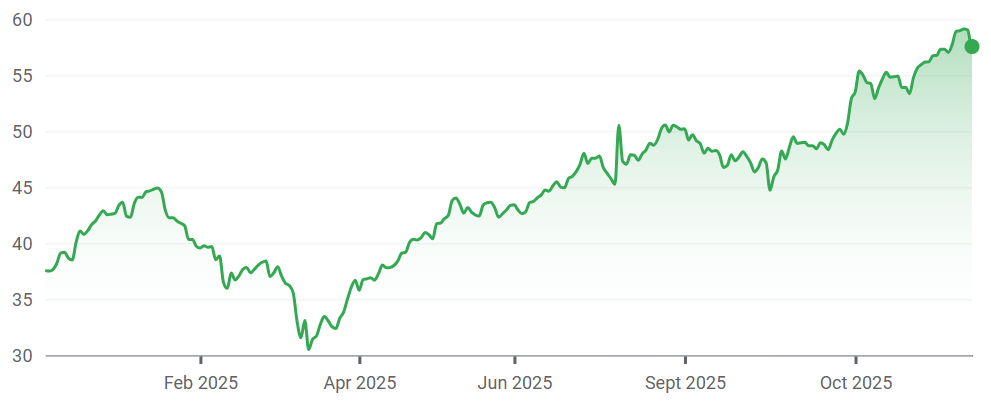
Sandoz Group’s share price has surged 53.3% year-to-date, but its trailing P/E of over 135x looks inflated due to significant restructuring costs following its spin-off from Novartis in 2023, while the forward P/E of 19x points to expectations of stronger profitability ahead.
Stock price performance YTD
Source: Google Finance
MercardoLibre
Nguyen also highlighted MercadoLibre, the largest ecommerce platform in Latin America, which has been a long-term holding for Baillie Gifford Positive Change since February 2020.
“The reason why we like this company is that ecommerce penetration in the LatAm region is still very low at around 15% of total addressable retail compared to over 20% in the western world and over 30% in China,” she said.
“From an impact perspective, a platform like MercadoLibre is very important in supporting small- and medium-sized businesses and providing them with access to online markets, which then leads to significant job and income creation.”
Nguyen estimated that over 110,000 jobs have been created on the company’s platforms, with MercadoLibre being the primary source of revenue for 60% of the SMEs that use it.
“It is also emerging as one of the leaders in the region’s fintech industry,” she noted. “And it is this fintech arm which we feel even more excited about.”
The ecommerce giant first started moving into financial services by providing digital payment solutions for customers and merchants but is now expanding into a wider array of financial services, from investment insurance to lending.
Nguyen said that about two-thirds of the population in the region are unbanked or under-banked and typically have poor access to financial services.
“On the other hand, you have a handful of incumbent banks which have been able to exploit and charge enormous fees for simple things such as getting a text message about the balance in your account,” she added.
“Companies like MercadoLibre are able to leverage the internet and mobile phone usage to really disrupt the industry and promote financial inclusion across the region, with 60% of SMEs seeing their sales growing by using the payment system and two-thirds of entrepreneurs on the platform making their first investments through the platform.”
As such, MercardoLibre has created “huge economic opportunity” in a region where formal employment and financial access remains limited, creating economic wealth which can “translate into very exciting opportunity for shareholders”.
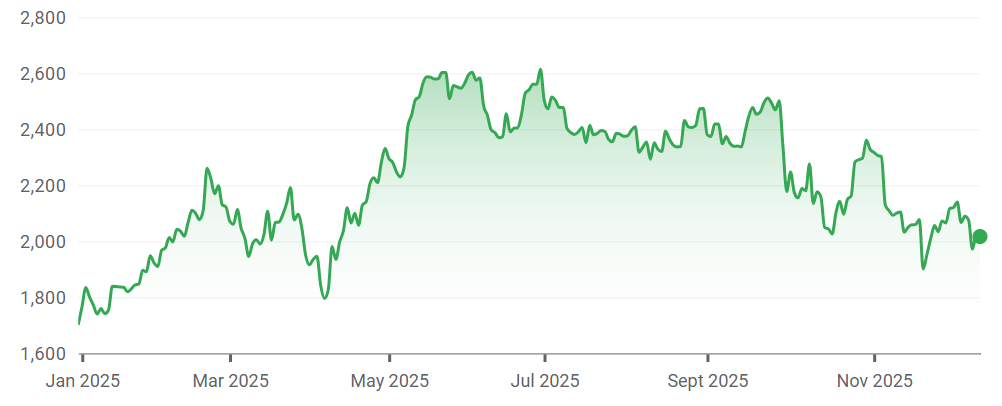
The share price is up 18.6% year-to-date and 25.5% over five years. It is also expensive, with a P/E ratio of 45.1x.
Stock price performance YTD
Source: Google Finance
Arm Holdings
Nguyen’s third stock pick was the UK-based semiconductor company Arm Holdings, which was founded in 1990 in Cambridge and bought by Japan’s SoftBank in 2016.
The company designs chip technology and licences it to other companies. Its designs are used in most smartphones and other devices like cars and servers. As well as the licencing fees, Arm Holdings receives a small royalty for every chip sold using its technology.
Chips using Arm Holdings technology are “increasingly adopted in cloud and AI applications and emerging applications like robotics and autonomous vehicles”, Nguyen said. “So we believe that the opportunity for Arm Holdings is open-ended.”
Until now, the company has been pricing conservatively, but Nguyen noted the company has a new monetisation strategy that “more closely reflects its critical value in the ecosystem”.
“The royalties from every chip sold could increase from around 2% today to as high as the low teens in the future,” she said.
“And the company also has a formidable competitive edge, as software developers have cumulatively spent hundreds of millions of dollars optimising their software based on Arm chips, which makes it hard for competitors to catch up.”
Big players in the AI race, like Amazon and Microsoft, have also chosen to use Arm Holdings-based architecture chips, meaning that the company is embedded in modern computing and AI innovation.
With many experts flagging the energy-related bottlenecks likely to cause problems as companies rush to build-out AI capabilities, Arm Holdings is also set to benefit due to designing chip infrastructure that has lower power consumption, which means it is offering a key technology that can help lower energy usage in data centres.
“From an impact perspective, Arm Holdings is helping to mitigate power consumption and mitigation carbon emissions growth,” Nguyen said.
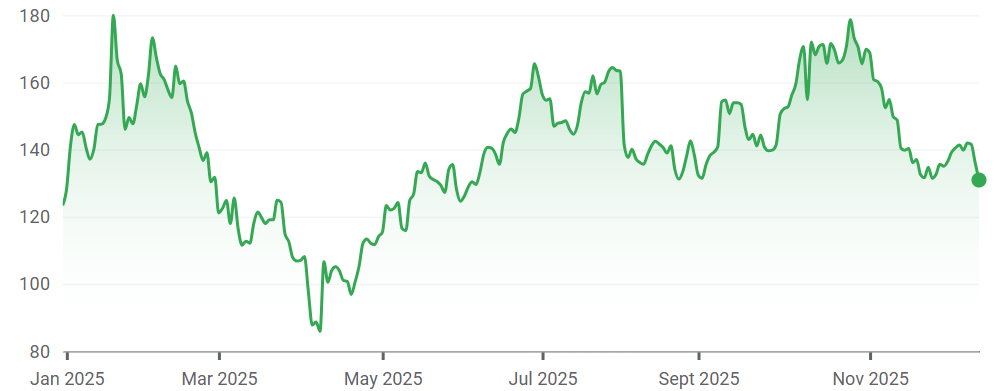
The company currently has a P/E of over 150x, while the share price is up 6.1% year-to-date and a more impressive 115.5% over five years.
Stock price performance YTD
Source: Google Finance