






NASA’s Artemis II mission has returned safely to Earth after a historic 10-day journey around the moon – further than man has ever travelled before.
The mission was designed to validate systems for future lunar landings and reignited attention on space exploration, amid growing commercial activity from high-profile figures, such as Elon Musk and Richard Branson.
For investors, however, the opportunity lies less in moonshots and more in the ecosystem behind them, including satellites, defence systems and data infrastructure.
Against this backdrop, Trustnet asked fund selectors which strategies could give investors targeted or indirect exposure to the space industry within a diversified portfolio.
One of the most direct ways for UK investors to gain exposure is through Seraphim Space Investment Trust, a London-listed vehicle dedicated to investing in space technology.
The portfolio is highly concentrated, with its largest holding – Finnish satellite company ICEYE – representing almost 40% of net asset value (NAV) as at the end of December 2025.
The trust takes a venture capital-style approach by investing heavily in private, early-stage businesses, with holdings spanning satellite communications, earth observation, navigation and defence applications.
Jason Hollands, managing director at Bestinvest, said: “This gives investors access to parts of the space economy that are otherwise hard to reach but it also means higher risk and greater volatility,” Hollands said.
Other companies it has invested in have since come to market, including Voyager Space, AST SpaceMobile and Astroscale.
Richard Philbin, chief investment officer of investment solutions at Hawksmoor Investment Management, said this “shows the trust has had a number of successes – and it still has a position in these firms”.
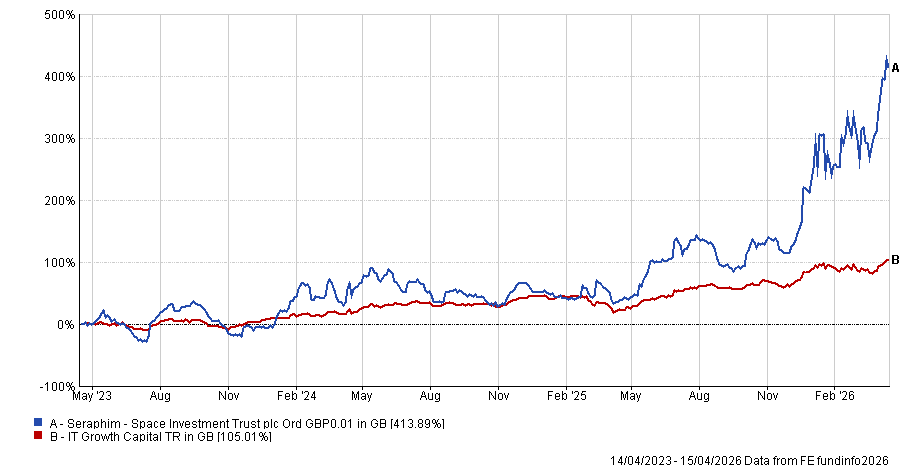
Seraphim Space Investment Trust delivered the third-strongest performance among investment trusts in February 2026 as it benefitted from an increase in investor interest in space technology. It was also one of the best-performing trusts in 2025.
The trust has £438.8m in assets and is currently trading at an almost 30% premium to NAV. Earlier this month, it announced it is considering a ‘C’ share issue fundraising.
Performance of the trust vs sector over 3yrs
Source: FE Analytics
Hollands also suggested VanEck Space Innovators UCITS ETF. The exchange-traded fund (ETF) tracks a basket of around 25-30 listed companies largely involved in the infrastructure underpinning the space ecosystem, including satellite operators, launch providers and enabling technologies.
“As a passive ETF, it spreads risk across the theme, although it remains relatively concentrated given the modest universe of public companies in this arena and can be volatile,” Hollands said.
He noted that specialist funds provide different ways to tap into that theme but, given the risks and volatility involved, “they are best considered 1-2% punts within a diversified portfolio rather than as core holdings”.
Not all exposure to the space economy comes via specialist vehicles, however, with broader vehicles also increasing their involvement in space‑related businesses.
One such example is Scottish Mortgage Investment Trust, which accesses space-related investment opportunities primarily through its long-standing holdings in high-growth companies where space technology is central to the business model – most notably, SpaceX.
Earlier this month, it was widely reported that SpaceX had confidentially filed for an IPO, raising expectations of a potential listing as early as this summer.
Victoria Hasler, head of fund analysis at Hargreaves Lansdown, said: “Scottish Mortgage’s closed-ended structure allows it to invest meaningfully in unlisted businesses like SpaceX, giving public market investors access to private space-related assets that would otherwise be unavailable.”
Managed by FE fundinfo Alpha Manager Tom Slater and Lawrence Burns, last month it was announced the trust would be asking shareholders to approve an amendment allowing it to make up to £250m of new investments in private companies while its exposure remains above the existing 30% cap.
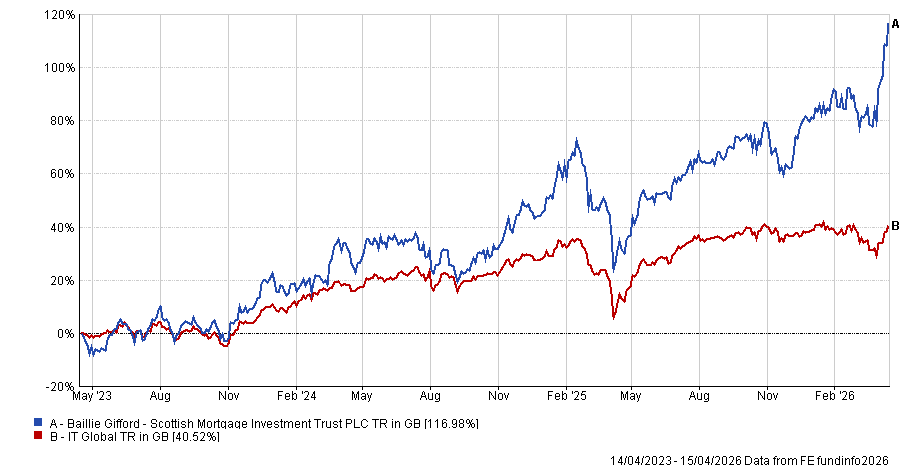
Hasler noted that the trust’s performance has been strong in the past 12 months, with both the share price and NAV benefitting from valuation uplifts in private holdings and improved sentiment towards growth assets.
“It has materially outperformed global equity markets over this period, reflecting renewed investor confidence in its largest growth holdings, including space-related investments,” Hasler said.
While the trust’s focus on higher-growth public and private companies can lead to strong results over time, she warned that this also means it can be more volatile and perform very differently to its benchmark.
“We would therefore suggest that it is best used as a smaller position in a broad, diversified portfolio,” she said.
Scottish Mortgage Investment Trust is trading at a 5.1% premium to NAV as at 14 April 2026.
Performance of the trust vs sector over 3yrs
Source: FE Analytics
Alongside Scottish Mortgage, Philbin noted that Schiehallion, Baillie Gifford US Growth Trust, Edinburgh Worldwide and RIT Capital Partners also all offer exposure to SpaceX.
However, Hollands said that, if SpaceX does list in the coming months, UK investors will likely eventually be able to gain exposure indirectly through global and US equity index funds they may already hold, as SpaceX “will in time likely become a constituent of major indices such as the S&P 500”.
Alongside investment trusts, selectors also pointed to a number of open‑ended funds that have been building exposure to space‑related themes within broader portfolios.
Paul Angell, head of investment research at AJ Bell, suggested BlackRock European Dynamic.
“It has been increasing its weighting in aerospace and defence companies over recent years, making up just over 15% of the fund at the end of February 2026,” Angell said.
Some of the fund’s key holdings within the theme include Safran, Airbus, MTU Aero Engines and Saab.
Angell said fund manager Giles Rothbarth impresses in how macro views are incorporated into bottom‑up stock selection.
The management team invests in businesses with strong cashflow and earnings, resulting in a quality-growth tilt to the portfolio.
“The fund can be dynamic with regards to this style exposure, however, for example rotating into more cyclical names in the second half of 2020,” Angell added.
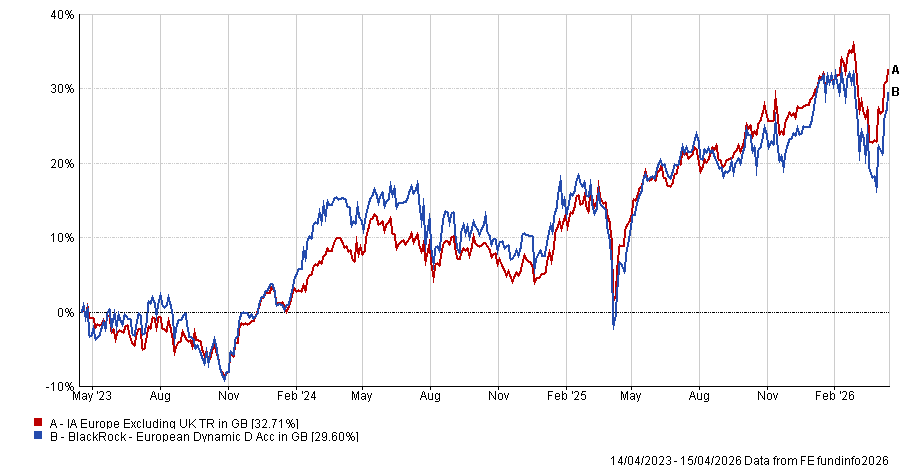
BlackRock European Dynamic has a stellar long-term track record but struggled over one year, slipping into the fourth quartile of the IA Europe ex UK sector.
Performance of the fund vs sector over 3yrs
Source: FE Analytics
Finally, Hasler also pointed to the £296.9m FTF ClearBridge UK Mid Cap fund, which invests in aerospace and defence-related companies as part of a diversified portfolio.
“The managers [Richard Bullas, Daniel Green, Marcus Tregoning and Courtney Westcarr] focus on bottom-up stock selection within the FTSE 250, where aerospace and defence-related companies form part of the UK’s mid-cap industrial universe,” she said.
“Exposure is not driven by a dedicated aerospace or defence theme but arises where individual companies meet the managers’ quality, valuation and long-term growth criteria.”
British multinational Serco Group is one such portfolio holding highlighted by Hasler, with the business delivering services across defence and aerospace operations under long-term government contracts that offer high revenue visibility and defensive cashflows.
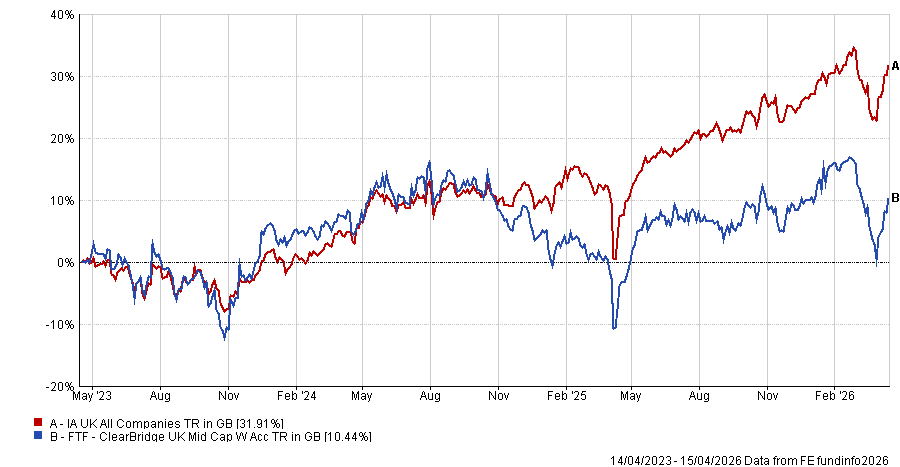
Hasler acknowledged that UK mid-caps “have been a difficult place to invest over the past few years”, however noted that the fund’s 12-month performance to the end of March 2026 was a little stronger “as sentiment towards UK equities became a little more positive”.
Performance of the fund vs sector over 3yrs
Source: FE Analytics