






Seven funds in the IA Mixed Investment 40-85% Shares sector have proven the most consistent of their peers, beating the average return in every single year over the past decade.
As part of an ongoing series, Trustnet mapped the discrete annual returns of funds in each multi-asset peer group between 2016 and 2025, highlighting those which beat the sector average in the most years.
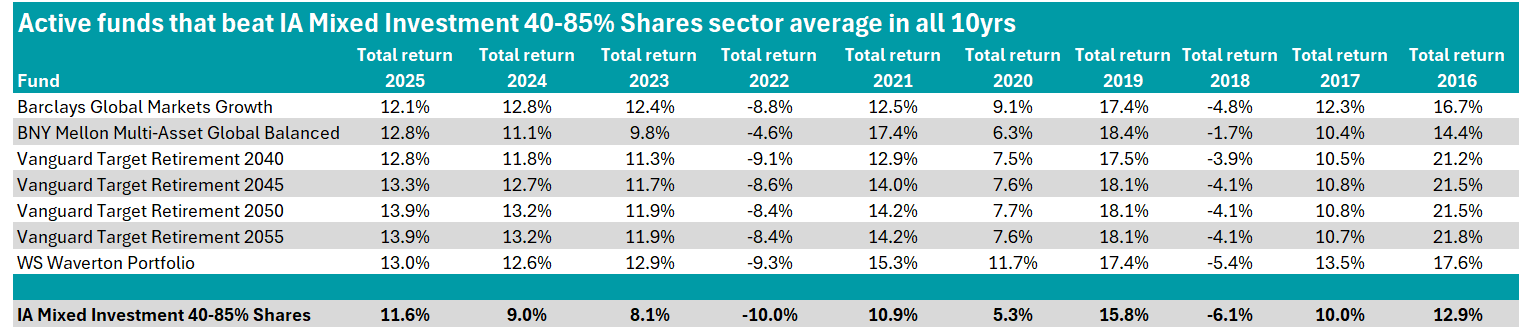
Source: FE Analytics. Figures highlighted in red represent years in which a fund underperformed the IA Mixed Investment 40-85% Shares sector average.
The £607.3m WS Waverton Portfolio fund had the strongest 10-year return of all funds in the table, gaining 148.6% over the assessed period – placing the fund in the top three in the IA Mixed Investment 40-85% Shares sector.
When looking at its returns year-to-year, it was also in the top 10 in the sector for its 2023 return with a 12.9% gain.
Algernon Percy has been managing the fund since inception in 2007 and was joined by James Mee as co-manager in March 2021.
The portfolio is heavily equity-driven, with over 75% invested in equities, including Magnificent Seven mega-caps Alphabet, Amazon and Microsoft. The remainder is split between global fixed interest, alternative assets and the money market, at 12.6%, 8.6% and 2.3% respectively.
Of the funds in the table, BNY Mellon Multi-Asset Global Balanced offered the best protection on the downside due to its focus on holding assets with a low correlation to equities in order to dampen volatility.
In 2022, the £701.8m strategy limited its loss to 4.6%, placing it in the first quartile in the sector for returns in that year – the only fund in the table to do so. Looking further back, it was also the best-performing fund in 2018 – when every fund in the sector was down, the strategy limited its loss to 1.7%.
BNY Mellon Multi-Asset Global Balanced was also the best-performing fund in the table in 2021, posting a first-quartile 17.4% return, followed by WS Waverton Portfolio, which gained 15.3%.
The fund was launched in 1998 and is co-managed by FE fundinfo Alpha Manager Bhavin Shah, Paul Flood and Simon Nichols, who utilise Newton’s global thematic investment approach, which focuses on long-term themes such as financialisation, evolving trade and big government.
Last year, it was also identified as just one of five funds across the Investment Association’s four multi-asset sectors that was consistently among the top in its peer group for the Sharpe ratio over 10 years.
The fund proved more consistent than its stablemate BNY Mellon Multi-Asset Balanced which is managed by the same team and beat the sector average in nine of the 10 years.
Meanwhile, launched in 2010 and with £355.1m in assets, Barclays Global Markets Growth achieves its consistency through a combination of passive implementation and active asset allocation – investing at least 70% of its assets in exchange-traded funds (ETFs) and passive mutual funds via sub-investment manager BlackRock.
The overall allocation between asset classes is actively determined using both tactical and strategic views. It has been managed by Finlay Macdonald since November 2021, when he succeeded Will Hobson.
Barclays Global Markets Growth and WS Waverton Portfolio were the only two funds of the seven in the table to achieve a first-quartile return in the sector in 2020 – gaining 11.7% and 9.1% respectively.
Several funds from the Vanguard Target Retirement suite also beat the sector average in all 10 years.
They are designed for investors planning to retire around the year stated in the fund name, starting with an 80% allocation to equities and 20% to bonds before gradually shifting toward a more conservative 30% to 70% split between equities and bonds respectively within seven years of the target date.
Although these funds invest at least 90% of their assets in passive index-tracking funds, the asset management house considers them to be actively managed because the management team retains discretion over which Vanguard funds to allocate to and in what proportions, rebalancing periodically over time.
Some of the Vanguard funds have made a strong start to 2026, with Vanguard Target Retirement 2055 posting the strongest return in the table with a 4.4% gain – placing it in the first quartile of the sector.
In contrast, WS Waverton Portfolio and Barclays Global Markets Growth have posted second-quartile year-to-date returns of 3.6% and 3.4% respectively, while BNY Mellon Multi-Asset Global Balanced has posted the weakest return in the table, gaining 3%. This places the latter in the third quartile of the sector, with the sector average sitting at 3.4%.
However, consistent outperformance in the sector was not limited to just these seven funds. A further 11 beat the sector average in eight or nine of the 10 years assessed.
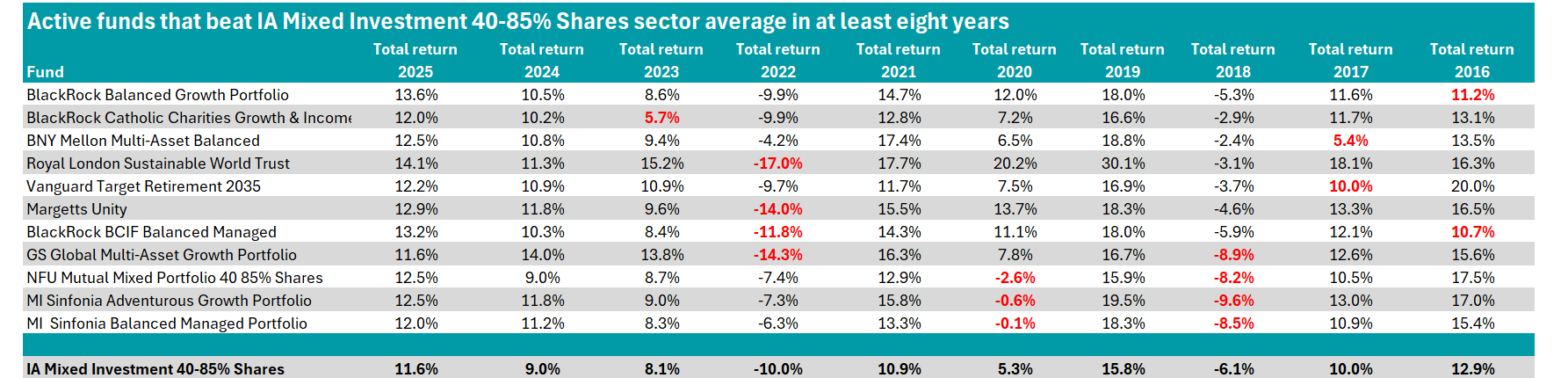
Source: FE Analytics. Figures highlighted in red represent years in which a fund underperformed the IA Mixed Investment 40-85% Shares sector average.
In particular, the £3.6bn Royal London Sustainable World Trust is a standout performer, with the strongest 10-year return in the table, gaining 197.4% – the second-best result in the sector overall, behind Orbis Global Balanced.
The fund has posted a first-quartile return in eight of the 10 years assessed, with standout years including 2019, when it was the best-performing fund in the whole sector with a 30.1% gain, and 2020 and 2021, when it returned 20.2% and 17.7% respectively.
However, a 17% loss in 2022 – the biggest of any fund in the above table that year – is what prevents it from beating the sector average in every year, despite its otherwise strong track record.
Launched in 2012, the fund is co-managed by Alpha Manager Mike Fox, George Crowdy, Sebastien Beguelin and Daphne Tsang, investing primarily in a combination of equities and fixed income, with the asset allocation split remaining relatively fixed over time.
It has a particular focus on identifying companies with strong standards across environmental, social and governance (ESG) themes, with prospective holdings expected to pass both a sustainable as well as a financial assessment.
Year-to-date, Royal London Sustainable World has rebounded to the top of the table of 11 funds, having gained 5.2% so far in 2026. This places it within the first quartile in the whole sector.