






UK investors may be overestimating their long-term returns, according to new research from Fidelity International, which highlights a growing disconnect between expectations and how portfolios are actually invested.
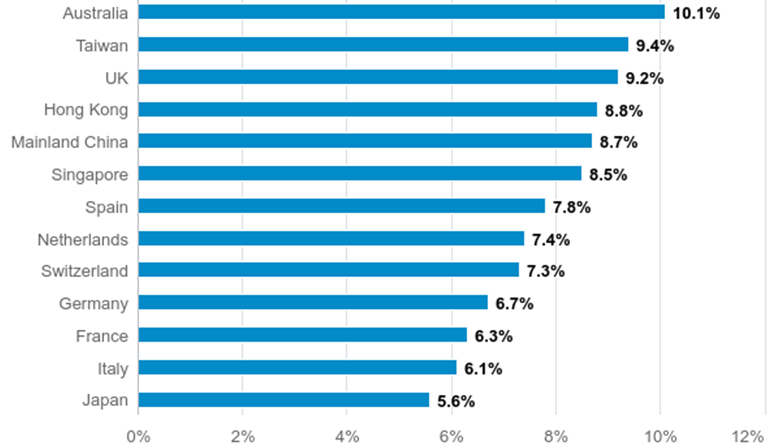
The firm’s latest survey, the ‘Be Invested Global Study’, noted that UK retail investors anticipate annualised gains of 9.2% over the next five years yet continue to hold an average of 42% of their investable assets in cash – with cash accounting for almost 17% of the typical investment portfolio.
Expected annualised return over the next 5yrs
Source: Fidelity International’s 2026 ‘Be Invested’ global study
Investors responding to the survey said they held significant sums in cash for reasons including maintaining an emergency fund (46%), needing near-term access to money (15%), waiting for better market conditions (10%) and concerns about potential losses (10%).
The majority (73%) of respondents claiming they are confident their existing investment portfolio will help them achieve their long-term goals, however, the Fidelity study highlighted a significant “aspiration-action gap” between expectations and reality due to the high exposure to cash.
Marianna Hunt, personal finance specialist at Fidelity International, said: “Cash has a role to play in everyone’s finances, but holding too much of it – particularly over long periods – can significantly limit your ability to grow the value of your savings.”
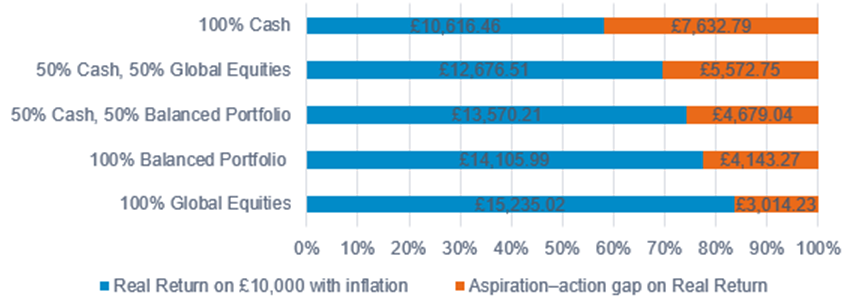
Using investors’ own expectations of an annualised return of 9.2% over the next decade, Fidelity modelled how different portfolio mixes might perform in real terms, also accounting for the resulting aspiration-action gap in each scenario.
It noted that a £10,000 investment growing at 9.2% a year would be worth £24,112 after 10 years, or £18,249 once adjusted for inflation. But, as the table below shows, portfolios with large cash weightings are unlikely to come close to this outcome.
A portfolio held entirely in cash, for example, would grow to just £10,616 in real terms over the same period, leaving investors more than £7,500 short of their typical goal.
In contrast, a portfolio fully invested in global equities would grow to £15,235.02.
The impact on real returns for £10,000 with inflation over 10yrs
Source: Fidelity International ‘Capital Market Assumptions’, April 2026, and Fidelity International ‘Opinium Be Invested’ Study, February – March 2026
Although stock markets have performed strongly in recent years, high returns are never a guarantee, Hunt noted, adding that expectations of around 9% growth a year “may be too optimistic in today’s environment”.
“At the same time, inflation means that cash risks losing value in real terms over time,” she said. “Staying invested remains key to improving the chances of meeting long-term goals.”
Four in 10 survey respondents said they would consider moving cash into equities, alongside 26% into bonds – usually with the caveat they have greater access to advice, better incentives or a less attractive environment for cash savings.