






SpaceX’s long-awaited initial public offering (IPO) arrived with numbers that immediately reshaped the upper end of the US equity market.
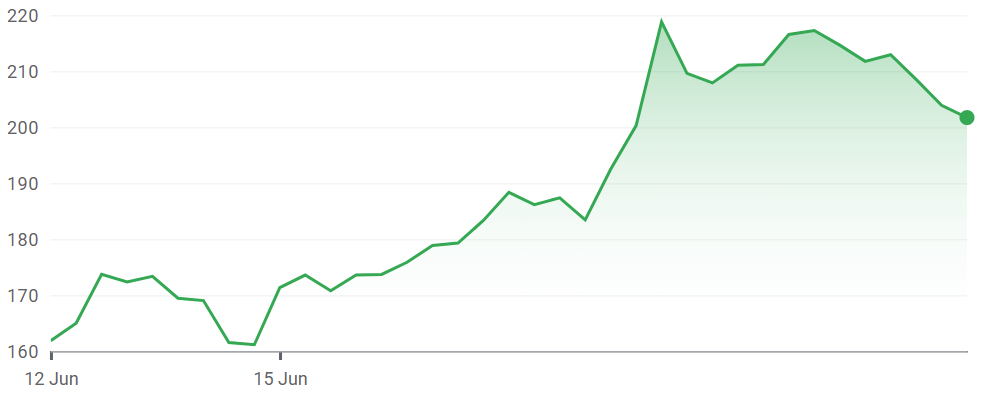
The company raised $75bn ahead of its record-breaking $1.8trn debut, pricing shares at $135, before opening on the Nasdaq at $150 – an 11% premium from the very start. The stock then surged as high as $176 intraday, with SpaceX closing its first day in public markets with a valuation above $2trn, making founder Elon Musk the world’s first trillionaire.
In the days following, momentum has continued as SpaceX stock climbed above $200, representing a nearly 60% growth from its IPO price and pushing its market capitalisation even higher – beyond $2.5trn.
Stock price performance in the days following IPO
Source: Google Finance
However, managers across the market have flagged their concerns around SpaceX’s valuation, highlighting the gap between the company’s current financials and the price.
SpaceX generated $18.7bn of revenue in 2025 and posted a net loss of $4.9bn, meaning investors bought in at roughly 100x sales on IPO day.
David Coombs, multi-asset fund manager at Rathbones, said the figures attached to the listing were “eye-watering” – particularly when compared to other large and popular companies.
“For context, Tesla trades at about 16x last year’s sales,” he said. “Even Nvidia, the poster child of the AI boom, sits at 25-30x.”
Joakim Agerback, lead manager of the Finserve Global Security fund, added that the valuation “leaves little room for anything short of exceptional execution and total dominance in the sector for a long period of time”.
For some managers, that gap presents a real risk to portfolios. Sean Peche, manager of Ranmore Global Equity, drew a direct parallel with pharmaceutical giant Pfizer.
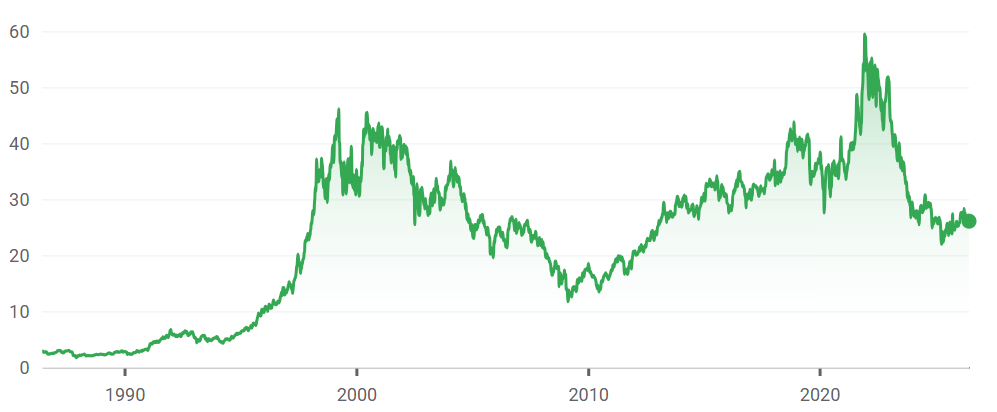
"If you bought shares in Pfizer in April 1998, before Lipitor generated more than $130bn of sales and before its Covid-19 drug Cominarty generated a further $95bn, you would be pretty upset,” he said.
“Bloomberg tells me your total return would be -26% over 28 years, [and] had you bought in June 2000 after the excitement of the additional revenue and pipeline acquired from the Warner Lambert acquisition, you would be down 44%.”
Stock price performance since 1990
Source: Google Finance
The problem, Peche argued, was not the business itself but the price investors were willing to pay for the story.
“Stories are about the past but it is the future that kills you,” he noted. “Forecasting growth over five years is an impossible task and the growth rate usually falters for some unexpected reason at some point. When it does, the de-rating can often be worse than feared.”
The volatility of such a high valuation has already shown itself within the first week of public trading, as SpaceX shares fell 5% on Wednesday 17 June, trimming its debut rally.
Yet for long-term growth investors, the bull case for SpaceX remains compelling.
Tom Slater, manager of Scottish Mortgage Investment Trust – which has high exposure to SpaceX – said the company is not just a rocket company but “is becoming infrastructure for the global economy”.
“Starlink already serves over 10 million subscribers across more than 160 countries and we think that business is still in its infancy,” he said, adding that the opportunity broadens materially when considering mobile connectivity, defence, aviation and maritime.
“We have followed this company closely for many years and our conviction in its long-term potential has only grown,” Slater said.
Mark Boggett, chief executive officer of Seraphim Space Investment Trust, took a similarly expansive view, noting that SpaceX has fundamentally changed the economics of access to space, with “its scale, execution and vertical integration making it one of the most important companies in the sector, which is why the IPO attracted such significant attention”.
Boggett added that SpaceX going public helps to reinforce space as a mature and investable commercial market rather than a niche technology theme.
Alongside the long-term optimism, however, managers also point to a separate set of considerations that have little to do with technology or market opportunity and more to do with SpaceX’s governance structure and the degree of control held by its founder.
SpaceX has listed with a dual-class share structure that gives Musk around 82% of voting rights through Class B shares, while public investors hold one-vote-per-share Class A shares. For some managers, this concentration of power is a material consideration.
While not all of Musk’s companies have a dual-class share structure – for example, Tesla does not – managers argue that his dominant ownership and influence across his businesses raises governance concerns.
Henry Birt, senior research analyst at JM Finn, said: “Whilst arguably exposure to Musk’s entrepreneurship is positive, he has a history of erratic decision-making and without the proper checks and balances on this power, it is hard to guarantee these decisions will be made in the best interests of shareholders.”
For investors trying to navigate that risk, the comparison between Musk’s two listed companies – Tesla and SpaceX – may be unavoidable.
Julian Wheeler, partner at Shard Capital, acknowledged that Tesla remains something of an “Elon-cult-stock” in that it is highly polarising, with a valuation that still reflects considerable optimism beyond its core electric vehicle business. But relative to SpaceX, he argued, that premium looks modest.
“SpaceX has genuine strategic scarcity value – but not at any price,” he said, noting that the entry point carries real risk.
“An exceptional company can still be a poor investment if the starting price is too high.”
By contrast, Tesla’s bear case is “arguably weaker than it was”, according to Wheeler, as the stock has underperformed other high-multiple growth companies and its valuation is less stretched relative to peers.
Of the two, Wheeler said he would currently prefer to own Tesla – with electric vehicle (EV) adoption in the US expected to accelerate as price points improve and charging infrastructure matures.
“Elon Musk is such a bifurcating figure – the reality is investors are likely to own both or neither,” Wheeler said.
“From our perspective, each company should be analysed individually. If both are priced attractively relative to its value, then governance and ownership risk mean both should be owned at a reduced level.”
To own SpaceX, Wheeler said he would need to see Starlink demonstrate stronger annual recurring revenue (ARR) growth and the non-Starlink business move from R&D into operational execution. For Tesla, the threshold is lower – a refreshed product line and stronger evidence of demand recovery.
There is a longer-term strategic dimension worth watching, however. Wheeler suggested that Musk may seek to bring Tesla and SpaceX closer together over time, potentially using highly valued SpaceX equity as part of a broader transaction – a move that could reshape the investment case for both companies simultaneously.