






Global technology stocks have suffered one of their sharpest reversals in months, with semiconductor and AI-linked names giving back a large share of their recent gains as momentum trades unwind across major markets.
Since 22 June, the MSCI AC World index has fallen 1.5% in US dollar terms, but much heavier losses have been seen in the tech space. The MSCI AC World Information Technology and Communication Services index has shed 8.2% while the MSCI AC World Semiconductor & Semiconductor Equipment index has lost 14.6%.
Correspondingly, given how much the AI and semiconductor trades have driven equity markets in recent years, the MSCI AC World Momentum index dropped 14.4% over the same period.
Some in the market attribute part of the recent AI sell-off to technical positioning, arguing that crowded momentum trades were vulnerable to a sharp unwind regardless of the underlying fundamentals.
But Wolf von Rotberg, equity strategist at J. Safra Sarasin Sustainable Asset Management, said the real story behind the wobble is not a loss of faith in AI itself but a structural shift in how the technology's biggest backers are paying for it.
Von Rotberg noted that the combined free cashflow of the five US hyperscalers that have underpinned the AI rally for three years – Alphabet, Amazon, Meta, Microsoft and Oracle – is now approaching negative territory, a shift that is forcing them to fund capital spending externally rather than from their own cash reserves.
Performance of indices since 22 Jun 2026
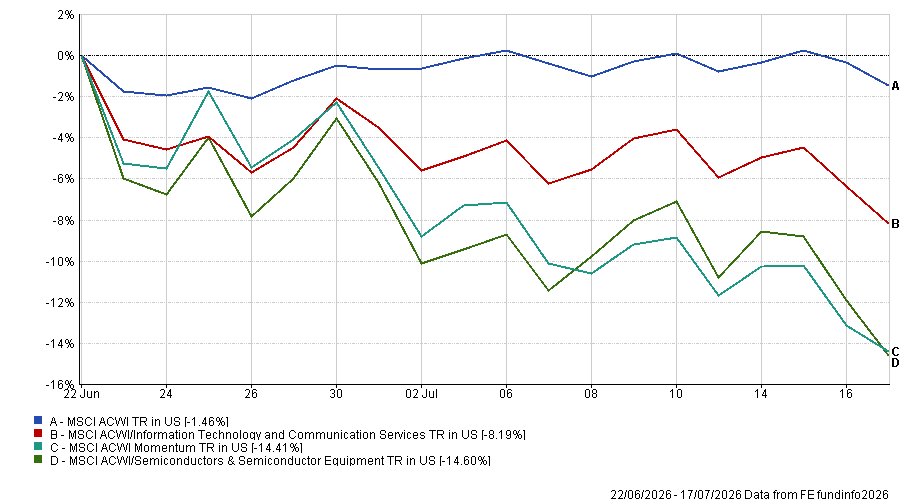
Source: FE Analytics. Total return in US dollars between 22 Jun and 17 Jul 2026
Alphabet has already raised $85bn of fresh equity toward its planned $190bn of 2026 capital expenditure, one of the largest equity raises on record. It has issued a further $110bn of debt since the start of 2025, trailing only Amazon's $152bn, with Oracle having issued $71bn over the same period.
"The market has taken note of the build-up in leverage and has shown its discomfort," von Rotberg said.
"The [hyperscaler] complex has underperformed the broader equity market in 2026. It has fallen by 1.5%, while the S&P 500 has gained 10% year-to-date. The same holds for the newly issued credit instruments, whose performance has been far from stellar. Spreads to treasuries have spiked in July, in an otherwise calm credit market environment."
On the surface, this retreat has left hyperscalers looking "attractively valued". Their aggregate price-to-earnings (P/E) ratio has fallen to its lowest level since the end of the pandemic, yet von Rotberg cautioned against taking this at face value, pointing to a sharp rise in the price-to-free-cashflow multiple that tells a very different story to the P/E ratio alone.
The gap between the two measures matters because it depends on whether capital spending translates into earnings growth, he explained.
J. Safra Sarasin Sustainable Asset Management estimated that cloud earnings would need to keep growing at around 20%, matching the sector's historical performance, to justify current valuations; anything short of that would make the sector look expensive rather than cheap.
A shift in the composition of that spending is adding to the strain. Memory chips now account for 18% of data centre costs, up from just 2% five years ago, and chips depreciate over three to five years, compared with seven to 10 years for buildings and power infrastructure.
"In effect, the incremental capex dollar spent not only fails to generate more future return but is also recognised more quickly as depreciation, weighing on earnings," von Rotberg said. "The impact is sizeable, with depreciation expenses as a share of revenues rising sharply over the coming years."
The firm's modelling suggests depreciation could rise from 8% of sales in 2025 to 22% by 2030. "Against this backdrop, consensus margin expectations appear quite optimistic, remaining largely stable for the coming years," he warned.
A similar concern is playing out on the supply side of the AI trade. Susannah Streeter, chief investment strategist at Wealth Club, pointed to TSMC's results as the trigger for some of last week's selling, despite the Taiwanese chipmaker reporting a 61% year-on-year rise in second-quarter net profit and confirming plans to invest $100bn on expanding advanced manufacturing capacity in the US.
The concern is not whether demand exists today, since customers including Nvidia, AMD and Apple continue to signal strong appetite, but whether the equipment being built now will still be competitive by the time it needs to earn its keep.
"Given the rapid pace of innovation in AI chips and computing architecture, there is a risk that equipment could become outdated, forcing operators to replace it sooner than expected," Streeter said, adding that the build-out phase is taking longer than some anticipated while returns remain further off.
The tension between long-term conviction and near-term doubt can be seen in the recent Natixis Investment Managers' 2026 Strategist Survey. It found 91% of respondents expect AI to remain the single biggest driver of market performance in the second half of the year, while 97% believe its benefits will eventually spread to companies beyond the direct chipmakers and infrastructure builders.
But there was also caution over timing and concentration. Just 45% of strategists surveyed expect a return on AI capital expenditure within the next year and 85% rank concentration in a small number of AI-linked companies as a top concern.
Von Rotberg's take on what happens next is conditional rather than pessimistic. Hyperscalers need to show that AI revenues are materialising, he argued, or they may be forced to moderate their spending plans to protect shareholder value.
But such a moderation would not necessarily be negative for markets, he finished: "A rebalancing of supply and demand for AI infrastructure components would likely trigger a partial reversal of recent price increases and could provide the basis for a more balanced, yet flatter build-out in the years to come."