






American companies had a strange first half of the year and flows in and out of IA North America funds shows a mixed picture, as investors may have been unsure how to invest.
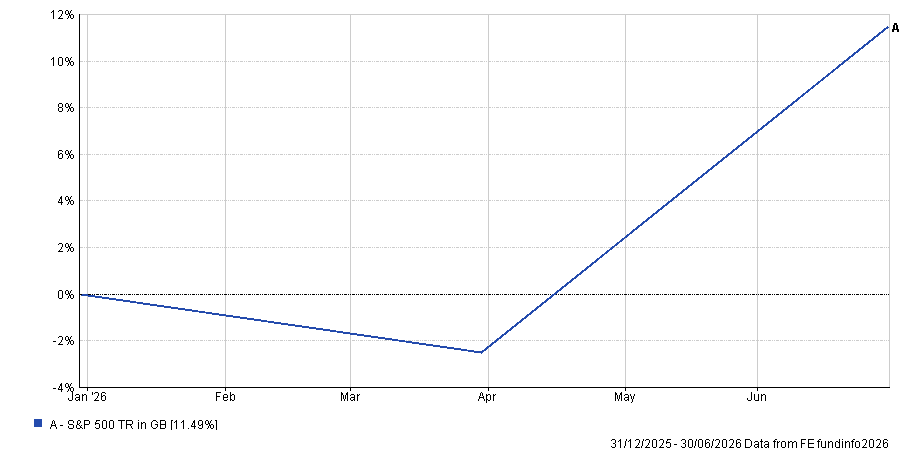
In the first quarter, US stocks (as represented by the S&P 500 index) slipped back 2.5%. The three months between January and April were dominated by the outbreak of the war in Iran, which shook markets.
The disruption proved short-lived, with the premier US index up 14.4% in the second quarter, resulting in an overall strong first half.
Performance of index in H1
Source: FE Analytics
Some funds benefited from this yo-yoing, while others were quite heavily sold. Predominantly, those using the relative weakness in the first quarter to gain access to US stocks at a bit of a discount chose to do so passively.
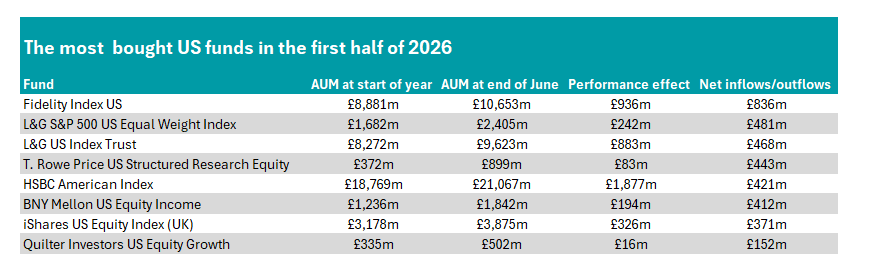
The £10.7bn Fidelity Index US fund took in the most new money, with £836m added in the first half of the year. This, alongside £936m in performance, took the fund's assets under management (AUM) up by more than £1.7bn over the first half of 2026.
L&G US Index Trust, HSBC American Index and iShares US Equity Index (UK) were other traditional passive funds to take in strong inflows.
L&G S&P 500 US Equal Weight Index is a slightly different option for investors. It is a £2.4bn equally weighted index, which gives it a materially different make-up compared with traditional market composition.
Recommended by analysts at FE Investments, the fund replicates the performance of the index by direct ownership of all the underlying securities.
"Legal and General Investment Management prefer to keep things simple when it comes to passive investing, which means full physical replication where possible," FE Investments analysts said, noting that this means "counterparty risk is low".
Source: FE Analytics. All figures for UCITS and OEIC funds. Data does not include ETFs or SICAVs.
T. Rowe Price US Structured Research Equity was the most-bought active fund on the list. Managed by Alexa Gagliardi, Ann Holcomb, Jason Polun and Jason Nogueira, the smaller OEIC version of the strategy was launched in 2024, although the overall strategy has been in existence since 1999.
The fund, which has risen in AUM from £372m at the start of the year to £899m by the end of June, is recommended by analysts at RSMR, who highlighted the fund's unique approach, allowing analysts to own parts of the portfolio. As many as 30 people are working on it at any one time.
"This facilitates analysts' career development as they are able to demonstrate the ability to manage client capital in their area of expertise leading to a diversified portfolio manager role," they said.
The fund aims to beat the index over a full market cycle and during both bull and bear runs, with the analysts suggesting it is a "core option for investors that are seeking exposure with similar characteristics to the index, with the ability for additional alpha generation due to the active input of the analyst resource".
BNY Mellon US Equity Income, headed by John Bailer, and Quilter Investors US Equity Growth (managed by JP Morgan Asset Management), were the other active funds in favour between January and June.
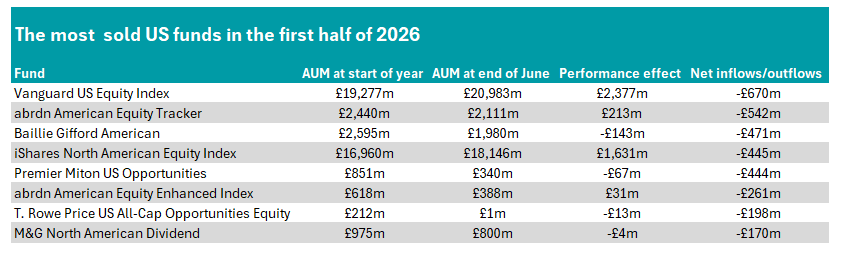
It was a similar pattern among the most-sold funds, however, with the top of the table below dominated by large US trackers.
Source: FE Analytics. All figures for UCITS and OEIC funds. Data does not include ETFs or SICAVs.
Vanguard US Equity Index topped the list, with £670m in net outflows, although it added £2.4bn in performance, so its AUM rose in the first half.
Abrdn American Equity Tracker and iShares North American Equity Index also featured, together with the systematically invested abrdn American Equity Enhanced Index.
Baillie Gifford American was the largest active fund to suffer outflows, some £471m in outflows and a loss of £143m from performance taking the fund below the £2bn AUM mark.
Managed by Guy Robinson, Kirsty Gibson, Dave Bujnowski, Lillian Li and FE fundinfo Alpha Manager Tom Slater, the fund was dropped by analysts at Hargreaves Lansdown, who recommended the portfolio on their Wealth Shortlist until April this year.
"In addition to higher levels of volatility, performance and stock-picking has recently been challenged and the fund hasn't performed as well as its benchmark and some of its peers in recent years. As a result, we no longer believe that clients are being adequately compensated for taking on this level of risk," they said.
Other active funds struggling to retain investors' money were Premier Miton US Opportunities, T. Rowe Price US All-Cap Opportunities Equity and M&G North American Dividend.