






Tech funds continue to post the highest returns over 2026 so far despite July's sell-off, research by Trustnet shows, although strategies focused on energy and emerging market dividends are among those that benefited from last month's volatility.
July was a rough month for broad equity indices, driven mainly by a reversal in the crowded semiconductor trade as investors worried whether AI infrastructure spending could keep justifying sky-high chip and hardware valuations.
Meanwhile, conflict in the Middle East and its impact on energy prices prompted risk-off sentiment and macro fears that inflation would worsen.
Performance of global equities in July 2026
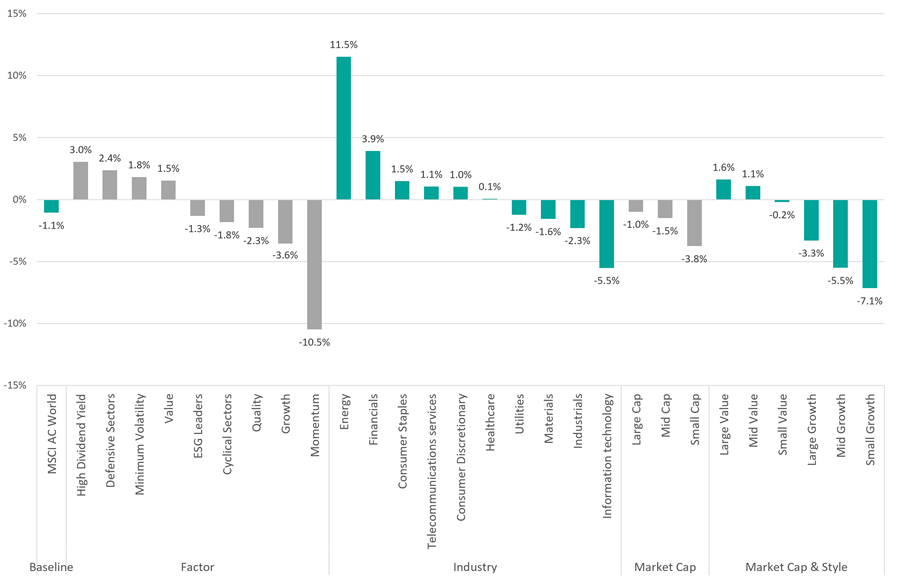
Source: Finxl. Total return in sterling between 1 and 31 Jul 2026.
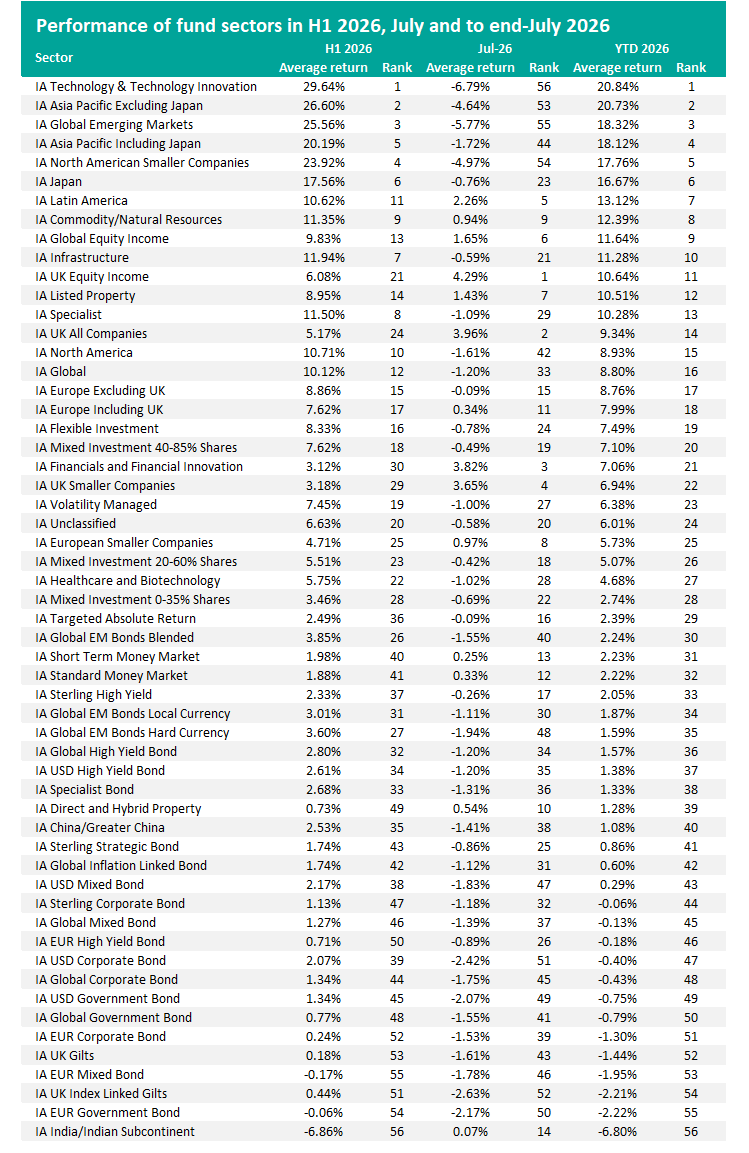
Despite the average fund falling 6.8% in July, the IA Technology & Technology Innovation sector remains the best performing peer group of 2026 thanks to an average gain of 20.8%. However, this is down from the 29.6% posted at the end of 2026's first half.
Matt Britzman, senior equity analyst at Hargreaves Lansdown, said: "Investors are grappling with virtually every AI concern imaginable, from questions about hyperscale spending and model efficiency to worries that the sector's extraordinary growth is beginning to slow.
"The key question now isn't whether companies can keep delivering endless upside surprises, but whether this earnings cycle proves more durable than the market expects. In our view, the bull case remains intact, but the low-hanging fruit of constant upgrades is behind us. The opportunity increasingly centres on a structurally improved margin cycle, with higher peaks, shallower troughs and the potential for significant shareholder returns as monster earnings translate to enormous cashflows."
Source: FE Analytics. Average return in sterling.
There's been no change to the sectors immediately after either, with IA Asia Pacific Excluding Japan and IA Global Emerging Markets holding onto second and third places respectively because of the spectacular gains from Korea and Taiwan in the year's opening months. They did join tech funds at the bottom of the July leaderboard though.
Alex Smith, head of emerging market and Asian equities investment specialists at Aberdeen Investments, said: "The strength of the market in previous months has left it vulnerable to momentum swings. We do not believe there has been any materially 'new' news; rather, the market has shifted its focus toward risks instead of opportunities."
IA Asia Pacific Including Japan (currently in fourth) and IA North American Smaller Companies (fifth) have switched places after Japan's muted fall helped to shore up the first peer group while US smaller companies fell harder.
There's no change at the very bottom of the table as well, with IA India/Indian Subcontinent taking last place with an average loss of 6.8%. This is barely changed from a month before as the peer group was down just 0.07% in July.
However, there were bigger moves among the UK equity sectors as investors turned to the UK – which lacks big tech exposure like US and global markets – to shield themselves from the AI semiconductor sell-off.
IA UK Equity Income was July's best-performing peer group with an average return of 4.3%; this took it from being the 21st best sector at the end of H1 to the 11th best by the end of July. Likewise, IA UK All Companies went 24th place to 14th and IA UK Smaller Companies moved from 29th to 22nd.
James Flintoft, head of investment solutions at AJ Bell, said last month: "The UK market has lagged the AI-led rally, partly because it has much lower exposure to mega-cap technology and semiconductor businesses. That has been a headwind in a market led by a narrow group of winners, but it can become a strength when leadership starts to wobble.
"The FTSE 100 and broader UK large-cap market have a very different sector profile from the US and many global indices, with more exposure to healthcare, energy, financials, consumer staples and industrials, and far less exposure to the highly valued technology names that have dominated global returns. This gives UK equities a distinct return profile and can reduce reliance on a single investment theme."
Source: FE Analytics. Total return in sterling.
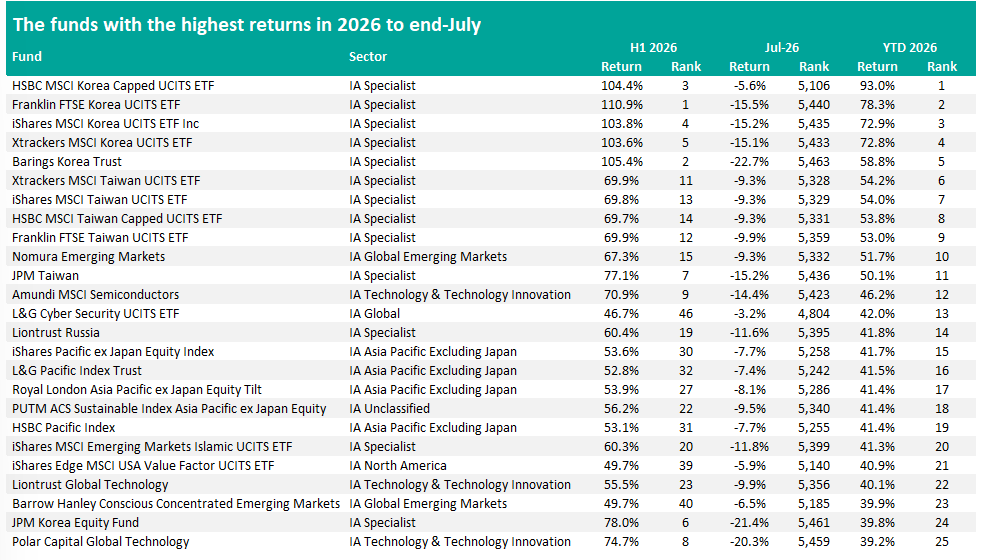
When it comes to individual funds, there's been some jostling for position at the top of the table but the top five funds over 2026 to date remain Korean equity portfolios, followed by Taiwanese equity ETFs.
Kieron Poon, investment director of Asian equities at Aberdeen Investment, argued that the fundamentals of the Asian technology sector, particularly companies linked to AI, are "still robust" and the recent sell-off in the space was "a healthy one".
"Our discussions with companies across Korea and Taiwan point to strong and sustained AI-related demand, with management teams generally confident of the medium-term outlook," he added.
"Also, the recent market pullback has brought valuations to more attractive levels, creating opportunities for us to add exposure to high-quality businesses at more reasonable prices."
There have been some big moves in other areas, with energy funds such as iShares Oil & Gas Exploration & Production UCITS ETF, Xtrackers MSCI World Energy UCITS ETF and WS Guinness Global Energy jumping into the top 100 of the Investment Association universe for 2026 to the end of July. At the year's halfway point, funds like this had been around 400th place.
Energy funds' jump up the rankings was down to the increase in the oil price following the breakdown in the ceasefire between the US and Iran and continued disruption to the Strait of Hormuz. Oil has come back down in recent days after the two sides de-escalated to some degree.
There's also a cluster of Asian and emerging market income funds that pushed their way into the Investment Association's top 100 funds for the year to date. These were BNY Mellon Emerging Income, BNY Mellon Asian Income and Schroder Asian Income.
Income-focused Asian and emerging market funds naturally tilt towards dividend-paying stocks in financials, telecoms, utilities and REITs rather than growth-oriented stocks, so largely avoided the sell-off that hit semiconductor and memory chip companies.
Cybersecurity thematic ETFs such as Nasdaq Cybersecurity UCITS ETF and WisdomTree Cybersecurity UCITS ETF also improved their relative performance rankings after some strong earnings from the likes of Fortinet. The space is also benefitting from the expectation that rising AI-enabled cyber threats will push businesses to spend more on cybersecurity.