






The AI spending taps are well and truly on, with even more investment predicted for 2026 – led by the hyperscalers, such as Microsoft and Alphabet.
Analysts at Goldman Sachs have forecast global AI investment will surpass $1trn by the end of the year, with just over half coming from the US.
Predicted investment globally in AI in 2026
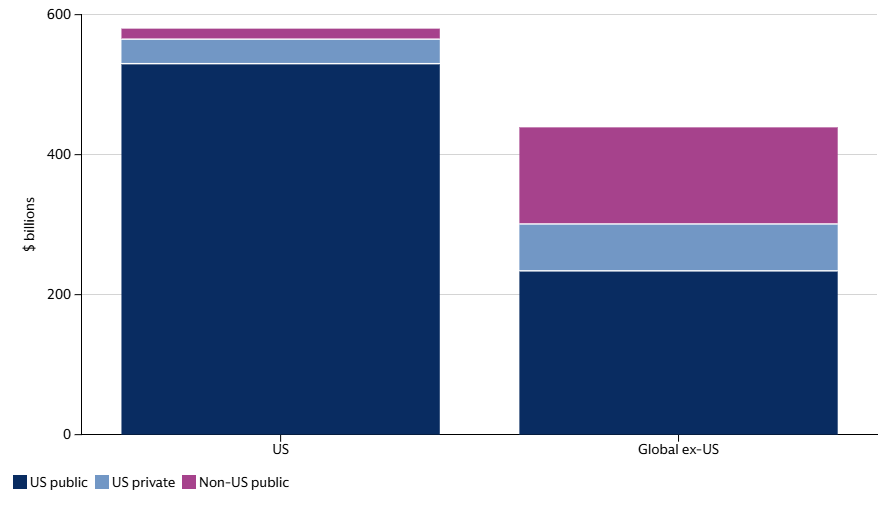
Source: Goldman Sachs
The sheer scale of capital raises an obvious question for investors: with hyperscalers, chipmakers and data centre builders already firmly on the market’s radar – with high valuations to match in many cases – have the obvious AI trades already played out?
Dom Rizzo, manager of T. Rowe Price Global Technology Equity, said: “The market keeps wanting the next AI winner to be something totally different – I completely understand that instinct but the differentiated insight for 2026-2027 is that more of the same can still be right.”
He argued that the market is in the early-to-middle stages of a multi-year infrastructure build-out, rotating from the mega-cap names into a broader set of beneficiaries, from developers of central processing units (CPUs) and agentic compute power to grid infrastructure, cooling, connectivity and passive components.
In particular, the market may be underestimating CPUs and digital logic tied to agentic AI, with Rizzo predicting 2026 is “the beginning of the CPU renaissance” following a focus on graphics processing units (GPUs).
GPUs and CPUs are essentially the ‘brain’ of a computer. The former has become the dominant chip because it can process thousands of tasks simultaneously, although the latter will become more important in with the expansion of agentic AI.
“If you buy a pair of shoes, you can open one browser tab, go to one site and check out once – but an agent may open a thousand tabs, compare every merchant, run multiple workflows and execute hundreds of actions,” Rizzo said. “That is not just a GPU problem. That is serial compute that requires CPUs.”
Over the next three years, the T. Rowe Price portfolio will likely migrate toward the model-plus-harness winners, such as OpenAI, Anthropic and potentially Palantir if it proves it can own the agentic control plane, Rizzo added.
Alongside CPUs, Tomasz Godziek, manager of the JSS Sustainable Equity – Tech Disrupters fund, expects future returns to “flow to whichever bottleneck combines demand with a small number of companies holding genuine deep tech advantages”.
As such, Godziek is watching data centre interconnections closely as power constraints force operators to link campuses across cities via high-capacity optical networks. “This structural shift favours firms with deep optical interconnect expertise.”
YT Boon, head of thematic in Asia at Neuberger, claimed valuations of optical networking component companies remain underappreciated, which speaks to the wider growth opportunities related to all AI hardware.
“We are seeing many traditional hardware components where demand massively outstrips supply, [resulting in] stronger pricing power,” Boon said, such as multi-layer ceramic capacitors.
Meanwhile, David Harrison, manager of Rathbone Greenbank Global Sustainability, argued that power infrastructure still looks undervalued and is a multi-year investment opportunity.
“We are likely to see significant amounts of continued innovation to find power solutions,” Harrison said, pointing to companies like Siemens Energy. He likes the business for its broad portfolio of power solutions – wind assets, gas turbines and grid infrastructure – and that “few can compete with its scale”.
Alec Cutler, manager of Orbis Global Balanced and Orbis Global Cautious, is looking more specifically at ignored US natural gas companies, investing in the businesses transporting the fuel, such as dividend-paying Kinder Morgan, Enbridge and Antero Midstream, as well as the regional producers located where the need for data centres is high and the natural gas pipeline connections are limited, such as Pennsylvania.
“For North America, much of the electricity [needed for data centres] must be generated by natural gas,” Cutler said.
Popular renewables like wind and solar are too intermittent for data centres that need to run 24/7, while new nuclear capacity takes too long to build. Coal is an option, but Cutler noted it “has limited idle capacity and nasty byproducts”.
This leaves natural gas as “the obvious choice”, as it is abundantly available throughout North America and at a more attractive price.
“Despite the obvious new demand growth data centres should provide to natural gas providers, we have not seen any meaningful change in investor perception,” Cutler noted.
But there is also the question of energy efficiency within the data centres themselves. For this, Rathbone’s Harrison highlighted companies such as Amphenol, which makes “mission critical but relatively low value” products that can promote better reliability, heat management and energy at multiple points within a data centre.
Looking further afield, Cutler said he is increasingly focused on the possibilities around automation and robotics – or physical AI.
“Here, real strides are being made, and the impact appears to be economically beneficial for society, and the pathway to acceleration seems relatively clear,” he said.
The potential for physical AI spans robotaxis, drones and advanced factory automation, while there is “early promise being shown by humanoid robots”.
From the builders and innovators to the adopters
Not every fund manager is focused on the companies directly involved in the continued AI build-out, however.
Marcel Stotzel, manager of Fidelity European Trust and Fidelity European, said: “Ultimately, we think the market has largely priced in the first phase of the AI story – the next phase is likely to be driven by companies that successfully deploy AI at scale across the real economy.”
These ‘AI adopters’ will utilise the technology to improve productivity, automate repetitive tasks and strengthen customer engagement.
Stotzel noted that Europe’s equity market – which has suffered from its lack of exposure to AI players – has meaningful exposure to sectors where AI has the potential to drive “tangible improvements in profitability”, such as financials, industrials and healthcare.
He also argued that the market has become “overly pessimistic” on some perceived AI ‘losers’, such as software names like Dassault Systèmes.
“Rather than being displaced by AI, we believe these companies are more likely to incorporate AI into their existing platforms, allowing them to improve functionality while strengthening already sticky customer relationships,” Stotzel said.