






The Magnificent Seven are not a single trade anymore, with fund managers holding very different views on each of the seven names.
Banded together by investors at a time when the AI trade was booming, six of the seven have fallen double digits from their 12-month peaks.
This drop in performance has led to fund managers disagreeing over the potential of the group, with most noting that investors need to take a view on each company individually.
One key point of difference is between Nvidia and Microsoft. The former announced a plan to help mobilise up to $500bn for new AI infrastructure this week – with experts torn between circular financing fears and enthusiasm for institutional demand for AI infrastructure.
Microsoft, meanwhile, was down almost 30% from its peak in October 2025 to the end of June, with last month's results leaving investors no clearer on whether its AI spending is earning its keep. Yet returns have improved since and managers are mixed on its future.
Performance of stocks over 1yr
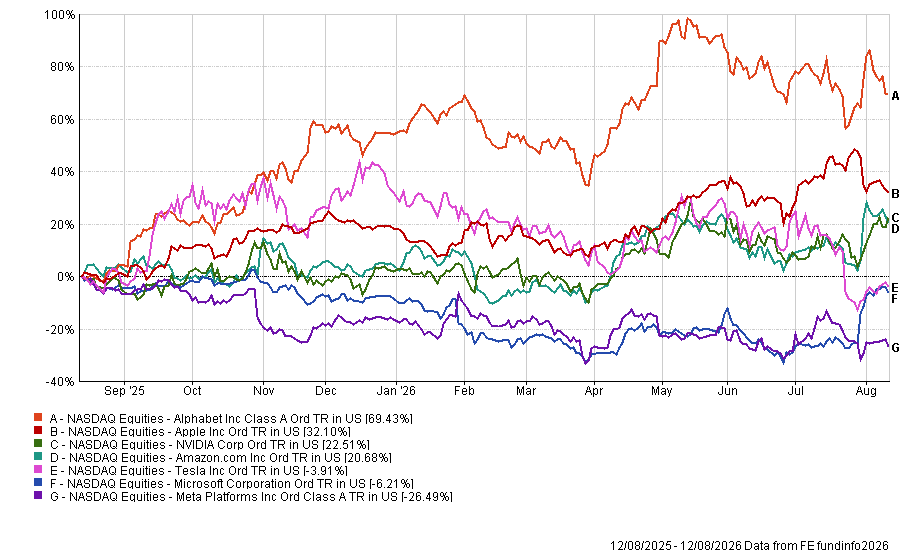
Source: FE Analytics
Selectivity is key
Rebekah McMillan, associate portfolio manager at Neuberger, said there has been “a notable fracturing in the performance of the Magnificent Seven, with average pairwise correlation amongst the group at its lowest level in years.”
“This reflects [investors] discerning between fundamental divergences on business models, future returns on investment and capex intensity,” she said.
The main cause of her concerns in the space is funding. Spending commitments are approaching 100% of free cashflow at the expense of buybacks, while increased corporate bond issuance “represents a key shift in balance sheet trajectory, which warrants close monitoring”.
Yet in its multi-asset portfolios, Neuberger maintains “a constructive view on global equities including US large-cap names” while emphasising selectivity within the Magnificent Seven.
“We also have tactical exposure to the AI infrastructure theme via thematic equity baskets, capturing physical AI and bottlenecks, and via non-US exposures across Japan and emerging markets,” she said.
“Whilst extended momentum in AI-linked names and a pipeline of large IPOs could create near-term supply pressure, we would treat a moderate pullback as a buying opportunity absent a genuine deterioration in earnings or credit.”
There are better options than Apple, Microsoft and Tesla
The £2bn JPMorgan American Investment Trust held roughly 30% of its portfolio in the Magnificent Seven as of 30 June 2026, modestly underweight the S&P 500 benchmark's 32% exposure to the group, according to Fiona Harris, head of international investment specialists at JPMorgan Asset Management.
However, “that underweight should not be read as a single, top-down view on the Magnificent Seven," said Harris, who highlighted the bottom-up process of the fund, meaning all stocks are considered individually for their fundamentals.
Making the portfolio’s top 10 are Nvidia (8%); Alphabet (6.1%), Apple (4.2%), Amazon (4%) and Microsoft (2.9%).
Nvidia is “a compelling full-stack platform at what we consider a relatively attractive valuation”, they said, adding that it is currently going through an underappreciated product cycle.
Meanwhile, the team is “gaining conviction” on Alphabet due to the continued strength in Google Cloud, and Amazon is held on the view that AWS growth will “re-accelerate as capacity continues to ramp”.
The managers also like Meta, which sits outside the trust’s top 10 holdings, for its “scale advantage in AI, capacity optionality, and a growing pipeline of new generative products”.
Despite appearing in the top 10 holdings, Apple and Microsoft were less in favour.
The former has been on a consistently upwards trajectory and has not suffered the same falls from its peak as other Magnificent Seven members. Yet Harris' team saw “more compelling risk/reward elsewhere”, citing near-term margin risk from memory pricing pressure and early signs of slowing in the core services business.
Microsoft drew the same verdict following its revised OpenAI partnership, which the team believes “reduces prior exclusivity advantages”.
Tesla is being trimmed too on uncertainty around the timing of a full self-driving inflection and potential headwinds from a SpaceX IPO.
“While we remain mindful of the scale of AI-related capital expenditure, we do not see an immediate negative catalyst,” she said. “We also recognise that our starting point has been relatively underweight many of the most direct AI beneficiaries, and we have therefore taken advantage of opportunities to add to positions or initiate exposure where the risk/reward has become more attractive.
“Notably, some of our top contributors to performance year-to-date through 30 June have come from outside the Magnificent Seven.”
The opportunity is still not reflected by the market
Matt Egerton and Terence Tsai, co-portfolio managers of the Fidelity Technology Opportunities fund took a more bullish view of Microsoft.
The duo owns Nvidia (8.3%), Alphabet (6.7%), Microsoft (5.7%) and Apple (3.1%) in their top 10 holdings and the managers believe the market has not priced the AI opportunity correctly.
“We don't believe these economics, together with the duration of the opportunity, is fairly reflected by the market,” they said, noting how every chip the hyperscalers can get hold of is being put straight to work.
“Any GPU or custom AI chip that these companies can get their hands on is effectively 'lit up' and becomes revenue generating instantaneously, there is no concept of inventory at the present time, which is what would present concerns.”
Demand still has a long way to run, they said. Enterprise use of AI remains mostly in pilot stages rather than production, while consumer adoption is still largely confined to chatbots and image generation. Agentic systems, once they arrive, represent demand that has not yet shown up in the numbers.
They also pointed to a shift in return on investment already visible this reporting season, as inference – AI systems generating answers, rather than being trained – takes a growing share of cloud workloads from training, which they said is margin-accretive for the AI labs as well as the hyperscalers.
Nvidia remains their conviction pick on chip economics, offering “the best token output per watt” in the industry.
“As we head into a more inference-centric world, we believe the market's concerns about Nvidia's GPU leadership in this new era are misplaced.”