






The Aegon Strategic Bond fund has posted a first-quartile return over 10 years, up 49.5%. Yet, between 1 January and 1 September of this year, it was down 1.4%.
Performance of the fund vs sector and benchmark YTD
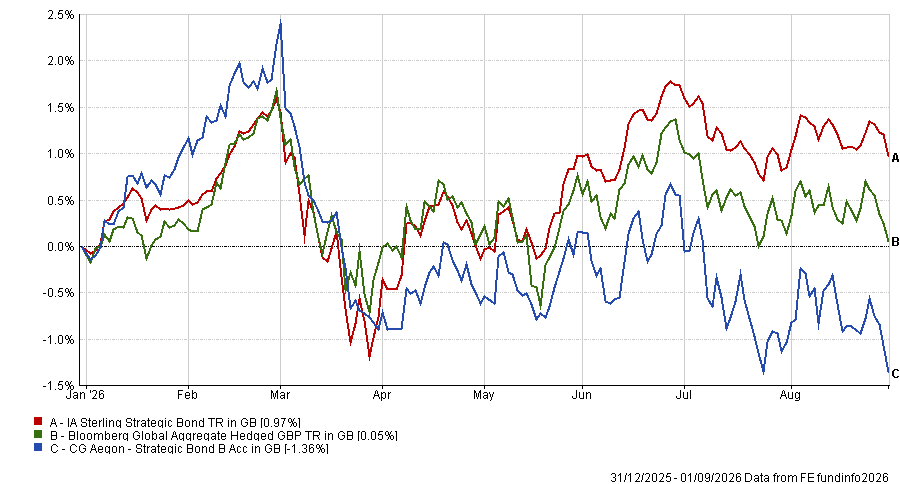
Source: FE Analytics
That’s a sharp swing for a fund in an asset class that is typically supposed to be one of the calmer parts of a portfolio. According to manager Alexander Pelteshki, who runs the fund alongside Colin Finlayson, the gap comes down to one thing: risk avoidance.
“What has repriced quite a bit is government bonds, or interest rates,” he said. “Between the beginning of April until today, we’ve had several market episodes with very sharp rallies and very sharp sell-offs, and most indices or funds have participated in that rollercoaster ride. We have not. [...] That’s been intentional, so that we can get better clarity and understanding of what we expect from the markets in the near term.”
And he won’t be changing this stance any time soon. “It continues to be our firm view, and we’re not seeing anything that makes us change that, or chase excessive market beta, at the moment,” Pelteshki said.
“It’s very easy to get ahead of yourself, and even easier for markets to humble you,” he added.
Below, Pelteshki explains the flexibility around his investment process, where he is finding value, and his best and worst calls.
What is your process?
The fund’s investment process primarily focuses on identifying mispriced opportunities in the global fixed income market – in particular, we have historically been good at identifying mispriced corporate credits.
We select market beta when we are overcompensated for it, while we also try to establish a central investment case and try to anticipate what the tail outcomes could reasonably be, so that we can hedge those as well.
How much flexibility does this process have?
On the credit side, we don’t have many constraints, if at all. We do have an upper limit on how much we hold in high-yield-rated credit or below investment-grade-rated credit, which is capped at 40% of the fund's assets.
If we don’t think the overall index level of credit spreads is compensating us sufficiently for the risks out there – particularly in the high yield market, because that’s a more default-risk-sensitive sector – then we look to minimise our net exposure to that part of the market. On the other hand, if we feel we're overcompensated for that particular risk, then we increase exposure towards the upper end of that part of the market.
How does that work in practice?
We build a portfolio with high conviction positions through a very repeatable and robust credit selection process. We tend to retain the credit we like, also within the sub-investment grade part of the market.
We use very simple credit derivatives, buying protection via a simple index credit derivative in the high yield market and that degree of protection can go all the way up to the size of the bonds we have.
A recent example of this is Liberation Day – there was upwards of hundreds of basis points (bps) of spread widening in the high-yield index which gave us the opportunity to move from about 5% net exposure to high yield to just over 30%.
As credit spreads rallied and reached historic tights at the beginning of this year, we again started reducing that net exposure to the generic level of market or credit risk.
What is your current positioning on spreads?
We aren’t in a risk-off mentality, but we have decided to focus on yield and carry, because we don’t see upside in credit spreads from these levels.
We think spreads will sell-off at some point. We don’t know the timing of that and we don’t have to time it because, at the current level of yield, if nothing changes in 12 months, we’ll have about 8% to 8.5% return – we’ll have earned the portfolio yield.
Where do you see the clearest example of that mispricing in credit markets today?
We still don’t think that market levels in investment-grade hyperscalers or data centres are compensating anywhere near enough for the supply schedule you’re going to see in the market.
Every time you get earnings from the Magnificent Seven, they highlight even bigger capital expenditure spending plans. If you do the numbers, that translates into next year’s supply in the public investment grade bond market of about $400bn – this year, we’ll finish at around $260bn.
That is saturating the market, meaning every new deal will need to come at a materially bigger concession to attract marginal additional demand, because we’re of the view that whoever wanted exposure to those names already has some exposure.
We also question the profitability, the earnings generation and the impact on the balance sheets of those projects, because we think the pay-off will be diminished versus current expectations.
Where do you currently see value in terms of duration?
We find the front end of bond curves more attractive versus the long end.
If you look purely at credit curves between three, five, 10, 15, and 30 years in corporate credit – if you ignore the hyperscalers for the moment – the corporate credit curve has been quite flat. There’s been no additional compensation for lending to someone for five years versus 30 years, and that’s wrong as, historically, those credit curves have been upward sloping.
We expect credit curves to steepen and they have started steepening this year in some parts of the market.
The hyperscalers have put pressure on the long end of credit curves, and we think there is more to go. There’s no point in us buying a 10-year bond at 10% when we can buy a two-year bond at 10% as well. The risk/reward is better on the shorter bond.
What have been your best and worst calls in recent months?
We were very positive on UK lender Metro Bank and had expressed that view convincingly in the portfolio in the period. In the 18 months to end-July, our holdings of three separate Metro Bank bonds have collectively contributed 55bps to fund performance.
On the other end of things, we were quite positive on Oracle earlier in the year following the repricing of the bonds lower. So far this has not been a correct decision, as ongoing capex spending from the hyperscalers, as well as from Oracle itself, has put pressure on the spreads further.
Oracle has dragged on overall portfolio performance by approximately 4bps.
What do you do outside of fund management?
I like any kind of sport. Lately, I’ve been playing sports with my kids and thankfully they are as competitive as I am.