






Gold climbed from about $1,500 an ounce in 2023 to more than $5,000 in January 2026 and holdings in gold exchange-traded funds (ETFs) reached a record high, with plenty of investors still looking at the metal or even wishing they could buy more.
But that isn’t the case for Adam Rozencwajg, co-founder and portfolio manager of commodities specialist Goehring & Rozencwajg, who, having bought early, had nearly sold out by the time everyone was buying, cutting gold from 27% of his portfolio to about 5%.
"Even with a three-to-five-year time horizon, I think it's actionable to take the chips off for gold for the time being and look to come back to that market at a more attractive valuation later," he said. "It was really a valuation call more than anything."
The manager built his gold position from late 2023 on what became known as the debasement trade. Gold fell from $1,900 in 2011 to $1,100 in 2015, with gold miners losing 70% to 80% in that spell. Then came Covid and a wave of money printing.
"We felt that the value of that gold versus the amount of paper assets in the world had just gotten to almost an all-time extreme," Rozencwajg said. "So there became a real bid in the market for something that was a true store of value and gold became that."
The return on invested capital from gold holdings on the Goehring & Rozencwajg Resources fund was about 100% in 2025, he said. He trimmed the gold position from 27% to 19% in October, but rising prices pushed it back to the mid-20s. Then in January this year, it was sold down to about 5%.
The reason was three signals flashing red.
The first was the gold-to-oil ratio, which counts how many barrels of oil one ounce of gold buys. Rozencwajg said 10 barrels is a sign oil is expensive and 20 to 25 a sign it is cheap. It stood at 50 at the end of 2025.
"We thought 50 was really high and it hit 90," he said. "That's when gold was up through $5,000 an ounce and oil was like 60 bucks."
The second was silver. The usual view in the gold market is that a strong bull run needs silver to outperform. Rozencwajg said silver usually lags for years and then catches up at the end, with 1973, 1979-80, 2011 and 2021 highlighted as peaks that came with a silver rally. Silver caught up again in January.
"It might be bullish in the moment it's happening, but it's a warning sign," he said. "It's not a sign to add to your exposure. It's a sign to begin taking it off."
The third was who was buying. Chinese and Indian buyers cut purchases when prices rise while central banks pay whatever the price is, but in January, money went into physical gold through ETFs.
"Imagine that gold went to $8,000 tomorrow. Do you think there'd be more investment demand in the US, or less? Of course there'd be more," he said. "And if gold fell to $2,000, everyone would liquidate their gold."
Rate expectations added to this caution. The run-up in January priced in the rate cuts markets expected from incoming Federal Reserve chair Kevin Warsh, but more hikes now look possible. Gold has fallen 20% from peak to trough.
"That would make it the most mild correction in a bull market we've seen in 50 years," he said.
In 2026, Goehring & Rozencwajg Resources struggled during the summer but recovered most of its losses, as shown in the chart below.
Performance of fund against sector over 1yr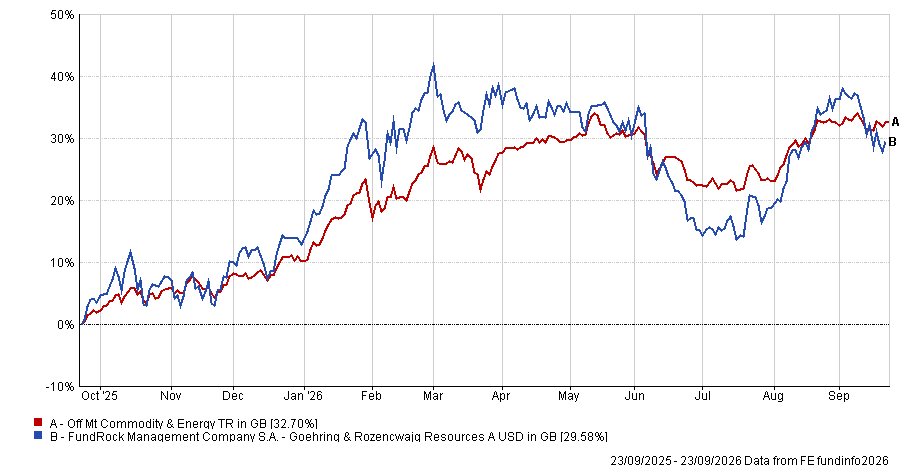
Source: FE Analytics
Rozencwajg still owns gold personally. "It's part of my savings. I'm not looking to sell that," he said. The firm's definition of long-term is three to five years and he expects gold to be higher in 10.
"It'll probably fall another 20% before it makes a bottom and begins to rally again," he said.
The rotation into energy
Most of the proceeds went into oil and US natural gas, which each rose from 14% or 15% of the portfolio to about 25%. Rozencwajg said the switch was made in January and February, before the Strait of Hormuz closed, so it was not a war trade.
The International Energy Agency (IEA) had forecast the biggest oil glut on record, at 2 million barrels a day in 2025 and 4 million this year. Rozencwajg said the stockpile data did not support it.
"If you did have a big glut and you were producing more than you were consuming, then inventories would have to increase and that wasn't happening," he said. "Oil has no business being at $50 a barrel."
The Hormuz closure in April removed about 10 million barrels a day of field production. Rozencwajg said the firm expected stocks to run dry within 100 days and that did not happen.
Analysts put the fall in demand at 6 million barrels a day, which he does not accept: airline and vehicle miles are at record highs. Instead, he said, refining capacity has fallen by about 6 million barrels a day, split roughly evenly between China, the Middle East and Russia. Reported demand is largely a measure of what refineries process, so a refinery shortfall can look like weak consumption.
That would mean stocks of refined products such as diesel and jet fuel are falling with no reliable count of them. Rozencwajg expects crude to fall when the war ends and then rally.
"Everyone is going to rush at an unbelievable pace to try to refill these barren stockpiles of refined product and that's going to put an unbelievable demand for crude," he said. "We haven't destroyed that demand. The demand's still there, we're just not refining enough product to meet it."