






UK equity funds had a strong third quarter in 2026, with the IA UK Smaller Companies sector rising 6.6% and equity income vehicles up about 4% across both funds and trusts.
Investors have started to take notice: according to Berenberg's autumn investor barometer, 34% of the nearly 300 institutions surveyed plan to raise their UK equity exposure over the next 12 months.
For those interested in allocating more to the home market, fund selectors were clear on where they should look: smaller companies.
Charles Stanley chief analyst Rob Morgan chose Aberforth Smaller Companies, noting that the further down the market-cap scale an investor goes, the better the valuations look. However, "there are higher risks too, such as low liquidity and the greater impact of domestic economic and political factors," he said.
Aberforth is a specialist smaller-company investor with a long-established, contrarian value approach. It looks for businesses where temporary problems, weak sentiment or excessive pessimism have pushed the share price below what the team believes the company is intrinsically worth.
The £1.4bn trust launched in December 1990 and is run by six partner co-managers, each covering set sectors. Duncan MacInnes, the newest, joined in September 2025 from Ruffer.
For Morgan, the closed-ended structure suits this job, as these stocks can be illiquid. Investment trusts can also use gearing, taking out debt to invest more. This gives trusts the potential to make additional long-term returns, although there is scope for higher volatility to the downside too, he noted.
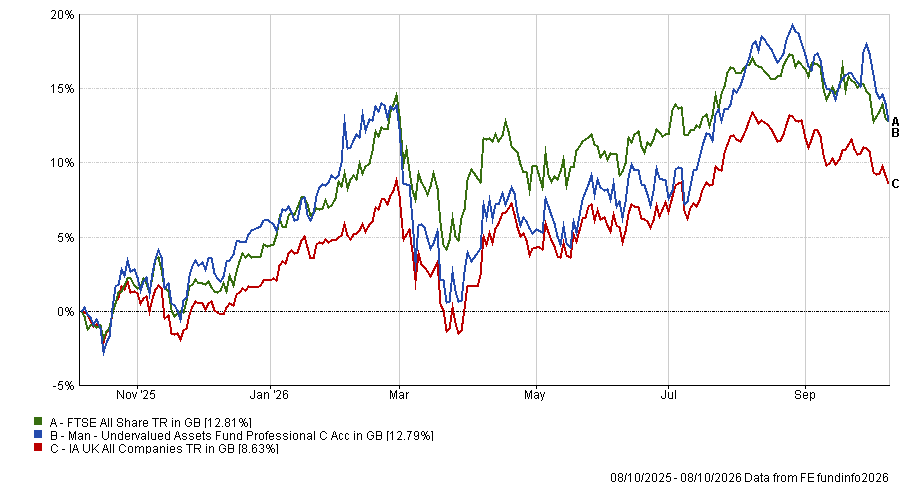
On the open-ended side, Morgan highlighted Man Undervalued Assets as “a well-managed broad UK market option”, with a disciplined approach to value investing and an emphasis on financial strength.
“By focusing more on the shape of the balance sheet, as well as cash generation and positive operating momentum, the managers [FE fundinfo Alpha manager duo Jack Barrat and Henry Dixon] target companies whose share prices do not fully reflect their ‘intrinsic’ value and those whose profit streams are undervalued by the market,” Morgan said.
“Importantly, this should weed out the majority of companies likely to fall victim to shaky balance sheets”.
The fund has delivered top-quartile performance versus its IA UK All Companies peers over the past 10 and five years as well as 12 months, as shown in the chart below.
Performance of fund against index and sector over 1yr
Source: FE Analytics
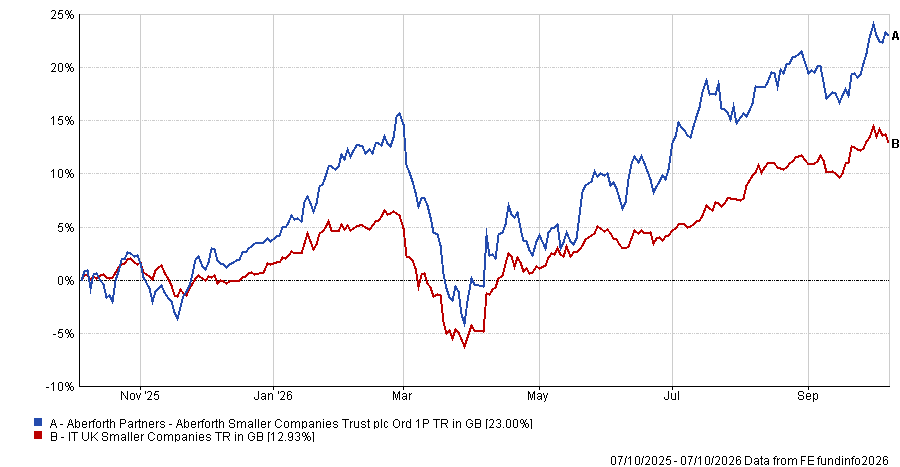
Sheridan Admans, founder and chief investment strategist at Infundly, also picked Aberforth Smaller Companies, describing it as “a meaningful satellite holding within a broader UK allocation rather than something to use in isolation."
The trust returned 22.5% over the year to the end of September and 64.5% over three years. It also beat its smaller companies benchmark over three and five years to the end of August.
Admans also pointed to the discount, which was about 10% to net asset value on 1 October, as a good entry point for investors.
Performance of fund against sector over 1yr
Source: FE Analytics
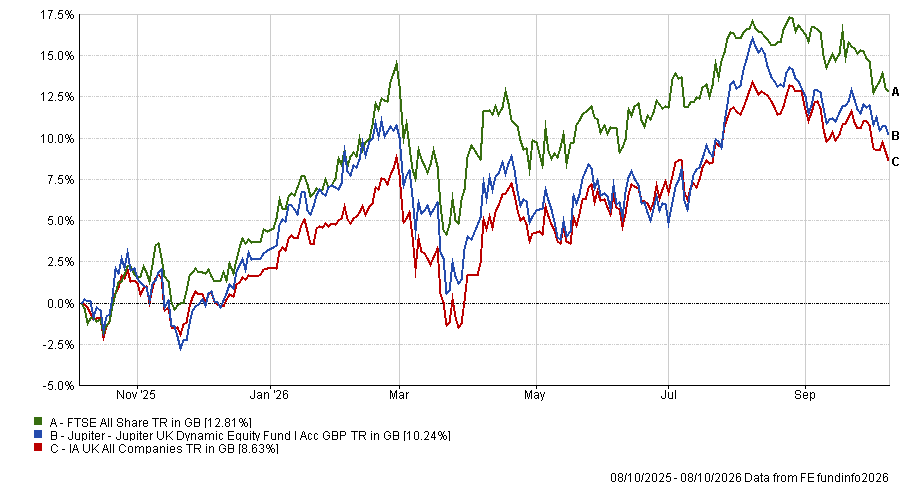
In the open-ended universe, Adman’s preference was for Jupiter UK Dynamic Equity.
Manager Alex Savvides and the team focus on businesses where uncertainty, weak recent performance, management change or strategic repositioning can create the conditions for business transformation and, ultimately, value recovery.
“That feels particularly relevant in the UK today,” according to Admans. While there has already been a stronger period for domestic equities, there is still “considerable variation between businesses, which creates opportunities for an active manager prepared to look beyond the wider market narrative”.
Admans said: “I like the discipline in the process. The team distinguishes between a transformation that is simply taking longer than expected and one where the original investment case has genuinely deteriorated and has shown a willingness to reduce or exit positions when the evidence changes.”
Performance of fund against index and sector over 1yr
Source: FE Analytics
Elsewhere, Andrius Makin, associate portfolio director at Killik, went for a different kind of value trust: one focused on takeover activity. The scale of M&A activity in the UK over the past 12 months shows that UK companies are “priced attractively right now”.
"The valuations on small- and mid-caps look compelling and analysts are forecasting accelerating earnings growth from here," he said.
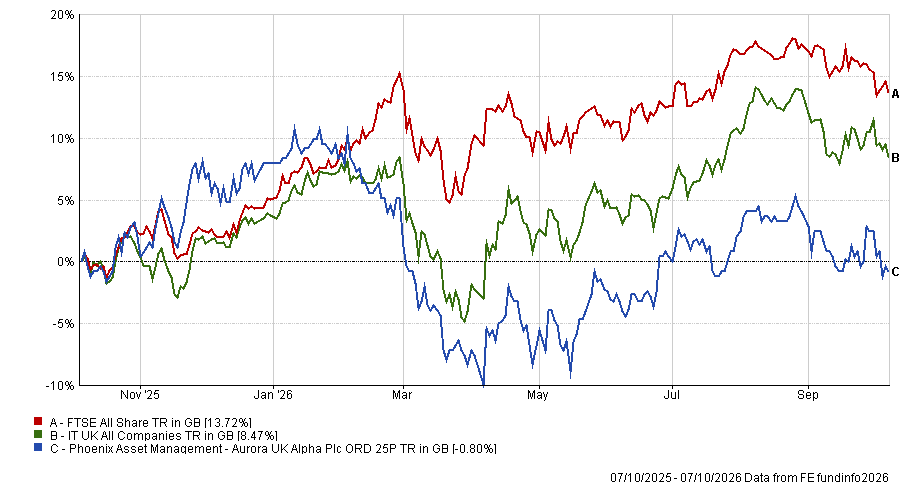
His pick was Aurora UK Alpha, a £257.6m IT UK All Companies trust run by Phoenix Asset Management. Gary Channon, who co-founded the firm in 1998, has managed it since January 2016.
The portfolio is concentrated in a handful of names, with the top six – Frasers Group, Barratt Redrow, Castelnau Group, Ryanair, Lloyds Banking Group and Nintendo – making up 75% of the entire assets under management.
The holdings are inspired by the philosophy of Warren Buffett, whose aim is to buy businesses with attractive returns on capital that are mispriced due to short-term factors, and then hold them indefinitely.
The fee is the other draw, said Makin. The trust charges no fixed management fee, so its ongoing costs are covered by the 0.45% ongoing charge. The managers are paid through performance fees. But “those fees are subject to clawback if outperformance reverses. I think this creates excellent alignment with shareholders," Makin said.
The shares are currently trading on a 12% discount, so investors are “essentially getting a 'double discount', first on the share price and then again on the underlying portfolio”.
Makin flagged the risk that smaller businesses tend to be more sensitive to rising rates and deteriorating economic conditions, with more of their revenues coming domestically. "A lot of this is already in the valuations in my view, which should limit downside to an extent if we see economic conditions tighten,” he said.
However, investors in Aurora may need to be comfortable with some big movements. While there have been more positive years recently than negative ones, strong performances in 2019 (31.9%), 2021 (13.5%), 2023 (28.8%) and 2025 (19.8%) have been punctuated by poor years in 2020 (-10%), 2022 (-16.3%) and 2024 (-5.6%). This year so far, the trust is down 8.1%.
Performance of fund against index and sector over 1yr
Source: FE Analytics
Lastly, Darius McDermott, managing director at Chelsea Financial Services, was the most guarded on the UK market as a whole, noting that the macro backdrop remains difficult.
“Rising gilt yields are not helpful,” he said, while the upcoming Budget is another reason for caution.
“There is no hiding place from the Budget for UK funds. Every portfolio will feel it, either directly or through sentiment," he said. If it is seen as another tax-raising Budget, “small and mid-caps will bear the brunt".
On top of that, "AI is also a growing disruption risk for many [UK companies], particularly intermediaries in areas such as mortgage broking and investment platforms. Stock selection matters more than ever.”
However, UK equities have become “simply too cheap to ignore” and the strong performance between July and September was the market recognising this, he said.
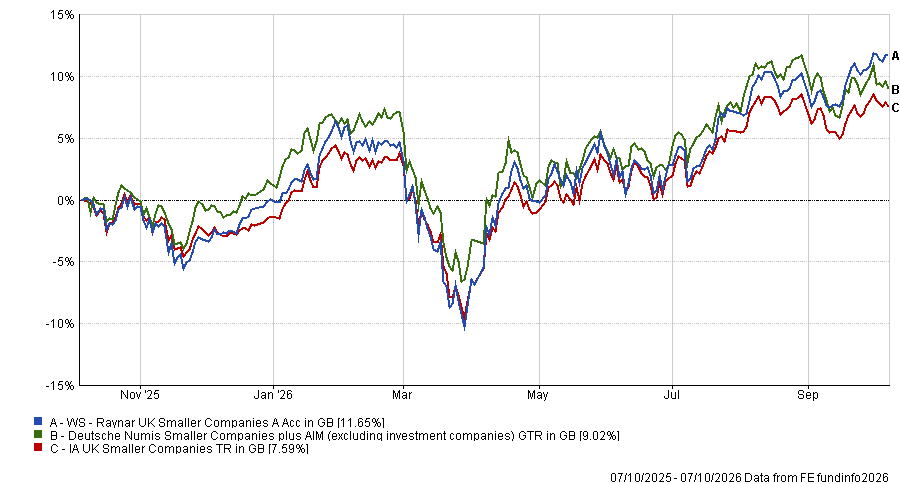
Therefore, the opportunity is one of selectivity rather than blanket optimism. As a result, his pick was WS Raynar UK Smaller Companies, run by Philip Rodrigs.
Performance of fund against index and sector over 1yr
Source: FE Analytics
"Rodrigs is one of the best UK small-cap managers around, and this relatively new fund has already made a strong start," McDermott said. "If UK smaller companies come back into favour, this could be a great fund to own."
The fund has £60m of AUM and charges an OCF of 1.04%.