


Takeover bids have been an almost permanent talking point for UK fund managers over the past few years, as overseas buyers have put in record numbers of deals for domestic companies.
This has left some feeling “frustrated” or even “sad”, but there are also times when investors should welcome these deals, according to investment trust managers.
Since January 2023 there have been 166 bids completed on UK companies with a market capitalisation of over £100m, for a total value of £180bn, according to Peel Hunt research. In the same period, there have been just 11 initial public offerings (IPOs) for a total value of £6bn.
Number and value of bids over 3yrs
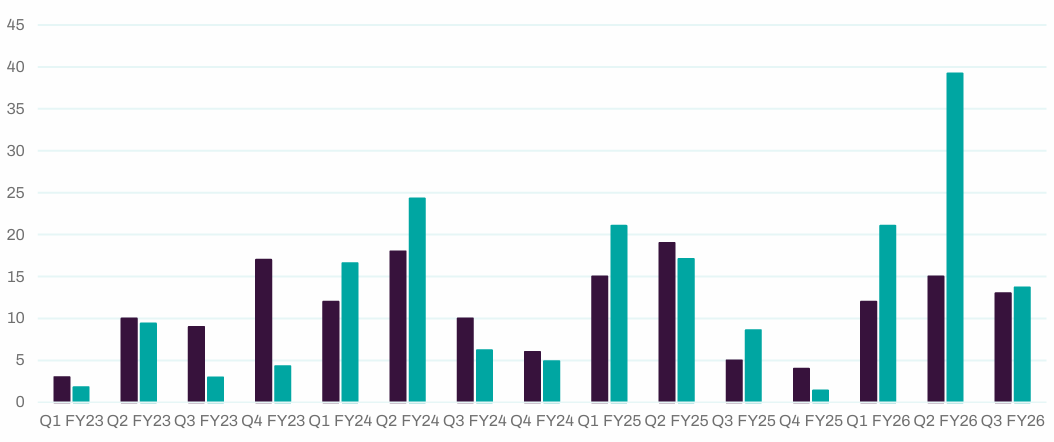
Source: Peel Hunt estimates
With UK companies cheap relative to other regions, mergers & acquisitions will only become more likely and IPOs less so, UK fund managers have warned.
Will Tamworth, manager of Artemis UK Future Leaders, revealed the fund has had 40 companies in its portfolio acquired since 2019.
He said: “This says third parties are taking a more positive view on the UK economy and the outlook for these companies than the public domestic market is. But it also reinforces the view that valuations aren’t just a little bit wrong – they are wrong by nearly 50%.”
He noted that this can be “frustrating” and is “not good for the UK economy or the UK market over the long term”.
Meanwhile, Job Curtis, lead manager of City of London Investment Trust, said five of the trust’s holdings have received takeover bids since 1 January of this year alone – all from overseas companies: Segro from Prologis, Schroders from Nuveen, Tate & Lyle from Ingredion Incorporated, Beazley from Zurich Insurance and Rotork from ABB.
The Peel Hunt research also pointed to other factors that make UK companies attractive acquisition targets for overseas bidders: the country’s openness to foreign buyers; increasingly international boards and shareholders who care less about where a company is listed; and the UK’s shrinking weight in global indices, which has fallen to 3.4% of the MSCI World from 6.5% around a decade ago.
Cashing in versus compounding
The growing number of takeovers is having an impact on trust managers’ ability to capitalise on compounding. Gareth Channon, manager of Aurora UK Alpha, said: “We don’t like [these takeovers] because we like to have investments that you can keep forever.”
He pointed to Apollo Global Management’s takeover of UK airline easyJet, which is set to complete early next year via a £7.15-per-share cash offer, equating to £5.7bn.
“It was trading on one-times enterprise value to EBITDA [earnings before interest, tax, depreciation and amortisation] – it was absurdly cheap,” Channon said.
“It has cash and it owns the planes, so it might [have gone for a huge] premium, but it still went for a cheap price, and the buyers are expected to make a lot of money – so we don’t like it, unless it’s us.”
However, Ken Wotton, manager of the Strategic Equity Capital, noted that there are times when a takeover can benefit UK managers.
“When there is a strategic exit at a multiple that we think effectively gives you tomorrow’s price today without the risk, then we are happy – it’s only frustrating when you get a company taken private at a 30% premium to a very depressed price,” he said.
Peel Hunt noted that the average bid premium has reached 45% so far in 2026.
Around a quarter of the names owned by Wotton’s Strategic Equity Capital trust have ended up being taken over since the end of 2020. He noted this is “not a surprising figure”.
“The companies we look for are ones which we think either have, or are building, strategic value. So they are attractive to other investors or private equity – and they are also trading at half price relative to companies elsewhere,” he said.
Meanwhile, Imran Sattar, lead manager of Edinburgh Investment Trust, admitted he gets “a little sad” when strong UK businesses get taken over, but took a similarly pragmatic view to Wotton, arguing it isn’t always such a bad thing as it means getting paid tomorrow’s price today.
He highlighted portfolio holding Rotork as an example, which was taken over by ABB at 506p per share – a 60% premium.
“I got three, maybe four years’ worth of compounding on day one, and that’s quite valuable for investors,” Sattar said. “So yes, you lose the power of compounding over several years, but you’re swapping it for strong returns today.”