


Chinese equity funds outnumber technology funds among the 100 biggest losers since chip stocks peaked in June, as the AI sell-off spread from Silicon Valley to emerging markets, Trustnet research shows.
Investors have become increasingly nervous around the AI revolution in recent months, shown in the performance of semiconductor stocks. These had rocketed thanks to their position at the core of the AI buildout but have fallen hard as investors start to reassess the economics of the trade.
FE Analytics shows that the Philadelphia Stock Exchange Semiconductor index – a common bellwether for the global technology and microchip hardware cycle – dropped 21.3% between 23 June and 2 November.
In contrast, the global stock market (as shown by the MSCI AC World) lost just 1.2% over the same period, in US dollars excluding dividends.
Price performance of Philadelphia Stock Exchange Semiconductor index vs global equities since 23 June 2026
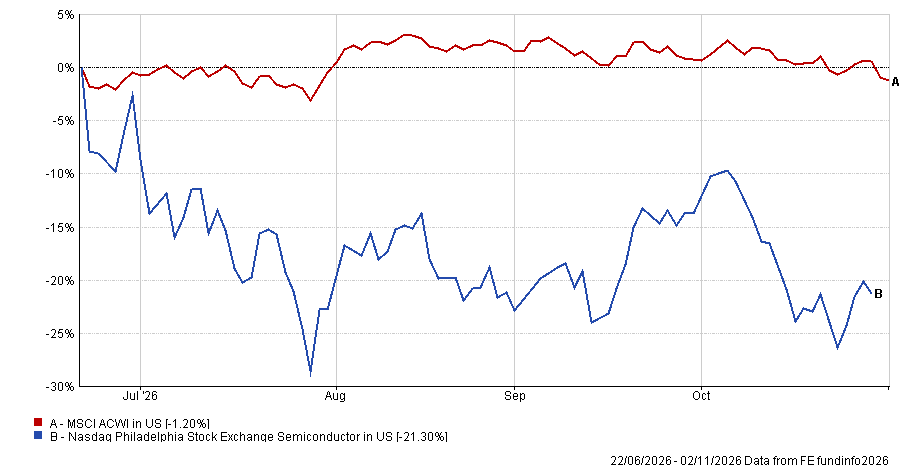
Source: FE Analytics. Price return in US dollars between 23 Jun and 2 Nov 2026
The US chip stocks that make up the Philadelphia Stock Exchange Semiconductor index reached record highs on the back of massive demand for semiconductor and memory chips to fill the datacentres and other infrastructure needed for the AI roll-out.
However, when the Federal Reserve started to hint that interest rates would have to rise to tackle above-target inflation, investors started to question the AI trade. These questions revolved around several issues, including when the AI infrastructure spending would start to pay off, how the build-out is being financed, the high valuations of many AI-linked stocks and weak results or guidance from some key players.
Although many investors expect the AI revolution to continue and the Philadelphia Stock Exchange Semiconductor index is still up more than 60% over 2026 so far despite the sell-off, some funds have faced heavy losses since 23 June.
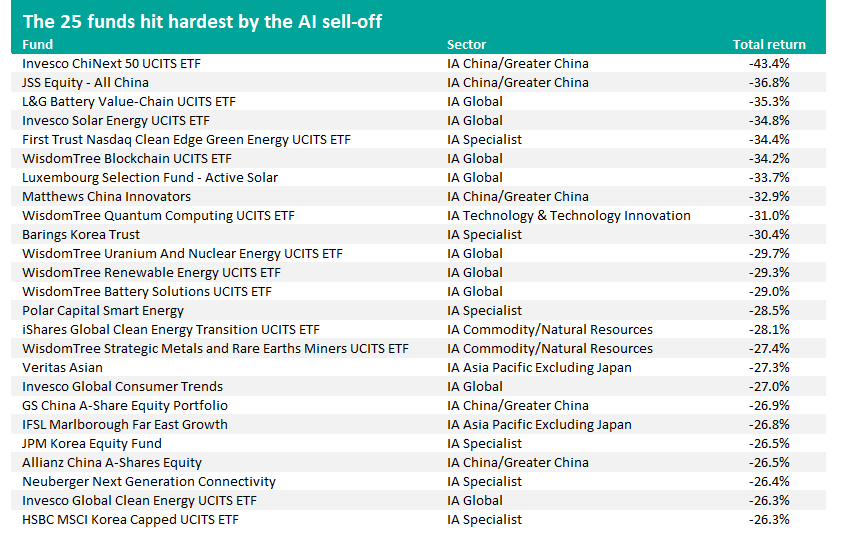
Source: Finxl. Total return in sterling between 23 Jun and 2 Nov 2026
The table above shows the 25 funds with the biggest losses over the period but if we look across the 100 hardest-hit funds, some clear themes emerge.
Chinese equity funds are the most-common, accounting for 20 of the 100 funds with the biggest losses and five of the bottom 25: Invesco ChiNext 50 UCITS ETF, JSS Equity - All China, Matthews China Innovators, GS China A-Share Equity Portfolio and Allianz China A-Shares Equity.
China has a strong AI sector, which was not immune to the worries of global investors. Indeed, the STAR50 index of China’s AI and chip leaders is down 47% – more than the Philadelphia Stock Exchange Semiconductor index – since the summer after the AI sell-off combined with concerns about China’s economic health.
The most direct link is funds that invest in the technology, AI and semiconductors. There are two of these in the table (WisdomTree Quantum Computing UCITS ETF and Neuberger Next Generation Connectivity) with another eight outside it.
But the worries around the AI buildout affected more than funds with an explicit focus on tech stocks.
Korean equities were hit hard, owing to the dominance of memory chipmakers Samsung Electronics and SK Hynix in that market. Barings Korea Trust and JPM Korea Equity, as well as four ETFs tracking the Korean stock market, are among the 100 funds with the biggest losses since 23 June, reflecting this market concentration and the pullback in these two stocks following a spectacular run in recent years.
Global emerging market equity funds have also suffered. Although none are in the 25 hardest-hit funds, 14 are among the bottom 100 including Fidelity Emerging Markets, BlackRock Emerging Markets, Polar Emerging Market Stars and Jupiter Global Emerging Markets.
Emerging markets are increasingly concentrated around the AI and chip themes. Taiwan is now the largest country in the MSCI Emerging Markets, largely because of Taiwan Semiconductor Manufacturing Company, with Korea in second place and China in third. Emerging markets have become a way to gain AI exposure outside of the US, meaning they sold off when investors became nervous about this trade.
In a similar vein, Asia Pacific ex Japan funds have lost out due to their focus on China, Korea and Taiwan. Veritas Asian and IFSL Marlborough Far East Growth can be seen in the table above but there are another 16 funds further down the list that made some of the Investment Association’s biggest losses.
WisdomTree Blockchain UCITS ETF and Invesco CoinShares Global Blockchain UCITS ETF are also in the list of 100 funds with the largest falls. Many former bitcoin miners now provide data centres for AI, meaning they are increasingly correlated with the AI narrative over the cryptocurrency theme.
There are also eight funds that fit into a growth, momentum and US small-caps theme, such as Invesco Global Consumer Trends, WS Blue Whale Growth, iMGP US Small & Mid Company Growth and iShares Edge MSCI USA Momentum Factor UCITS ETF.
Growth and momentum investors have been buying stocks linked to AI for some time, leaving them at risk when the market started to doubt this narrative. Meanwhile, US small-caps have benefitted from the domestic demand created by the AI infrastructure buildout but sold off amid worries this could start to slow.
Clean energy, batteries and the energy transition is a theme that unites funds such as L&G Battery Value-Chain UCITS ETF, Invesco Solar Energy UCITS ETF, First Trust Nasdaq Clean Edge Green Energy UCITS ETF, WisdomTree Uranium And Nuclear Energy UCITS ETF and WisdomTree Strategic Metals and Rare Earths Miners UCITS ETF.
This theme sold off on the prospect of higher interest rates and worries that a slowing AI buildout would lead to less demand for power.