


Technology funds made up 15 of the 25 biggest fallers in the Investment Association universe on 5 November as chip stocks suffered their worst day since March 2020 on fears of tougher AI regulation, FE fundinfo data shows.
At the other end of the day’s performance rankings, gold funds took the top six places yesterday and Chinese equity funds accounted for seven of the 25 best performers, as investors moved money out of AI hardware.
The Philadelphia Stock Exchange Semiconductor index fell 12.3% on Thursday, its worst day since 16 March 2020. The Nasdaq Composite dropped 5.5% and closed in correction territory, while the S&P 500 lost 4.4%.
Memory and AI chipmakers led the falls, with Micron losing 17.5% and AMD 17.3%, while Nvidia fell 9.3%, wiping out its gains for 2026.
The sell-off followed the Democrats’ victory in Tuesday’s US midterm elections. The result raised fears that tighter regulation could slow the AI data centre build-out that has driven markets to record highs this year, as Democrats won in states where opposition to data centres has grown.
Data centres were a key issue at the ballot box, as voters decided on 41 data centre measures across 10 states and sided with the industry just once. Texas’ new governor, Gina Hinojosa, has pledged a moratorium on data centre construction; the state accounts for more than 25% of planned US capacity by 2030.
Stuart Clark, portfolio manager at Quilter, said: “The blue wave at the ballot box has quickly been replaced by a sea of red on investors’ screens. Technology stocks have sold off sharply, with the immediate catalyst appearing to be concerns around tougher AI regulation, covering both the models themselves and the vast data centre infrastructure required to support them.
“The scale of the falls in some of the market’s biggest names has been striking. But it also highlights the concentration risk that has built up in US equity markets. With a relatively small number of technology and semiconductor stocks now carrying so much weight, weakness in those names quickly translates into sizeable falls for the Nasdaq and S&P 500.”
Performance of Investment Association sectors on 5 November 2026
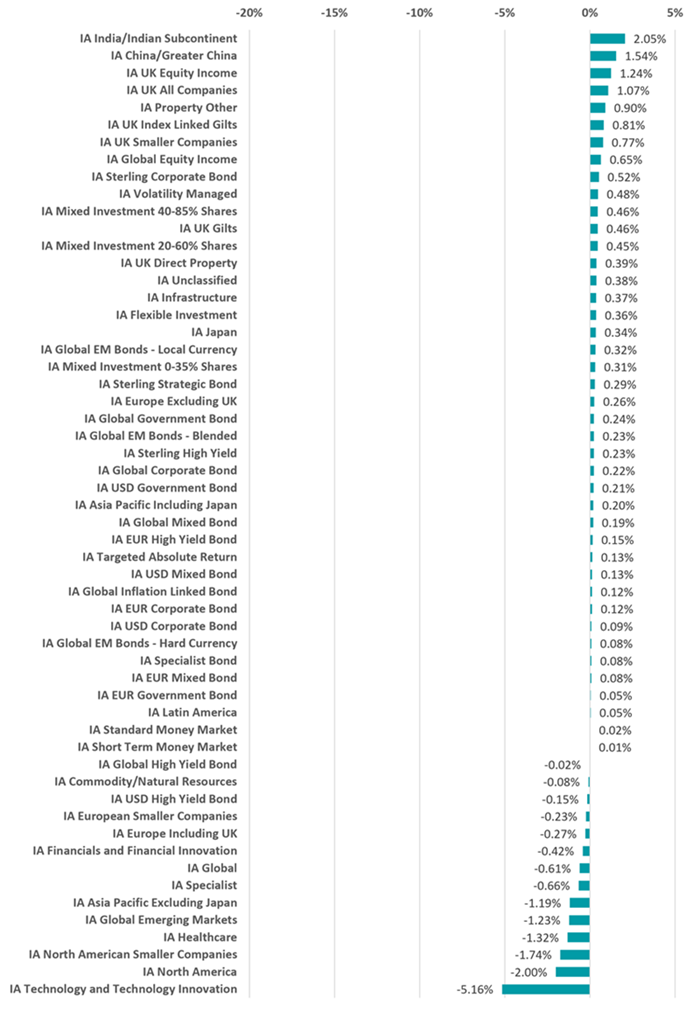
Source: Finxl. Total return in sterling on 5 Nov 2026
As would be expected, IA Technology and Technology Innovation was the worst-performing Investment Association sector on the day, with an average loss of 5.2%. IA North America (down 2%) and IA North American Smaller Companies (down 1.7%) were the next weakest, reflecting the weight of technology stocks in US markets.
At the other end, IA India/Indian Subcontinent made the biggest gain at 2.1%, followed by IA China/Greater China at 1.5%. UK equity sectors also held up, with IA UK Equity Income and IA UK All Companies both gaining more than 1%. In total, 42 of the 56 sectors made a positive return.
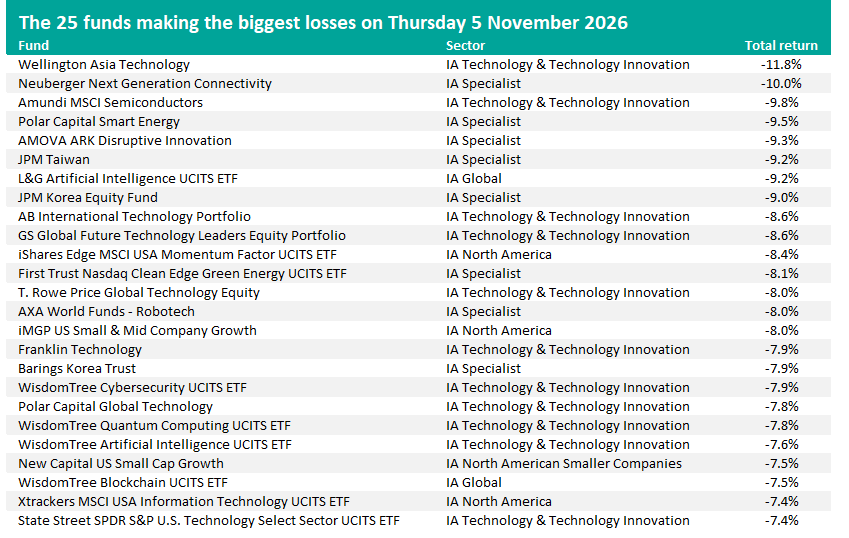
The table below shows the 25 funds with the biggest losses on the day and all 25 lost more than 7%.
Technology funds are the most common, accounting for 15 of the 25. Eight are broad technology funds, including Polar Capital Global Technology, T. Rowe Price Global Technology Equity and Franklin Technology, as well as passive funds tracking the US technology sector.
The other seven focus on AI, semiconductors and related themes. Neuberger Next Generation Connectivity was the second-worst fund on the day with a 10% loss, followed by Amundi MSCI Semiconductors with a 9.8% fall. L&G Artificial Intelligence UCITS ETF, WisdomTree Quantum Computing UCITS ETF and AMOVA ARK Disruptive Innovation also feature.
Source: Finxl. Total return in sterling on 5 Nov 2026
Wellington Asia Technology was the worst-performing fund of all, losing 11.8%. It is one of four funds in the table with significant exposure to Asian technology stocks, along with JPM Taiwan, JPM Korea Equity and Barings Korea Trust.
Korea and Taiwan are dominated by chipmakers. Samsung and SK Hynix both dropped more than 7% yesterday as investors worried about tighter US data centre regulation and its impact on demand for their products.
Clark said: “The weakness has inevitably spread to other technology heavy markets around the world, with Asian equities particularly exposed, while the UK market should be relatively insulated given its much lower weighting to technology.”
Polar Capital Smart Energy (down 9.5%) and First Trust Nasdaq Clean Edge Green Energy UCITS ETF (down 8.1%) were also hit. Utilities and power equipment makers exposed to the data centre boom, including GE Vernova and Constellation Energy, traded lower on the day.
The table is completed by iShares Edge MSCI USA Momentum Factor UCITS ETF, New Capital US Small Cap Growth and WisdomTree Blockchain UCITS ETF. Growth and momentum funds have invested heavily in the AI theme while many companies in blockchain funds are former bitcoin miners that now run AI data centres.
Source: Finxl. Total return in sterling on 5 Nov 2026
Clark added: “Importantly for investors, this isn’t a story of everything falling together. Healthcare and consumer staples have performed strongly over the past month and proved more resilient during the latest bout of volatility. It is a useful reminder of why diversification matters, particularly after a period when investors could have been forgiven for thinking owning the largest US technology companies was all they needed.”
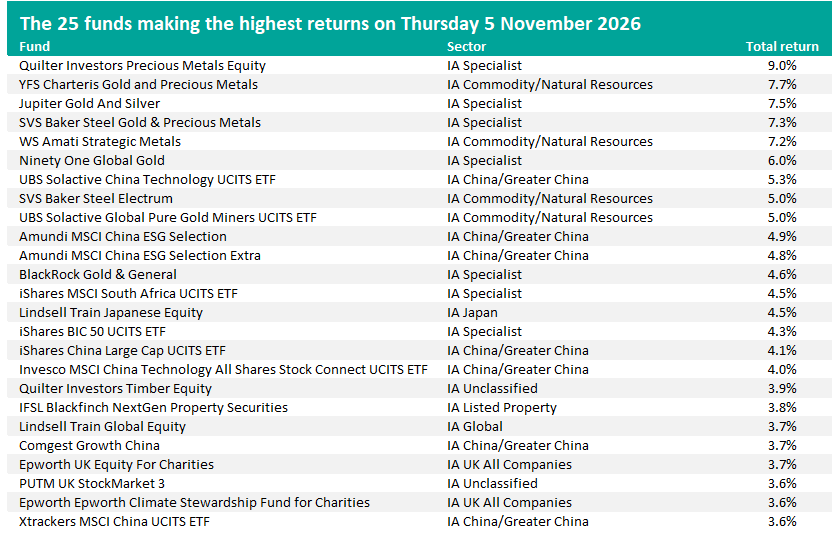
Gold funds dominate the top of the table. Quilter Investors Precious Metals Equity was the best performer with a 9 % gain, followed by YFS Charteris Gold and Precious Metals, Jupiter Gold And Silver, SVS Baker Steel Gold & Precious Metals, WS Amati Strategic Metals and Ninety One Global Gold. In all, nine of the 25 best funds invest in gold and precious metals miners.
Gold rose to a two-week high on Thursday as the dollar and US treasury yields fell for a second day. Mining shares tend to move further than the metal, because a higher gold price feeds through to profits when costs are fixed.
However, the yellow metal remains well below its record of $5,595 an ounce, reached on 29 January 2026.
Chinese equity funds are the second most common theme, with seven in the table including UBS Solactive China Technology UCITS ETF, iShares China Large Cap UCITS ETF and Comgest Growth China.
Hong Kong’s Hang Seng Tech index rose 5.6% on Thursday, its biggest gain since February 2025, as investors moved out of hardware stocks and into cheaper Chinese internet companies. Alibaba and Tencent were among the biggest drivers.
This created a split within Asia as Korean and Taiwanese funds were among the biggest fallers on the day, but Chinese funds were among the biggest risers.
Elsewhere, Lindsell Train Global Equity and Lindsell Train Japanese Equity gained 3.7% and 4.5% respectively. Both concentrate on companies with strong brands and steady earnings.