


Investors have been pulling out of tech stocks in recent months as the AI trade has started to falter, but some commentators have warned that the areas they are rotating into are now showing “extreme bubble-like dynamics”.
Over 2026 to Thursday 12 November, the MSCI AC World index made a 13.1% total return in sterling terms. However, FE Analytics shows this was unevenly spread over the year’s two halves: it made 12.7% in 2026’s opening six months but is up just 0.3% in the second half to date.
Investors were in a buoyant mood in the first half thanks to the ongoing AI build-out, with some chip stocks rising more than 100% over the period, while corporates reported strong profits and upward earnings revisions.
Performance of asset classes over 2026 to date
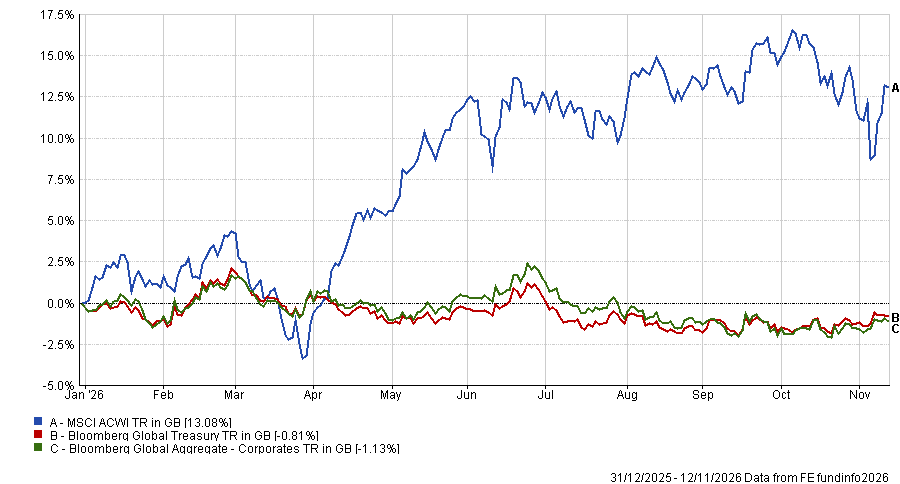
Source: FE Analytics. Total return in sterling between 1 Jan and 12 Nov 2026
However, recent months have been more challenging. AI and semiconductor stocks started to come off their highs in the summer, as the prospect of higher interest rates from the Federal Reserve prompted investors to question the health of AI’s future earnings against the massive spending of the build-out.
These worries heightened more recently, after the Democrats’ decisive victory in the US midterm elections increased the risk that tighter AI regulations and opposition to data centres could slow the AI revolution. Added to this, the space faces ongoing pressure from the departure of Jensen Huang as chief executive of chip giant Nvidia, amid a corporate scandal.
A look at the performance of the different sectors in the MSCI AC World suggests investors rotated out of growth areas of the market and into more defensive stocks in recent months.
Performance of MSCI ACWI sectors over 2026 to date
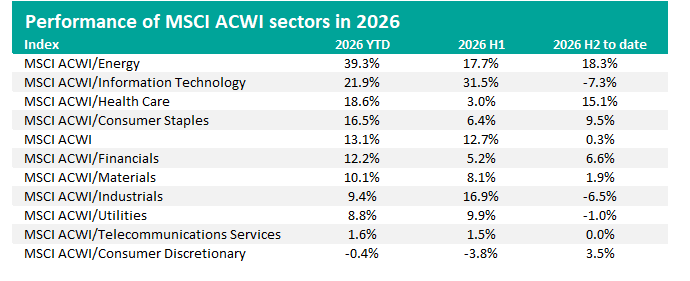
Source: FE Analytics. Total return in sterling between 1 Jan and 12 Nov 2026
Information technology stocks led the market in the first half of 2026 with a 31.5% return but are the worst performer in the second half after falling 7.3% on the concerns noted above. Industrials have also gone into reverse, reflecting that some of these companies are the 'picks and shovels' of the AI build-out.
Some of the largest constituents of the MSCI ACWI Information Technology index have endured a painful few months. South Korean chipmakers SK Hynix and Samsung Electronics gained 291.4% and 160% respectively in the first half but are down 54.1% and 38.3% in the second.
US semiconductor stocks also went from strong first-half gains to losses more recently. Micron Technology was up 265.8% in the first half but has fallen 29.7% in the second half to 12 November, according to Google Finance, while Nvidia made less than 6% in the first half but fell 16% in the second.
The chart above shows a rotation in the other direction, however. Healthcare stocks were up just 3% in the first six months of the year but have gained another 15.1% since the halfway point.
Charu Chanana, chief investment strategist at Saxo, highlighted US healthcare as an area of the market that could perform strongly after the US midterms, should a Democratic Congress tilt the policy debate towards healthcare affordability and insurance coverage.
“Healthcare providers and insurers could benefit if proposed coverage reductions are delayed or softened,” she explained, pointing to HCA Healthcare, Tenet Healthcare, Universal Health Services, Centene and Molina Healthcare as companies to watch.
The average fund in the IA Healthcare sector has made 11.8% since the start of July, ranking first among the Investment Association’s 56 peer groups. The average IA Technology and Technology Innovation fund is down 7.9%.
Consumer staples – another traditional defensive equity sector – have also picked up in the second half of 2026, going from a 6.4% return in the first half to a 9.5% gain in the second.
However, some strategists have warned that some defensive stocks are entering bubble territory after their strong run. In a Global Equity Volatility Insights note at the end of October, Bank of America analysts singled out US healthcare stocks as showing bubble-like dynamics, with consumer staples close behind.
Bank of America’s Bubble Risk Indicator (BRI) is a price-based measure designed to detect bubble-like instability across financial assets, based on their returns, volatility, momentum and fragility. It claims US healthcare is showing “extreme bubble-like dynamics”, with consumer staples not far behind.
BofA Bubble Risk indicator
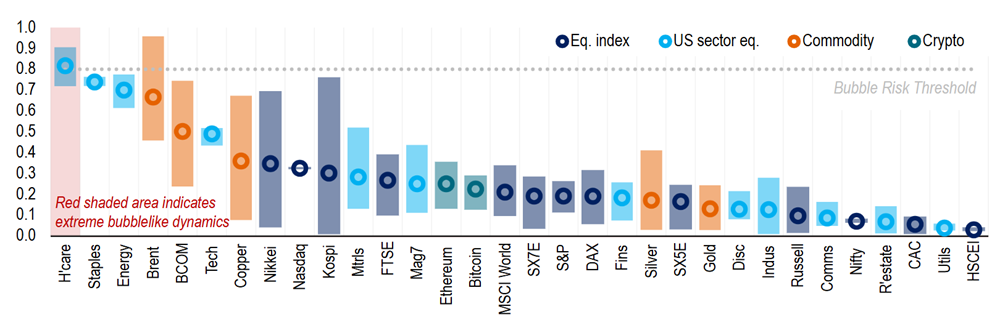
Source: BofA Global Research. Data as of 23 Oct 2026
“As the AI trade wobbles, defensives like healthcare and staples have seen a historic rotation that has paradoxically pushed their BRIs towards bubble-risk levels,” the report said.
“It turns out this is not unprecedented as we saw similar behaviour in the late 90s dot-com era and Covid melt-ups. These dynamics provide further evidence that markets continue to move towards a more bubble-like state.”
Since the report was published, the MSCI ACWI Healthcare index has gained another 5.6% and MSCI ACWI Consumer Staples has risen 3.9%, against 0.9% from the MSCI AC World.