






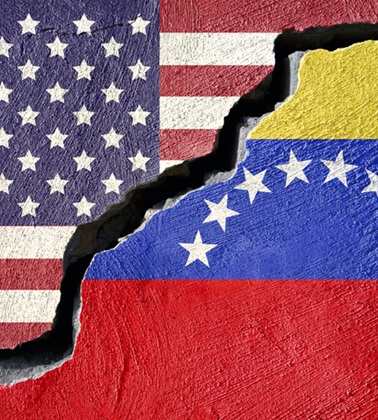
The lack of market reaction to the US intervention in Venezuela reflects the country’s diminished economic relevance but the broader implications for US deterrence, regional stability and international order warrant closer attention, investment managers have warned.
On 3 January 2026, the US launched Operation Absolute Resolve, a large-scale military intervention that resulted in the capture of Venezuelan president Nicolás Maduro. US president Donald Trump subsequently declared that the US would temporarily administer the country, citing American national security interests and the need to restore Venezuela’s oil industry.
However, the market reacted with relative calm to the event. Major stock indices rose, with investors buying energy stocks. The oil price also gained.
Katy Stoves, investment manager at Mattioli Woods, suggested markets failed to respond as expected because Venezuela’s global economic footprint has shrunk dramatically. The country’s share of world GDP has collapsed from 1% to 0.1% over the past 50 years, leaving it excluded even from frontier market indices.
“Following the US’s new take on foreign policy, this event seemed less of a ‘black swan’ than it might have done a year ago,” Stoves said, noting that the intervention appeared consistent with the Trump administration’s willingness to pursue unconventional approaches.
Precious metals and energy commodities showed limited movement. While gold prices edged higher, the gain barely registered against the metal’s 12-month rally.
Brent crude experienced the largest initial shift, yet prices stayed well within their established recent range. Stoves said Venezuela’s prolonged isolation under sanctions has eliminated its role in global supply networks.
“Oil is already in oversupply worldwide, prices are fairly subdued and Venezuelan crude is notoriously heavy and sulphur-rich, requiring significant investment before any production surge materialises,” she added.
However, Stoves questioned whether oil truly motivated the intervention and pointed to Trump’s renewed threats to annex Greenland. “This move may have less to do with oil and more to do with geopolitics,” she said.
Geopolitical implications
Anna Rosenberg, head of geopolitics at Amundi Investment Institute, noted that Trump is increasingly using US military might to achieve geopolitical goals. This now includes regime change, something he condemned in the past.
“The appetite of the US president to engage in unorthodox military undertakings will increase US deterrence,” Rosenberg said. “The operation will likely make Russia and China more concerned over US willingness to intervene militarily.”
But, as the events of recent days show, European governments face growing anxiety over Trump’s Greenland ambitions, while Latin American leaders have confronted heightened vulnerability. Cuba represents the most probable next target, with an oil embargo among potential measures, Rosenberg said.
Political analysts expect Washington to cooperate with Venezuelan vice president Delcy Rodriguez, whom the country’s Supreme Court swiftly installed as interim president. The rapid succession, combined with US secretary of state Marco Rubio’s remarks about the time it takes to organise elections, suggests no immediate vote.
Rodriguez and her brother built reputations as the regime’s pragmatists, previously leading negotiations with Washington.
“Her and her family’s experience in the power structures of Venezuela means she will likely be able to navigate the government in the short term,” Rosenberg said.
“However, there will likely be challenges. In times of transitions of power, political elites will compete, and there are also questions over the military. Also, US claims to Venezuelan oil will likely fuel anti-US sentiment.”
International responses highlight fracturing consensus on sovereign intervention. Russia and Brazil condemned the strikes forcefully, China maintained near silence and European capitals issued fragmented criticism of international law violations without directly confronting Washington.
Rosenberg argued that the operation could accelerate the degradation of established international norms with cascading risks. Latin America faces increased instability if governments diverge from Washington’s preferences, with Mexico and Colombia already receiving warnings. Taiwan faces heightened exposure to potential Chinese assertiveness, emboldened by weakened precedents, and Europe bears renewed pressure regarding both Greenland and security arrangements.
Market implications
When it comes to oil, meaningful production increases face extended timelines despite Trump’s ambitions. The country currently produces around 1 million barrels of oil per day and could increase by 300,000 barrels per day on average per year in an optimistic scenario, Rosenberg said.
“Venezuela's history of seizing company assets means Western firms not already present will be reluctant to invest until the new power structures and security situation become clearer,” she added.
Venezuelan sovereign bonds require fresh valuations given potential revenue streams from restored oil production. Current output sits below 1 million barrels daily (output is at a fraction of capacity after decades of under-investment, mismanagement and sanctions), with optimistic forecasts reaching 2.5 to 3 million barrels within five years.
“For bondholders, the regime change that matters is the one that unlocks those billions in capex and cashflows, but any restructuring will be complicated by large bilateral exposures to China/Russia," Rosenberg said.
The dollar faces both positive and negative implications. “On one side, a stronger grip on Venezuelan oil (which Trump now openly refers to as ‘US oil’) reinforces the dollar’s role,” she explained.
“On the other side, US credibility as a predictable partner is being eroded, which can fuel disaffection with the dollar in parts of the investment community, especially if ‘running’ a foreign country proves more chaotic than expected.”
Investment opportunities?
Despite muted broader market moves and complex geopolitical terrain, Syz Group chief investment officer Charles-Henry Monchau thinks specific investment opportunities have emerged because of the intervention.
Venezuelan distressed debt trades between 25 and 35 cents, depending on sanctions status, with Citi and Allianz analysts projecting recoveries of 30 to 55 cents under regime change. Ashmore holds the largest institutional debt position, whilst Houlihan Lokey advises the creditor committee.
“In sovereign restructurings, the advisors are paid ‘success fees’ and are the ‘picks and shovels’ play for restructuring,” Monchau said. Lazard's experience with Greek and Ukrainian restructurings positions the firm well, as Venezuela’s debt stack is arguably the most complex in history.
Infrastructure specialists could be another opportunity if the oil industry is to be overhauled. Technip, which designed Venezuela’s critical facilities, will likely secure rapid contract awards since alternative firms would require years to understand existing systems.
Graham Corp produces vacuum ejector equipment essential for heavy crude processing while Halliburton and Schlumberger could capture drilling and maintenance contracts across ageing infrastructure.
Meanwhile, Targa Resources controls the Galena Park Marine Terminal. “Reverting to US supplies means Targa’s Galena Park Marine Terminal (a major [liquefied petroleum gas]/naphtha export hub in Houston) would see an immediate massive spike in volume to displace the Iranian supply,” Monchau said.
Of the oil majors, Chevron seems best-placed as it maintained a presence in Venezuela when others left. This means it has the staff, the licences and the fields ready to ramp up production immediately, Monchau said.
Exxon Mobil could reclaim previously disputed assets, whilst ConocoPhillips holds billion-dollar arbitration awards potentially convertible to renewed access.
Syz Group also said Gulf Coast refiners face substantial margin opportunities from cheaper feedstock. Valero Energy, Phillips 66 and Marathon Petroleum operate facilities designed specifically for Venezuelan heavy crude.
They have been buying more expensive heavy crude from elsewhere while Venezuela was under sanctions but a flood of oil would lower their feedstock costs and widen their profit margins.
However, Monchau warned that there are several barriers to all of the above, not least the fact that it could take many years for any benefits to be seen.
“President Trump stated that US companies will invest billions to rebuild the sector, though details on the interim ‘group’ management remain unclear,” he finished.
“Analysts warn that companies (like Exxon Mobil) will be cautious. They cite the ‘hard lessons’ of Iraq and Afghanistan and the memory of their assets being seized by Venezuela in the early 2000s. Reclaiming Venezuela’s former glory as an oil powerhouse would require decades of investment and billions of dollars.”