






Europe’s scramble for strategic autonomy has moved from political talking point to an investment reality.
With confidence in longstanding partners on the world stage no longer guaranteed and exposure to rivals becoming clearer, the European Union is pouring money into domestic defence, critical raw materials, energy infrastructure and semiconductor technology.
Trustnet asked European equity managers to highlight companies that will benefit from the bloc’s autonomy drive.
Rheinmetall
Europe’s defence sector is being reshaped by rising geopolitical tensions, NATO modernisation efforts and a sharp increase in government spending.
As one of Europe’s main manufacturers of battle tanks, infantry fighting vehicles and artillery ammunition, German automotive and arms manufacturer Rheinmetall is a core play for investors looking to support Europe’s national security efforts, according to Ben Lambert, manager of Ninety One European Equity.
“The investment case combines multi-year order visibility, margin expansion from operating leverage and the political certainty that defence budgets will remain elevated – which means structural growth with cyclical upside,” he said.
Rheinmetall’s sales rose 20% to €7.5bn in the first nine months of 2025, with defence revenue up 28%. The overall group operating profit increased by 18% to €835m, while the defence division alone delivered €825m – a 14% rise. Earnings per share also improved in the first nine months of 2025, from €7.32 in 2024 to €8.34.
Rheinmetall is now considering expansion into space technology. Last month, it was revealed the company is in talks over a joint bid to build an equivalent to Elon Musk’s Starlink internet service for the German military. The German military plans to spend €35bn in space technology over the next four years in a bid to reduce reliance on the US.
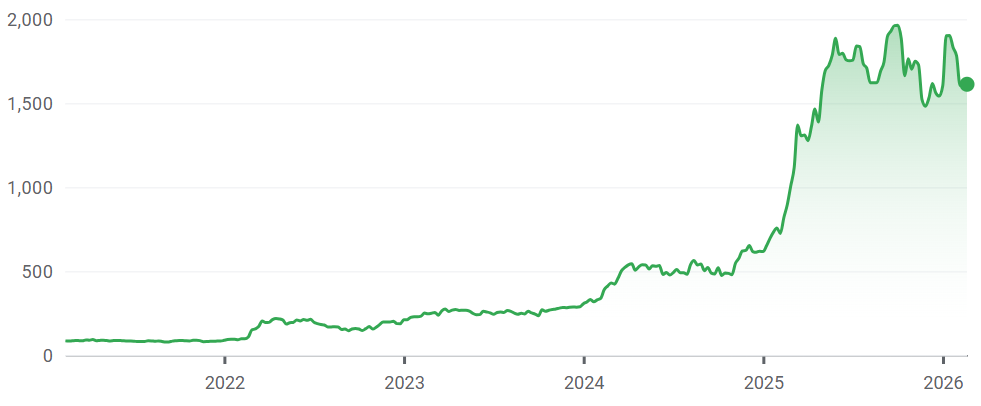
The company’s share price is up just shy of 73% over one year and 1,817% over five years.
Stock price performance over 5yrs
Source: Google Finance
Steyr Motors
Rather than choosing the household defence names, Mike Clements, manager of the VT Tyndall European Unconstrained fund, pointed to a more under-the-radar defence play: Austrian diesel engine manufacturer Steyr Motors.
It is actively involved in the defence industry through various strategic partnerships and contracts – for example, it has signed a major development and supply agreement with Rheinmetall to enhance military platform technology.
According to the company’s preliminary 2025 financial results, Steyr Motors grew revenues by 16% to €48.5m in 2025, has an order backlog above €300m and predicts €75m to €95m in revenue in 2026.
“We view it as the Ferrari of the defence world – focused on low volumes of high-quality engines sold at a high price point,” Clements said.
“It is less of a luxury and more of a necessity, so much so that key clients like the US Navy Seals happily pay the premium for [their motors].”
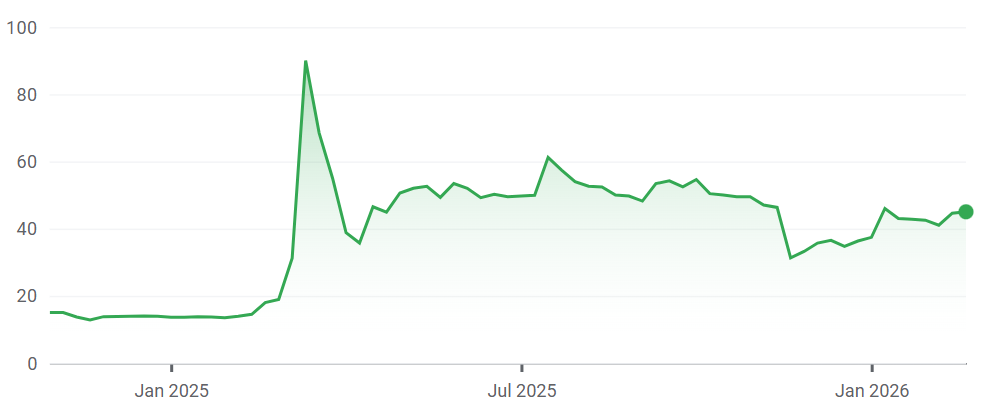
The company’s share price is up 168% over one year and 200% over five years.
Stock price performance over 5yrs
Source: Google Finance
Indra Sistemas
Lambert from Ninety One also suggested Spanish information technology and defence company Indra Sistemas, noting that it provides “numerous components” Europe needs for genuine defence autonomy, including radar systems, electronic warfare, air traffic management and command-and-control infrastructure.
“While less prominent than platform manufacturers, Indra is essential to the EU’s push for autonomous defence capabilities that do not rely on US software and systems integration,” Lambert said.
He added that revenue visibility is improving as European defence budgets pivot from procurement-heavy to technology-intensive spending, introducing a “differentiated exposure to the rearmament theme with less competition from US primes, leading to substantial upside risk to consensus earnings expectations”.
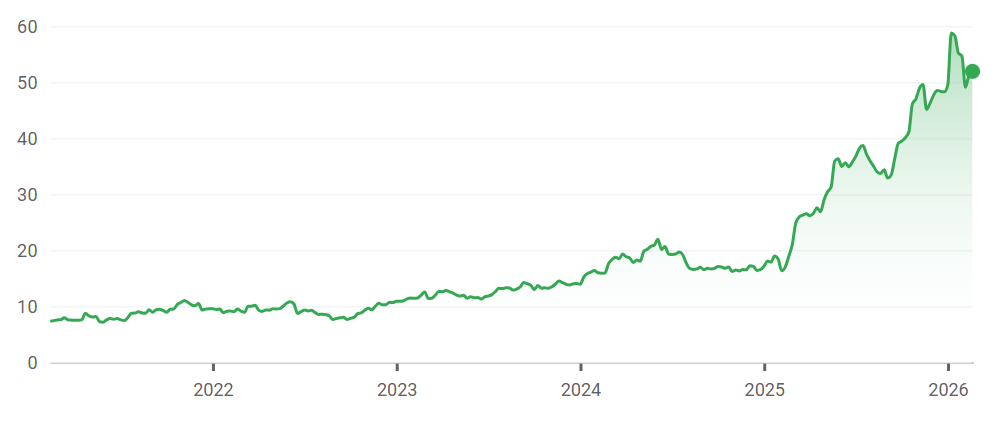
The company’s share price is up 193% over one year and 614% over five years.
Stock price performance over 5yrs
Source: Google Finance
UniCredit
Lambert’s third pick is Italian multinational banking group UniCredit.
He said the banking group is in a strategic position to benefit from the EU’s renewed push towards a unified Capital Markets Union (CMU), which aims to enhance market integration and competitiveness across the bloc.
“The policy imperative is clear: Europe needs to channel its estimated €10trn in excess savings toward productive investment to fund the energy transition, defence and competitiveness agenda, rather than leaving capital trapped in low-yielding deposits or fragmented national siloes,” Lambert said.
He noted that UniCredit chief executive officer Andrea Orcel’s leadership has transformed the company into a “capital-light, fee-generating franchise increasingly oriented toward wealth management and corporate advisory” – two areas he said the CMU will further stimulate.
Lambert added that the bank still trades on a single-digit prospective price-to-earnings (P/E) multiple and should return more than 30% of its market capitalisation to shareholders over the next three years in distributions.
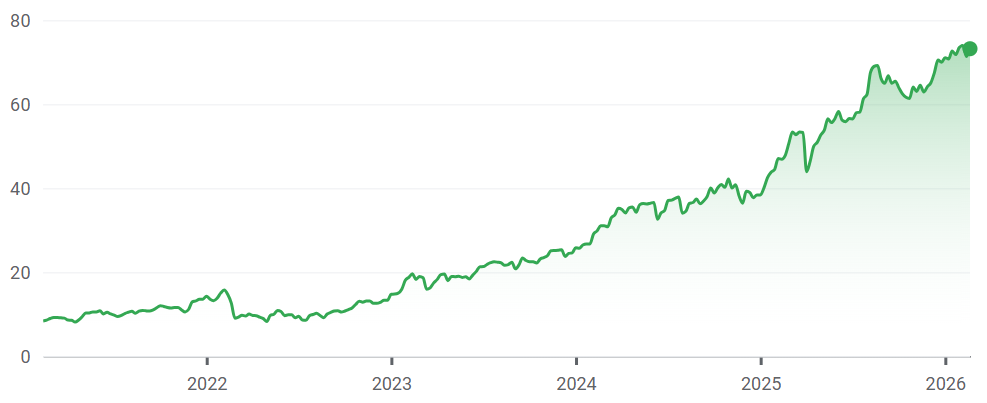
The banking group’s share price is up 54% over one year and 776% over five years.
Stock price performance over 5yrs
Source: Google Finance
Vulcan Energy
Europe’s push for strategic autonomy didn’t start with tensions with the US – it began with the realisation that the bloc’s economic model is overly exposed to China through exports, critical inputs and supply chain resilience.
“With China increasingly using its control of strategic minerals as a geopolitical weapon, Europe needs to increase its own homegrown supplies of many critical metals,” said Clements, noting the bloc is responding through its Critical Raw Minerals Act, which designates strategic projects for funding and accelerated permitting.
His second pick is therefore lithium and renewable energy producer Vulcan Energy.
It received €250m in financing from the European Investment Bank toward its €2bn project to build an integrated, battery-quality lithium supply chain in Germany based on geothermal brines to reduce Europe’s reliance on imported raw materials while also supporting the bloc’s decarbonisation commitments.
“Developing assets such as these is the key to strengthening Europe’s strategic autonomy,” Clements said.
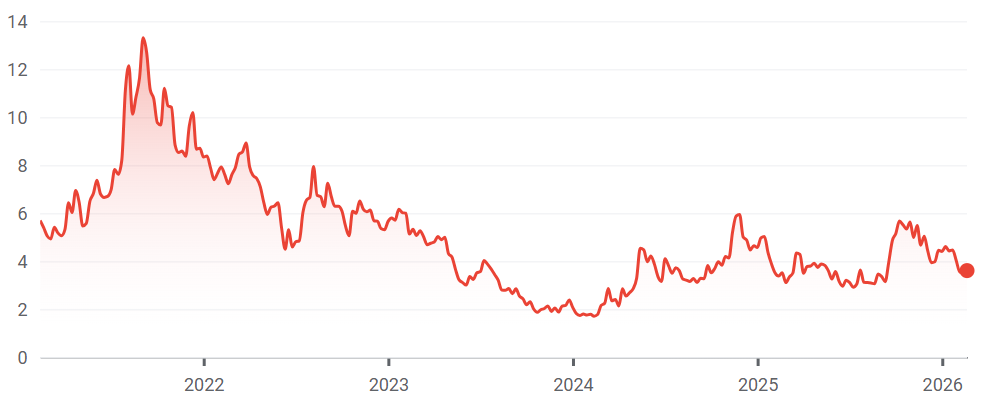
The company’s share price is up 2% over one year and is down 37% over five years.
Stock price performance over 5yrs
Source: Google Finance
Gaztransport & Technigaz (GTT)
Also considering European energy autonomy, Ben Ritchie, co-manager of Dunedin Income Growth Investment Trust, pointed to French engineering company GTT, which makes up around 3% of the trust’s portfolio.
“GTT strengthens European energy sovereignty by providing critical liquefied natural gas (LNG) containment technology that underpins secure, diversified gas supply independent of Russia,” he said.
Ritchie pointed to the company’s “quasi-monopoly position, long-dated order book and high-margin IP-based model [which] offer resilient cashflows and structural growth as Europe expands LNG capacity”.
The company reported a 29% increase in revenue for the first nine months of 2025 – up to €600m – driven by the increase in the number of LNG carriers under construction.
“The valuation is undemanding and the strong net cash balance sheet underpins an attractive shareholder distribution policy,” Ritchie said.
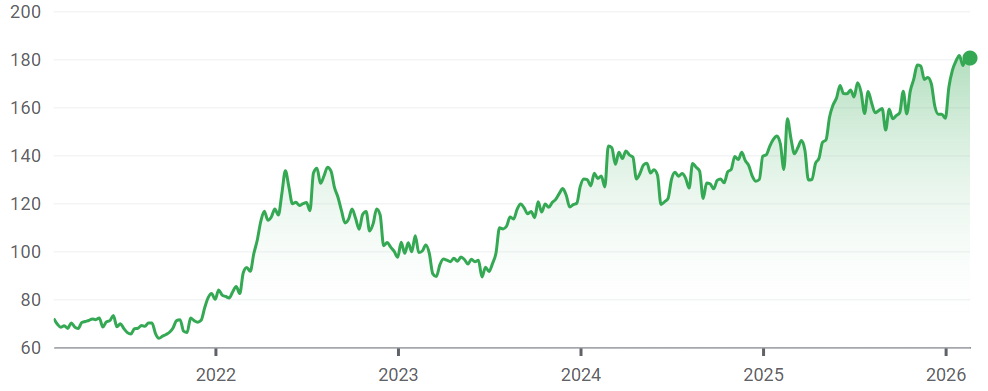
The company share price is up 33% over one year and 151% over five years.
Stock price performance over 5yrs
Source: Google Finance
ASML
Ritchie’s second pick is Dutch multinational ASML, a company he argues is “central to Europe’s technological autonomy as the sole global provider of leading-edge extreme ultraviolet (EUV) lithography systems, vital for advanced semiconductor production”.
EUV lithography is the use short-wavelength light to etch intricate patterns on advanced semiconductor chips, enabling the production of smaller and more powerful chips.
“ASML’s unmatched technological moat, multi-year backlog and recurring service revenues underpin strong visibility and pricing power,” Ritchie said, adding this “unique strategic importance and exceptional fundamentals make it a standout long-term European champion”.
ASML reported €32.7bn in 2025 sales and a net profit of €9.6bn. Its revenue and bookings numbers for the fourth quarter of 2025 also came in higher than expected, with ASML increases its full-year 2026 revenue guidance to between €34bn and €39bn.
The company has announced a €12bn share buyback programme that will run through to 2028.
ASML is a 2.5% position in the Dunedin Income Growth Investment Trust portfolio.
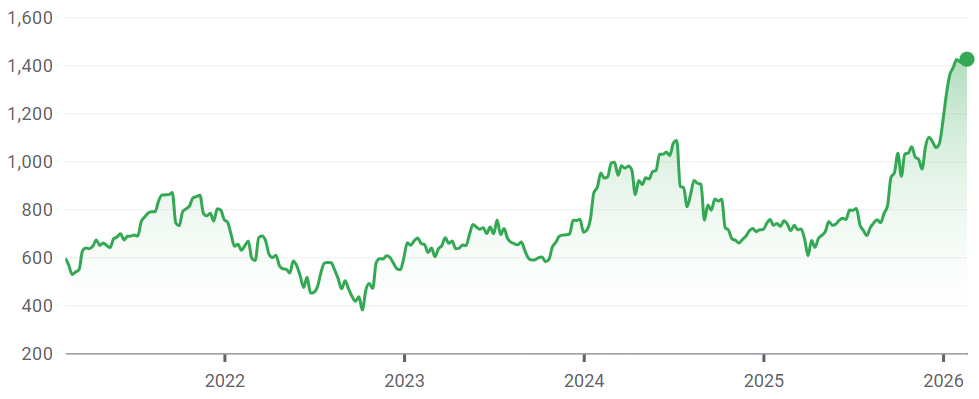
The share price is up 91% over one year and 140% over five years.
Stock price performance over 5yrs
Source: Google Finance