






Emerging markets have been resurgent in recent years and two young funds launched in 2022 have made strong use of this rebound, notching up impressive returns.
The region has been favoured by the likes of BlackRock and Franklin Templeton to start 2026 and returns have backed up their enthusiasm. Last year, the MSCI Emerging Markets index beat the developed MSCI World index (24.45 versus 12.8%). So far in 2026, the former is up 11.3% while the latter has made just 2.6%.
This turnaround comes after some difficult years, however. In the prior four years, the index lagged its developed global peers as US stocks rocketed on the back of an artificial-intelligence (AI) boom.
Some funds have timed this rebound well, launching in 2022 at the low end of the market and rocketing higher as it has rebounded.
In this study, Trustnet looks at funds launched in 2022 that passed the three-year mark last year, dissecting their performance over three years from the start of 2023 to the end of 2025. Previously, we have looked at the US, global and UK equity sectors, as well as sterling bond funds. Here, we turn to the emerging markets.
Of the six emerging markets funds launched in 2022, four are passive. While these funds have hoovered up investors’ cash, it is their active counterparts that have thrived.
| How the IA Global Emerging Market funds launched in 2022 have performed 3yrs on | ||||
| Fund | Return over 3yrs | Quartile ranking | Fund launch | Fund size |
| New Capital Emerging Markets Future Leaders | 48.1% | 1 | 28/03/2022 | £78m |
| Federated Hermes Global Emerging Markets ex-China Equity | 43.6% | 1 | 19/09/2022 | £6m |
| L&G FW ESG Tilted and Optimised Emerging Markets Index | 38.5% | 3 | 20/04/2022 | £431m |
| Vanguard ESG Emerging Markets All Cap ETF | 35.4% | 3 | 23/08/2022 | £66m |
| iShares Emerging Markets Equity ESG Screened and Optimised Index (UK) | 35.4% | 3 | 12/04/2022 | £1,301m |
| Invesco MSCI Emerging Markets ESG Climate Paris Aligned UCITS ETF | 26.4% | 4 | 19/11/2021 | £106m |
Source: FE Analytics
New Capital Emerging Markets Future Leaders tops the list of young funds above, producing a top-quartile three-year return of 48.1%.
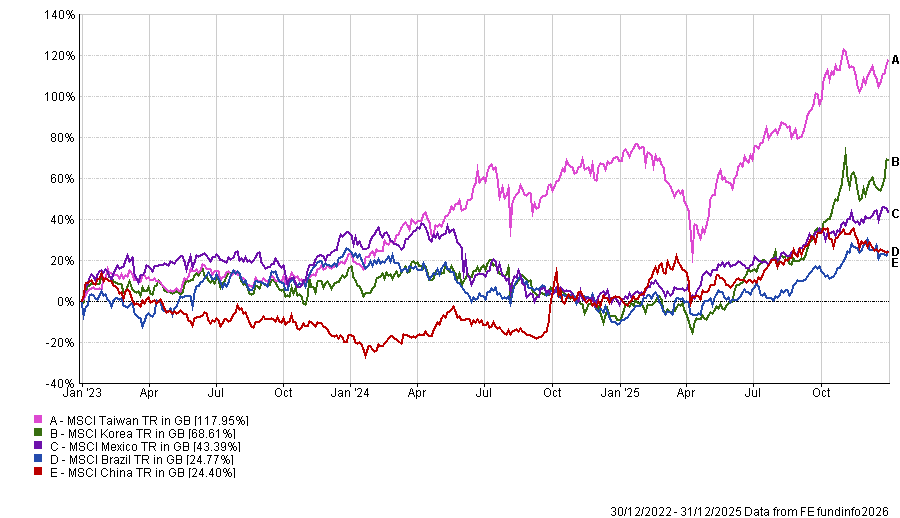
The £48m fund, which holds a maximum FE fundinfo Crown Rating of five, is differentiated from its peers, notably through its lack of exposure to China. Instead, Brazil (14.3%), Taiwan (11.5%), South Korea (9.8%) and Mexico (9.8%) dominate.
This helped the fund, as all of these markets have outperformed the MSCI China index over the past three years, as the chart below shows.
Performance of indices over 3yrs
Source: FE Analytics
Despite its track record, the fund has lost traction with investors. It peaked with assets of more than £104m last year but has been sold off in recent months, and so far in 202,6 £26m has been pulled from the fund, around a third of its total assets at the start of the year.
Only just outside the top quartile of the peer group, Federated Hermes Global Emerging Markets ex-China Equity was the only other fund to beat the average peer over the three years to the end of 2025.
Another that eschews China, the portfolio relies on other countries such as Taiwan, Korea and India, which combined make up 58.9% of the fund.
Headed by Kunjal Gala, large redemptions at the end of 2025 have affected its size. The fund once held almost £66m in assets under management but this has dropped to just £6.7m today.
In the fund’s half-year report last August, the manager said emerging markets offered a “compelling opportunity for quality and growth investors” amid a global economy under pressure from US trade tariffs.
“Emerging market equity positioning remains light, and valuations are attractive relative to developed markets,” he noted, adding that a weaker dollar is also supportive.
The fund is particularly focused on companies enabling technological transformation, with around half of its assets invested in businesses across artificial intelligence (AI) infrastructure, industrial technologies, and communication.
Despite the strong performance of these active funds, however, it is their passive rivals that have garnered the most investor interest. Despite its third-quartile 35.4% return, iShares Emerging Markets Equity ESG Screened and Optimised Index (UK) is the largest of the emerging market funds launched in 2022, with £1.3bn in assets under management.
It tracks the Morningstar Emerging Markets ESG Enhanced index, which filters out companies associated with controversial weapons, tobacco, nuclear weapons, civilian firearms, thermal coal, oil sands, adult entertainment, alcohol and gaming, as well as UN Global Compact violators.
L&G FW ESG Tilted and Optimised Emerging Markets Index has been the best performer of the four passive options, up 38.5%, while the iShares fund above and the Vanguard ESG Emerging Markets All Cap ETF have both made 35.4%.
The worst performer on the list is the £106m Invesco MSCI Emerging Markets ESG Climate Paris Aligned UCITS ETF, which has made 26.4% over the three years.