






High net worth investors have identified global political tensions and artificial intelligence (AI) bubble fears as their primary concerns for 2026, according to a survey by Wealth Club, prompting the wealth manager to highlight defensive strategies ahead of the tax year-end.
Some 70% of respondents cited geopolitical risks as the biggest threat to portfolios, while two-thirds flagged worries about an AI bubble. Those fears have already materialised in sharp sell-offs across software, wealth management and cybersecurity stocks, as AI threatens established business models.
Susannah Streeter, chief investment strategist at Wealth Club, said: “We're on a rollercoaster of AI disruption with geopolitical risks adding to the uneasy ride. Sell-offs have rocked markets as artificial intelligence tools and services threaten to disrupt sectors.”
The US military build-up in the Middle East, the assault on Venezuela and January's stand-off over Greenland have contributed to heightened uncertainty, while tariff turmoil has begun to weaken the US economy. Negotiations between the US and Iran have raised fresh concerns about further destabilisation in the region.
Against this backdrop, Wealth Club has recommended three investments for investors seeking stability: multi-asset fund Troy Trojan, US-listed infrastructure company Brookfield Infrastructure Corporation and Swedish holding company Investor AB.
Troy Trojan
The multi-asset fund aims to preserve capital and deliver real-term growth over the long term through a mix of high-quality equities, bonds, gold and short-dated treasury bills. FE fundinfo Alpha manager Sebastian Lyon and co-manager Charlotte Yonge target returns of the retail price index (RPI) plus 2%-5% over rolling five-to-seven-year periods.
It has delivered on its capital preservation mandate in recent years, with volatility of 4.8% over the five years to February 2026 – less than half that of global equities, with the MSCI World index at 12.9%. Trojan’s maximum drawdown of 5.8% was roughly a third of the 16.7% fall experienced by global equity markets over the same period.
Fund research house Square Mile notes that, over the fund's full history since 2001, it has delivered equity-like returns with substantially lower volatility, though acknowledged recent performance has lagged broader markets.
The fund returned 6.2% annualised over the five years, significantly below the 13.2% delivered by global equities, though ahead of RPI inflation at 4.91%.
Performance of fund against index and sector over 1yr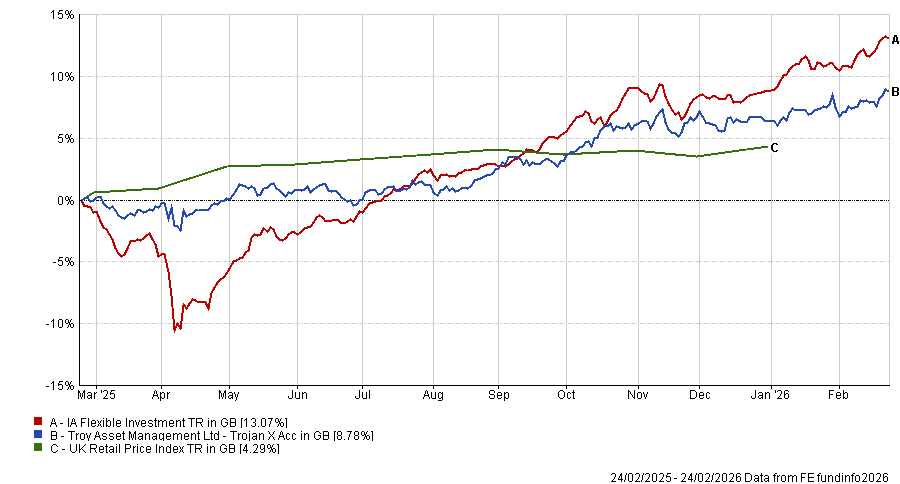
Source: FE Analytics
Streeter said the fund “helps build resilience at the centre of a portfolio in more unsettled times, such as fresh geopolitical tensions, but the managers can also adjust and increase risk if conditions improve.”
Holdings include a mix of assets with predictable return profiles. The managers rarely hold corporate bonds due to liquidity concerns and avoid alternative investments, including infrastructure and real estate investment trusts (REITs), believing they do not provide genuine diversification.
Brookfield Infrastructure Corporation
The US-listed company owns and operates critical infrastructure assets across multiple sectors and geographies, focusing on stable cashflows and growth prospects. Significant exposure to data centres provides a play on the physical infrastructure underpinning AI development, while holdings across energy, water and freight offer diversification.
Streeter noted that, while software companies face ongoing AI-driven volatility, “investments in companies providing the backbone to the technology look more resilient".
“As the AI revolution gathers pace, second-level opportunities across infrastructure and industrial sectors look set to come into their own," she said.
Investor AB
The Swedish investment and holding company takes significant minority stakes in businesses across the healthcare, industrial and technology sectors, focusing on what it considers strong and sustainable companies. Its European focus offers geographic diversification, while it also has exposure to private equity through the EQT group.
Streeter emphasised that, despite market turbulence, time in the market and diversification remain essential. “For investors owning quality companies over the long term, big bumps in the road are part of the journey,” she said.
UK investors can access both stocks through brokers offering international trading, although they should be aware of potential currency conversion costs and tax.