






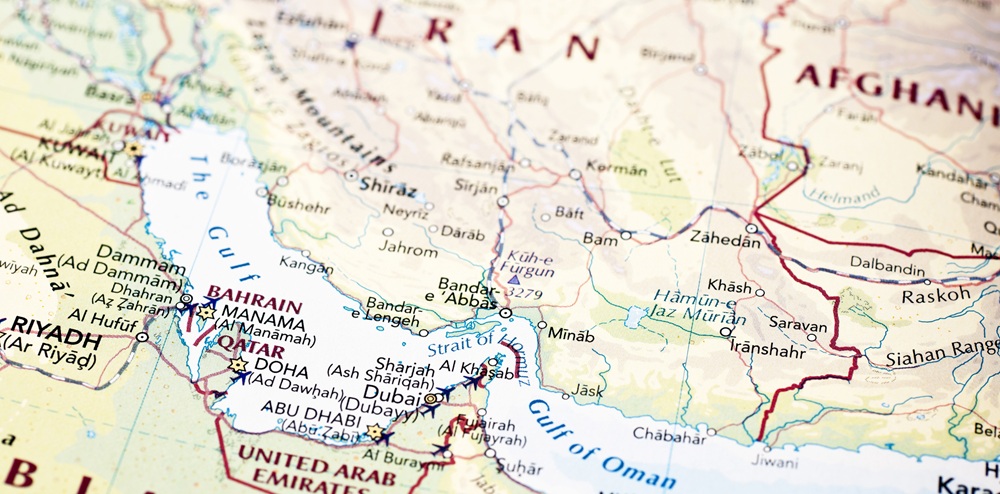
The Strait of Hormuz is one of the most consequential stretches of water on earth. A narrow passage connecting the Persian Gulf to the open ocean, it carries a fifth of the world’s oil supply every day.
On 28 February 2026, US and Israeli forces launched coordinated strikes on Iran, killing supreme leader Ali Khamenei. Iran retaliated with missile and drone attacks across the Gulf region while its Islamic Revolutionary Guard Corps (IRGC) threatened to close the strait to shipping.
John Wyn Evans, head of market analysis at Rathbones, said: “From a global perspective, pretty much everything hinges on the Strait of Hormuz and the implications of any disruption to global energy flows.
“Oil prices already reflect a sizeable risk premium, with current levels implying an expectation of a limited but meaningful interruption to shipping, but analysts note that the impact would worsen quickly if the closure were protracted, given the non‑linear nature of supply constraints. The longer it is closed, the worse the effects. For now, inventories and limited rerouting options provide some buffer, but the situation remains finely balanced.”
Below, Trustnet explains what the strait is, why its disruption matters and what investors need to understand about the risks it represents.
What is the Strait of Hormuz?
The Strait of Hormuz is a narrow waterway between Iran to the north and Oman to the south. It connects the Persian Gulf with the Gulf of Oman and the wider Arabian Sea. At its narrowest point it is around 39km wide, though the tanker shipping lanes are only about 3km wide in each direction.
The strait is what analysts call a chokepoint: a narrow passage on a major trade route with no practical alternative. The Persian Gulf has no other outlet to the sea and pipeline capacity can carry only a fraction of the volumes that move by ship. There is no equivalent bypass route.
How much of the world's energy passes through it?
Around 20 million barrels of oil per day passed through the strait in 2024, according to the US Energy Information Administration. That represents roughly 20% of global petroleum consumption and about a quarter of total seaborne oil trade. Approximately one-fifth of global liquefied natural gas (LNG) trade also transits the strait, primarily exported from Qatar. Around a third of global fertiliser trade also passes through it, meaning a disruption reaches beyond energy into agricultural supply chains.
Which countries depend on it most?
Asia bears the greatest direct exposure, according to figures from the US Energy Information Administration. Around 84% of crude flowing through the strait in 2024 was destined for Asian markets. China, India, Japan and South Korea together accounted for approximately 69% of all Hormuz crude flows, with India importing around half of its total crude through this route.
The UK and Europe source a greater proportion of their energy from elsewhere, but oil is priced on global markets. A supply shock large enough to move prices does so regardless of where a buyer sources its barrels.
In 2024, the US moved about 7% of its total crude oil and condensate imports and 2% of its petroleum liquids consumption through the strait.
Why has the strait effectively closed in March 2026?
US and Israeli airstrikes on 28 February 2026 targeted Iranian military and nuclear facilities and killed supreme leader Ali Khamenei. Iran responded with ballistic missile and drone attacks on US military bases across Qatar, Kuwait, Bahrain and the UAE.
The IRGC issued warnings prohibiting vessel passage and attacked tankers in adjacent waters. Major shipping companies suspended transits and ship-tracking data showed traffic falling by approximately 70%, with over 150 vessels anchoring outside the strait rather than risk passage.
Are there alternative routes?
Some bypass capacity exists. Saudi Aramco’s East-West Pipeline links Gulf coast fields to the Red Sea port of Yanbu. The UAE’s Habshan-Fujairah pipeline connects onshore fields to a terminal on the Gulf of Oman. But combined spare capacity across both pipelines is a modest fraction of normal Hormuz flows.
LNG has no pipeline alternative at all. Qatar ships its entire LNG export volume through the strait and an extended closure creates a supply gap that no existing infrastructure can fully bridge.
What happens to oil prices and the wider economy?
The immediate effect is upward pressure on oil prices. Following the February 2026 strikes, Brent crude futures rose by approximately 10 to 13% in initial trading, with analysts estimating a sustained closure could push crude above $100 per barrel.
Higher oil prices feed quickly into fuel costs, transport costs and, from there, the prices of a wide range of goods. War-risk insurance premiums surged by up to 50%. Ships rerouting around the Cape of Good Hope add weeks to journey times and significant freight costs. The combined effect is inflationary pressure across multiple sectors at once.
How does this affect financial markets and investors?
Energy sector equities typically benefit from higher oil prices in the short term, while sectors with significant energy cost exposure, including airlines, logistics and consumer goods, tend to face margin pressure. Bond markets are affected through inflation expectations and central banks in oil-importing economies face a more complex trade-off between containing price rises and supporting growth.
Geopolitical disruptions are difficult to price because their duration is uncertain. Markets often react sharply to an initial shock before partially recovering as the situation stabilises or becomes better understood. Strategic petroleum reserves and coordinated inventory releases can buffer short-term supply gaps, but provide limited protection if a closure extends over months.
The Strait of Hormuz has been a persistent source of geopolitical risk for decades and understanding its role in global energy supply is part of understanding the risk environment in which all investments operate. Diversification is the most reliable tool for managing this type of risk as portfolios with broad geographic and sector spread are less vulnerable to a single geopolitical event.