






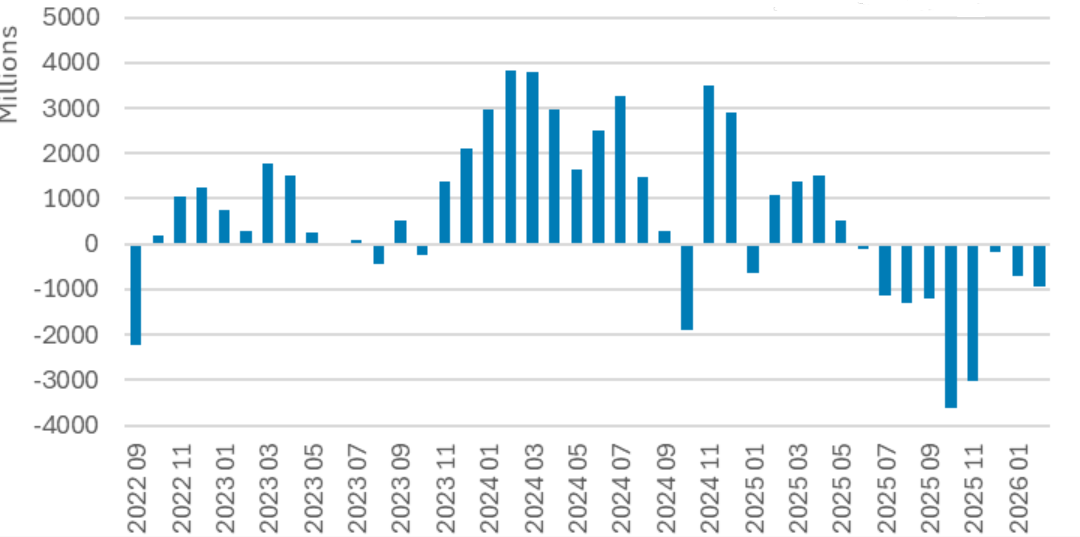
Persistent investor unease in the face of volatility has resulted in the ninth consecutive month of outflows from equity funds, with £927m taken out in February, according to recent data from Calastone.
Between June 2025 and February 2026 – a time period which has included many spikes in volatility, from US tariffs to the outbreak of conflict in the Middle East – a net £12.2bn was pulled from equity funds, which Calastone said is enough to reverse more than a typical year’s worth of inflows.
Equity funds – net fund flow
Source: Calastone Fund Flow Index – February 2026
February recorded the highest degree of selling since November 2025, when the autumn Budget weakened investor sentiment.
Despite a greater appetite to withdraw capital, the level of buying has remained “relatively steady”.
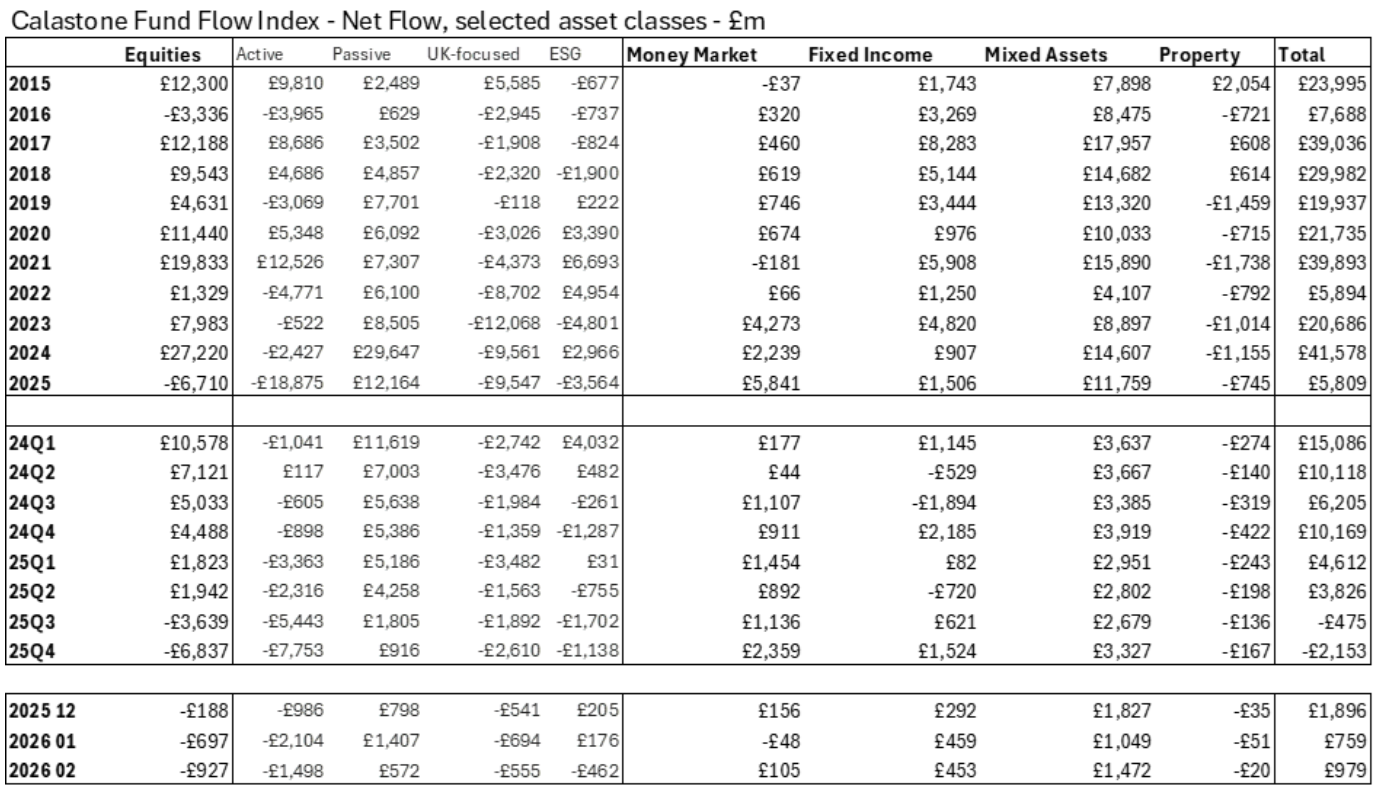
UK equities lost the most, logging £555m in redemptions, as global funds lost £518m and specialist sector funds lost £284m – for the latter, £162m in outflows came from technology funds.
Edward Glyn, head of global markets at Calastone, said: “Investors seem to have gotten a taste for selling and are looking for reasons to pull money out of funds.
“Certainly, February was a very volatile month for global share prices, as successive waves of panic about which sectors will see their business models disrupted by AI swept through stock stocks.”
However, he maintained that we are not in a bear market, even if some pockets of the market are being punished.
“The global index ultimately ended the month more or less where it began, while the UK top 100 surged 6.7% in just four weeks to a record high,” Glyn said.
“Investors are sitting on large capital gains and it seems that nerves and volatility are driving them out of equities.”
Actively managed funds specifically have logged outflows for 14 consecutive months, while index trackers continue to enjoy inflows – in February, investors sold down £1.5bn of active funds but bought £571m of passive ones. Passive funds last reported mass redemptions in August 2023, Calastone said.
“Active equity funds tend to attract investors who are making a choice – they are selecting a manager, a style, a thesis, [which] often comes with higher engagement, more switching and a willingness to react when the news shifts,” Glyn said.
“This may explain why they are always first under the hammer.”
More defensive asset classes have benefited from the sustained volatility, with investors adding £453m to fixed income funds and £105m to money market funds. Multi-asset funds recorded ongoing strong inflows, adding £1.5bn.
Source: Calastone Fund Flow Index – February 2026