






The UK equity market had a strong 2025, yet enthusiasm for the domestic economy remains muted. Sticky inflation, elevated energy costs and weak business sentiment have kept investors cautious, while Labour's political difficulties add a further layer of uncertainty.
Yet the case for UK equities does not rest solely on the domestic economy. Over 70% of FTSE 100 earnings are generated overseas, yet UK stocks continue to trade at a notable discount to global peers.
For those looking to gain exposure, three funds dominate the active UK equity landscape: Artemis UK Select (£5.3bn), Fidelity Special Situations (£4.3bn) and Invesco UK Equity High Income (£2.7bn).
All three sit in the IA UK All Companies sector but they are built differently, carry different levels of risk and earn different levels of enthusiasm from fund selectors.
The three philosophies
Invesco UK Equity High Income, co-managed by Ciaran Mallon and James Goldstone, is the most defensively positioned of the three. With a yield of 3.14% and a beta of 0.81 over the past year, it moves less than the market and pays investors to wait. Its volatility over the past 12 months is the lowest of the group.
Fidelity Special Situations occupies the middle ground. Managed by Alex Wright since 2014, alongside Jonathan Winton since 2020, takes a classic contrarian approach – hunting for unloved, undervalued companies typically in the mid and small-cap space where the market has overlooked recovery potential.
Rob Morgan, chief analyst at Charles Stanley Direct, described it as "an unconstrained fund, meaning the manager is free to generate outperformance without regard for the benchmark, something Wright has successfully done on a consistent basis since taking charge in 2014".
Artemis UK Select is the most aggressive of the three, co-managed by Ed Leggett and Ambrose Faulks.
Jason Hollands, managing director at Bestinvest, described it as "a high-conviction, benchmark-agnostic multi-cap fund" that combines top-down macro views with bottom-up stock picking, with the added dimension of short positions to differentiate returns further.
Performance of funds against sector over 1yr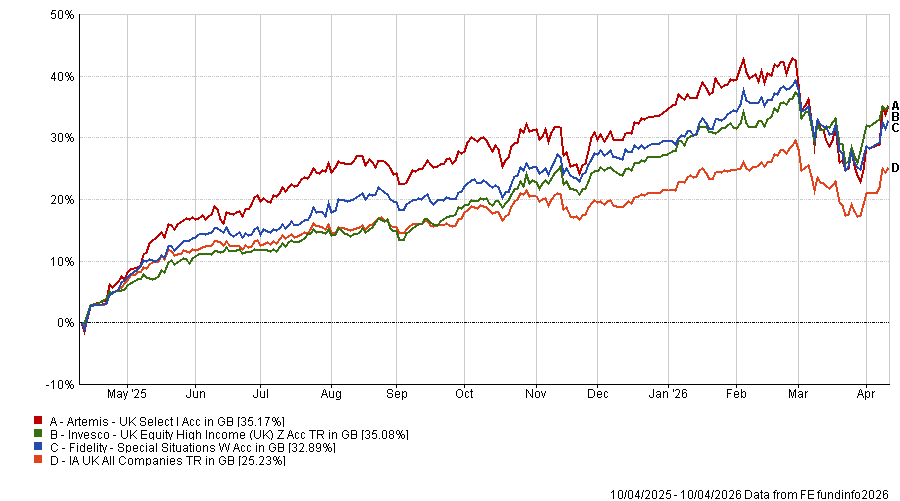
Source: FE Analytics
Performance-wise, over five years Artemis leads at 73%, ahead of Fidelity at 70.6% and Invesco at 67.9%. All three have beaten the sector over that period, though the routes have been very different.
Calendar year data illustrates the style gap most clearly. In 2022, Artemis fell 9.8% – far deeper than Fidelity's 0.5% decline and Invesco's 1.2% loss. After that, Artemis posted 19.1% in 2023, 25.3% in 2024 and 28.3% in 2025, comfortably leading the group in each of those three years.
Fidelity and Invesco were far more even across the cycle, with Invesco in particular recording its strongest returns in the most recent 12 months at 24%.
öFor their allocations, Artemis has 96% of its portfolio in UK equities; Fidelity has 86%, with meaningful exposure to European equities at 10.7%; Invesco sits at 78.7% UK, with 10% in North American equities – an unusual feature for a fund of its type.
Hollands noted that Fidelity Special Situations has a significantly higher allocation to smaller companies, around 40% of the portfolio, compared with roughly 16% for Artemis UK Select. Morgan added that this mid and small-cap bias "has been a headwind over much of this period" for Wright – making the consistent outperformance more notable, not less.
The verdict
Morgan's pick was Fidelity Special Situations, citing Wright's consistent record, high active share and the fund's low overlap with both the benchmark and major peers – which makes it, in his view, "a good complement to a tracker or more benchmark-aware fund".
Hollands holds both Artemis and Fidelity in his own ISA and SIPP but, pressed to choose, leaned toward Artemis UK Select. Its "more balanced style – blending both value and growth characteristics – and its lower exposure to small caps make it, in my view, a slightly more versatile core holding," he said.
Benjamin Newton, investment manager at Credo, also picked Artemis, pointing to the short-selling capability as a "dimension that most UK equity funds simply cannot offer".
He added that despite "a solid recent recovery" under Mallon and Goldstone, Invesco UK Equity High Income has tracked the FTSE All Share index "remarkably closely" since their tenure began in May 2020.
"For those seeking genuine differentiation, it is perhaps better described as a well-executed income tilt rather than a truly active strategy," he said.
Alternatives
For those looking beyond the three, Morgan said he "slightly prefers" Fidelity Special Values, the investment trust run by Wright, noting that gearing and less liquidity constraints means the trust "typically offers more bang for your buck".
Hollands' current preference is Temple Bar Investment Trust, managed by Ian Lance and Nick Purves at Redwheel, which follows a value-driven approach focused on companies with robust balance sheets acquired at a discount to intrinsic value.
Newton took a different route to UK equity exposure: Merchants Trust for large-cap value and a small position in Rockwood Strategic, the micro-cap trust managed by Richard Staveley at Harwood Capital, which he described as "emphatically not a proxy for the UK economy" – its returns driven by individual company catalysts rather than the macro backdrop.