






Balanced portfolios built around the long-touted 60/40 split between equities and bonds offer a healthy mix of growth potential and downside resilience.
A popular fund that adopts this model is £19.1bn Vanguard LifeStrategy 60% Equity fund, which continues to garner interest from investors. Last year it attracted more than £325m in net new money and £1.8bn in performance gains, underscoring its continued appeal as a core holding.
However, the 60/40 split isn’t an exact science, with increasing discourse around the need for further diversification to navigate the volatile landscape.
As such, Trustnet asked fund pickers to highlight strategies they believe can complement the Vanguard fund.
Sheridan Admans, founder and chief investment strategist at Infundly, suggested SVS RM Defensive Capital could add an effective defensive multi-asset exposure alongside Vanguard’s balanced equity-bond offering.
“Its role is not simply to add more bonds but to introduce alternative return drivers, valuation discipline and explicit downside protection that can behave differently from both equities and conventional fixed income,” Admans said.
The fund comprises alternative assets including structured notes, convertible bonds, preference shares, bond and loan assets and discounted assets, while the investment process combines top-down macroeconomic research with bottom-up security selection.
Admans added that the £113.8m strategy’s “defensive design” also combines discount capture, alternative income streams and tail-risk hedging.
“This gives it a clearer drawdown-control role than many traditional multi-asset funds,” Admans said. “And that makes it useful as a stabiliser within a balanced portfolio.”
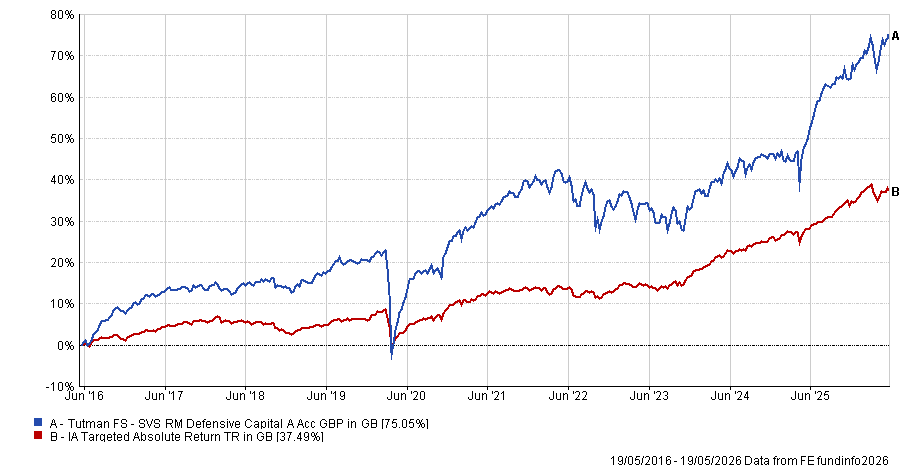
The fund has beaten the IA Targeted Absolute Return sector average return over three, five and 10 years, gaining 71.2% over the decade to the end of April 2026.
Performance of the fund vs the sector over 10yrs
Source: FE Analytics
Admans also turned to other alternatives for investors wanting a slightly more defensive portfolio, such as L&G Global Infrastructure Index.
“Infrastructure can provide differentiated sector exposure, often linked to regulated utilities, energy networks and transport assets, giving the portfolio a more real asset-oriented equity sleeve than Vanguard LifeStrategy 60% Equity’s broad market allocation,” he said.
Admans described the £1.8bn L&G strategy as “simple, transparent and physically replicated, as its appeal is implementation reliability rather than active judgement”.
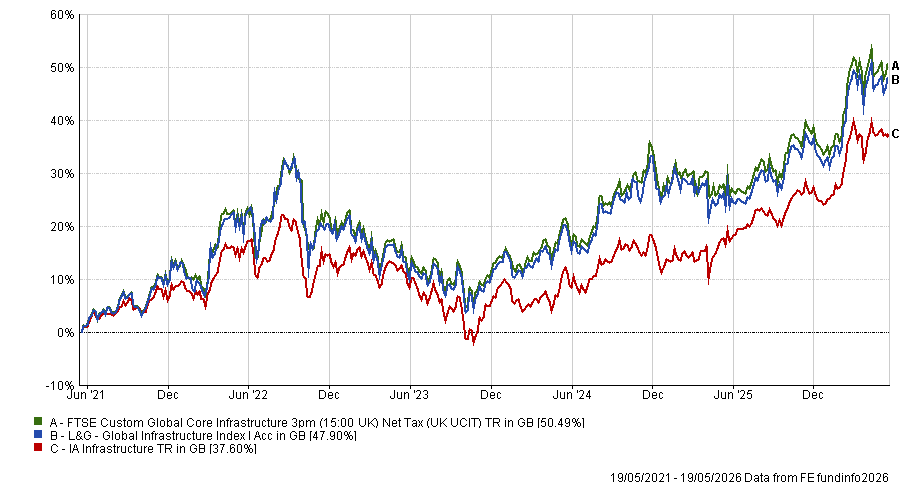
The fund, which posted a 44.7% five-year return to the end of April 2026, has more than half (56%) of its assets invested in utilities, followed by 20% in industrials, 17.7% in energy and 4.1% in real estate. Its top 10 holdings include Nextera Energy, Union Pacific and Enbridge.
Performance of the fund vs sector and benchmark over 5yrs
Source: FE Analytics
Similarly, Darius McDermott, managing director at Chelsea Financial Services, also turned to infrastructure, suggesting M&G Global Listed Infrastructure.
“Vanguard LifeStrategy 60% is a genuinely balanced portfolio but its equity sleeve is passive and market-cap-driven and its bond sleeve heavily weighted towards conventional gilts, and there is no real alternative source of return,” he said.
“Infrastructure assets have low correlation to both equities and bonds and, unlike gilts, real assets tend to be far more resilient to inflation – revenues are often contractually linked to it.”
He said M&G Global Listed Infrastructure, managed by Alex Araujo, takes a broader view of the asset class than most, investing beyond utilities and toll roads into data centres, mobile towers and payment companies, with a target yield of 3-4%.
“It is the kind of diversified, inflation-aware return stream a passive multi-asset fund simply cannot replicate,” McDermott said.
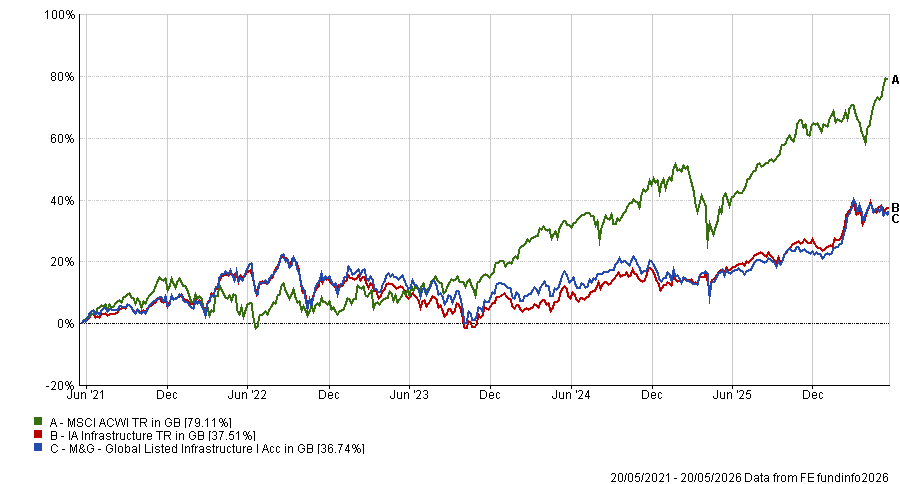
The £369.4m fund usually holds shares in fewer than 50 companies at a time, with current top positions including National Grid and Equinox.
Performance of the fund vs sector and benchmark over 5yrs
Source: FE Analytics
However, for those who want to add to the equity side of their portfolio, Dzmitry Lipski, head of funds research at interactive investor, suggested enhancing it by investing in funds offering exposure to smaller companies, such as Artemis US Smaller Companies and WS Gresham House UK Smaller Companies.
“As a classic balanced 60/40 fund Vanguard LifeStrategy 60% Equity Fund is a strong core holding to hold with satellite strategies,” Lipski said.
“Smaller companies funds can enhance the growth potential and introduce exposure to an area largely underrepresented in the Vanguard fund, as it is biased toward large-cap global indices.”
Artemis US Smaller Companies is co-managed by Cormac Weldon and Olivia Micklem, who take a long-only and dynamic view to small- and mid-cap companies they expect can grow in all market conditions.
Although focused on smaller companies, 37.4% of the £1.4bn fund is invested in companies with a market capitalisation over $20bn, versus just 1.4% in companies with a market cap under $2bn.
It has delivered first-quartile returns in the IA North American Smaller Companies sector over one, three and 10 years, gaining 294.4% over the decade, although it dropped to the second quartile over five years.
For investors looking to domestic small-caps, WS Gresham House UK Smaller Companies has posted strong returns in recent years, despite the overall challenges UK minnows have faced.
Last year, manager Ken Wotton predicted UK-based smaller companies could return more than 30% by the end of 2026.
The fund favours high quality businesses and should perform consistently across the economic cycle. However, although smaller company funds can add more growth and improve portfolio diversification across the market-cap spectrum, they are generally higher risk and more volatile, Lipski warned.
This is part of an ongoing series, following funds to hold alongside Vanguard LifeStrategy 100% Equity and 80%.