






Animal testing is a controversial topic and could be a line in the sand for some investors. This was evidenced by Hargreaves Lansdown’s sustainable investor survey at the end of 2025, which revealed half of its customers are uncomfortable investing in companies conducting animal testing.
However, there is a big distinction between animal testing for medical and non-medical purposes, said Dominic Rowles, lead ESG analyst at Hargreaves Lansdown. The former has led to the production of breakthroughs such as antibiotics, the polio vaccine and the Covid-19 vaccines.
Where investors could have more of a moral issue is when animals are being subjected to tests that are more frivolous, such as the beauty and cosmetics industry.
It is illegal to market or sell cosmetics in the European Union where the final product of any of its ingredients were tested on animals for cosmetic purposes. The UK kept similar rules after Brexit, although testing can occur in limited specialist circumstances.
But not everywhere has the same stringent laws, noted Rowles. In the US, for example, there is no such ban on cosmetic animal testing, although some states have outlawed it.
Meanwhile, in some countries such as China, certain products such as hair dyes or sunscreens can require animal testing before being sold.
This variation across the world means investors who wish to take a stand against animal testing must be selective. Below, Rowles outlines two UK funds that specifically invest with this in mind.
Aegon Ethical Equity
The first is Audrey Ryan’s Aegon Ethical Equity fund, which uses a strict exclusions-based approach and will not invest in companies involved in activities deemed unethical, such as tobacco and alcohol producers, munitions manufacturers and banks with significant exposure to third-world debt.
“Crucially, the fund also avoids companies that provide animal testing services, or that sell animal-tested cosmetics or pharmaceuticals,” said Rowles.
“[Ryan] aims to identify and understand the key environmental, social and governance (ESG) risks of each company, industry and sector she invests in. She believes companies that lead the way in governance and sustainability can outperform over the long run.”
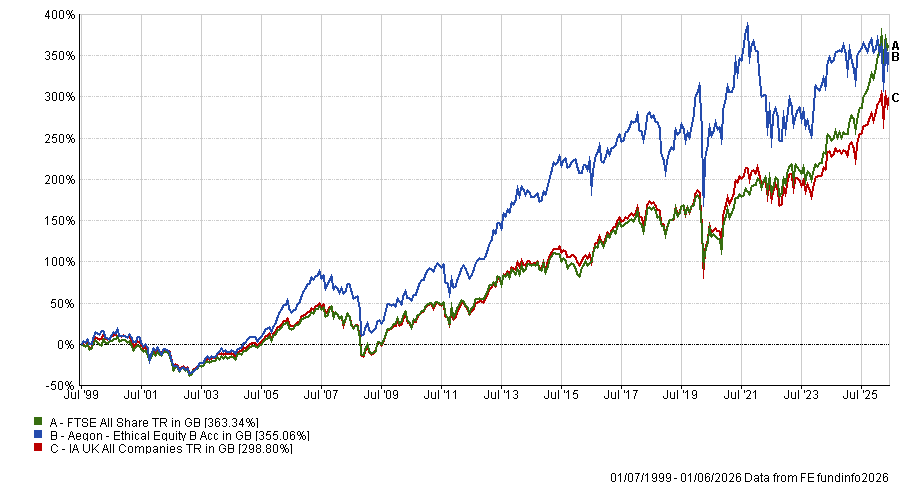
This has not been the case in recent years, with Aegon Ethical Equity a bottom-quartile performer over one, three, five and 10 years.
Performance of fund vs sector and benchmark since start of data
Source: FE Analytics
The fund is just behind the FTSE All Share since July 1999 – the earliest available data on FE Analytics – although it was a long way ahead until recently, when oil and commodity stocks rallied following the outbreak of the US/Israel-Iran war.
As well as animal testing, the fund also applies several other animal-related exclusions, including companies involved in intensive farming, businesses that operate abattoirs or slaughterhouses and stocks that produce or sell meat, poultry, fish, dairy or slaughterhouse by-products.
Janus Henderson UK Responsible Income
For a fund with an income focus, Rowles highlighted Janus Henderson UK Responsible Income, which has been managed by Andrew Jones since January 2012.
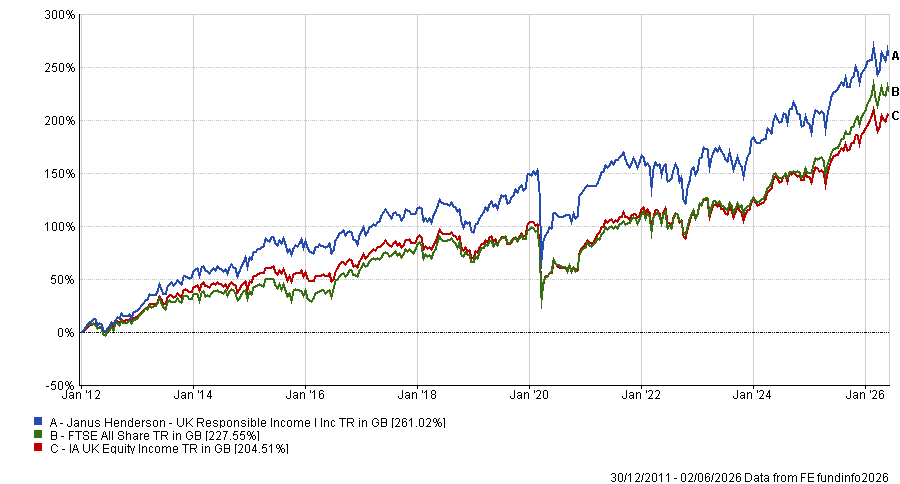
Since he took charge, the fund has made 261%, the ninth-best return of 51 funds in the IA UK Equity Income sector during this time.
Performance of fund vs sector and benchmark since manager start
Source: FE Analytics
“His investment process starts with a screen that excludes companies involved in areas some investors consider unethical. He also excludes companies that aren’t compliant with the UN Global Compact [United Nations principles on human rights, labour, the environment and anti-corruption],” said Rowles.
The fund also does not invest in vitamin, cosmetics, soap or toiletries makers, unless their products and ingredients are not animal tested, but will invest in companies that use animal testing for medical purposes providing they can demonstrate best practice.
To do this, the manager has a set of guiding principles, called the ‘Three Rs’, Rowles noted: refine experiments to ensure suffering is minimised; reduce the number of animals used to a minimum; and replace animals with alternative techniques where possible.