






Technology and cybersecurity funds have made the strongest returns in the 100 days since the start of the Iran conflict, but this came after two distinct phases: energy funds leading during active fighting while AI and semiconductor funds dominated after the ceasefire.
On 28 February 2026, Israel and the US began a series of strikes against Iran, targeting its nuclear and ballistic missile programme. Supreme leader Ali Khamenei was killed in the opening hours of the campaign. Iran responded with missile strikes against Israel, US military bases across the Middle East and civilian infrastructure in neighbouring Arab states.
Iranian attacks also targeted oil infrastructure in the region and effectively closed the Strait of Hormuz, through which 20% of the world's oil passes. On 8 April, the US and Iran agreed to a temporary ceasefire mediated by Pakistan, which US president Donald Trump extended indefinitely on 21 April, although it has been violated by both sides since its declaration.
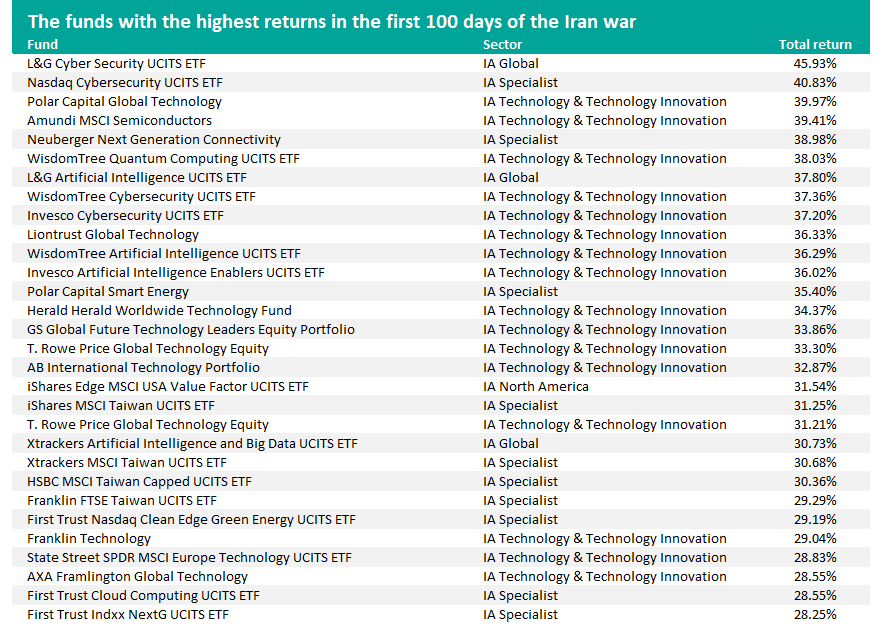
Source: Finxl. Total return in sterling between 28 Feb and 8 Jun 2026
Over the 100 days of the conflict so far (28 February to 8 June 2026), the top performers are almost entirely technology funds: L&G Cyber Security UCITS ETF returned 45.9%, followed by Nasdaq Cybersecurity UCITS ETF (40.8%), Polar Capital Global Technology (40%) and Amundi MSCI Semiconductors (39.4%).
Around 25 of the 30 funds in the full-period top 30 sit within IA Technology & Technology Innovation, IA Specialist or IA Global sectors. Three groups account for most of the list: cybersecurity funds, AI and quantum computing funds, and Taiwan equity funds.
However, the top-30 list for the initial conflict period, spanning 28 February to 8 April, looks nothing like the full-period rankings.
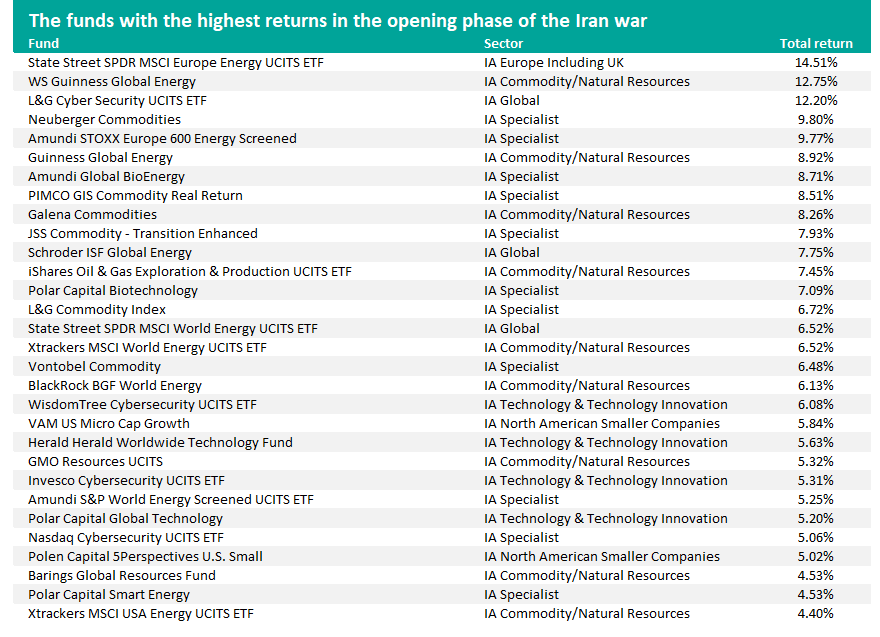
Source: Finxl. Total return in sterling between 28 Feb and 8 Apr 2026
State Street SPDR MSCI Europe Energy returned 14.5% during that period, WS Guinness Global Energy returned 12.8% and multiple commodity funds ranked in the top 30. The Strait of Hormuz's closure caused the oil price to surge past the $100 a barrel mark, benefitting energy funds.
However, the gains did not hold as the oil price came off its highs. State Street SPDR MSCI Europe Energy lost 0.7% after the ceasefire, ranking it 4,783rd across the full Investment Association universe. WS Guinness Global Energy fell 3% (ranking 5,214th) and iShares Oil & Gas Exploration & Production dropped 1.2% (ranking 4,986th).
Most energy and commodity funds that were in the top 30 during the initial phase of the conflict finished the full period ranked between 100th and 900th overall, following post-ceasefire rankings in the thousands.
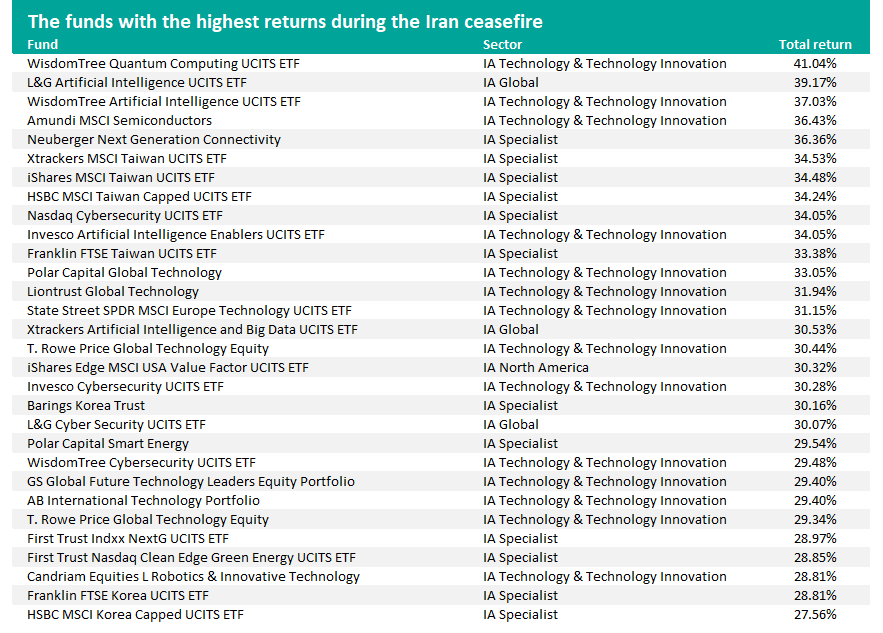
Source: Finxl. Total return in sterling between 8 Apr and 8 Jun 2026.
After 8 April, markets rotated back into AI and semiconductor funds despite the Strait remaining effectively closed.
WisdomTree Quantum Computing UCITS ETF returned 41% in the post-ceasefire period, ranking first. L&G Artificial Intelligence UCITS ETF made 39.2%, ranking second, and WisdomTree Artificial Intelligence UCITS ETF returned 37%, putting it in third place.
During the hot phase, those three funds had ranked 1,996th, 718th and 470th respectively.
Taiwan equity funds saw the sharpest reversal. During the hot phase, four Taiwan ETFs ranked between 2,414th and 3,208th, each posting negative returns, but post-ceasefire, all four ranked between 6th and 11th, with gains of 33.4% to 34.5%.
Fears about disruption to Taiwan's role in semiconductor supply chains drove the initial sell-off but those fears eased once the ceasefire took hold and investors came back to the AI theme that has dominated markets for several years.
Korean equity funds followed a similar pattern. Barings Korea Trust, Franklin FTSE Korea UCITS ETF and HSBC MSCI Korea Capped UCITS ETF ranked 5,219th, 5,335th and 5,342nd during the hot phase.
Samsung and SK Hynix, both central to AI semiconductor supply chains, drove the market's concern. Post-ceasefire, the three funds ranked 19th, 29th and 30th respectively. However, the scale of the first-phase losses kept them out of the overall 100-day top 30, despite post-ceasefire recoveries comparable to the Taiwan funds.
Cybersecurity funds appear across all three lists. When the conflict started, they benefited from concerns about offensive cyber operations by Iran-backed groups. After the ceasefire, they rose again alongside the broader AI trade, as investors focused on the risk of AI-enabled attacks and the infrastructure needed to defend against them.
Iran and Israel exchanged missile and drone strikes on 7 and 8 June, the first such exchange since April. Iran announced it was halting attacks but warned they would resume if Israel carried out further acts of aggression.
The US then launched strikes against Iranian air defence and radar sites on 9 June after Trump said Iran had shot down a US Army Apache helicopter patrolling over the Strait of Hormuz, though Iran suggested the helicopter may have crashed due to an accident. Iran retaliated by attacking US military bases in Bahrain, Kuwait and Jordan, dealing a fresh blow to peace talks that Trump had said were within days of producing a deal.
Nigel Green, chief executive of global financial advisory deVere Group, said: "The danger is not simply another military exchange. It is the emergence of a chronic source of geopolitical and economic uncertainty that repeatedly disrupts markets and reshapes investment decisions.
"The greatest risk may be a confrontation with no clear endpoint, where periods of relative calm are repeatedly interrupted by fresh escalation, and uncertainty becomes part of the backdrop."