






Five multi-asset funds are offering investors a middle ground between low-cost passive exposure and the potential for excess returns from skilled managers by combining low costs with high returns over the past decade, according to Trustnet research.
As part of an ongoing series, we screened Investment Association (IA) sectors for funds that sit in the cheapest decile of actively managed strategies while also ranking in the top decile of their sector for 10-year returns.
Across four multi-asset sectors, investors would have made a higher average return over the assessed decade by investing in the cheapest decile of actively managed funds as opposed to the most expensive.
The most notable difference is in the IA Mixed Investment 40-85% Shares sector, where the average 10-year return for the cheapest decile sat at 131.7%, while the average for the most expensive funds in the sector was 88.6%.
Five funds across the four mixed asset sectors combined cheap costs with top returns – notably, no funds from the IA Mixed Investment 0-35% Shares sector.

Source: FE Analytics
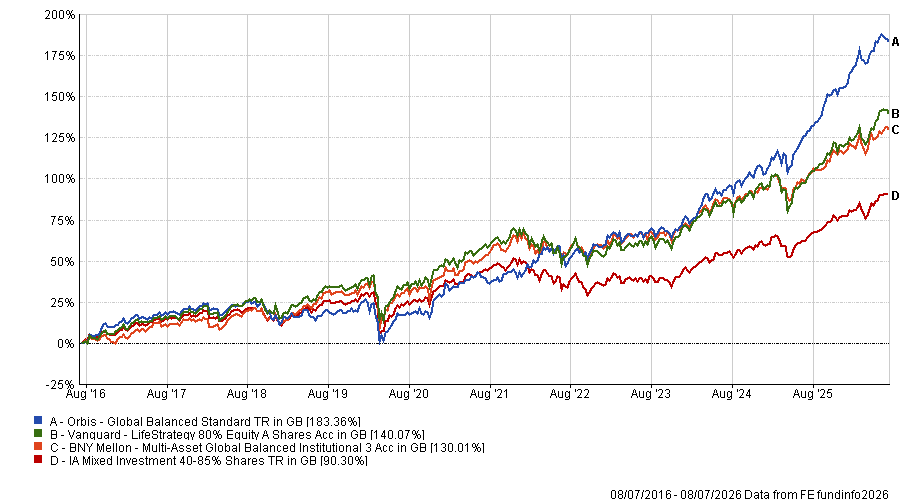
The cheapest active fund with a first decile 10-year return is Orbis Global Balanced, which is co-managed by FE fundinfo Alpha Manager Alec Cutler and Mark Dunley-Owen and has delivered a 221.3% return over 10 years.
It is a strategy that stands out not only for its performance profile but also for its unconventional fee structure, offering an ongoing charges figure (OCF) of 0%.
Unlike other funds, Orbis Global Balanced charges no annual management fee. Instead, the firm is paid only when the fund outperforms, through a performance fee structure that can also refund charges to investors during periods of underperformance.
The £2.4bn strategy also holds an FE fundinfo Crown Rating of five and has been in the top decile for returns over four of the 10 years.
The contrarian nature of Orbis Global Balanced, coupled with a focus on intrinsic value, means the fund is highly active, with bottom-up stock selection that can lead to significant dispersion from peers.
The fund is ‘Elite-rated’ by FundCalibre, whose analysts said the managers “have shown they have the ability to build a bottom-up portfolio of holdings that can perform across a variety of market conditions”.
The portfolio typically holds between 90-140 positions, with the managers accounting for both equity and currency hedging. Positions are held with a three-to-five-year time horizon.
Two other funds in the table are also from the IA Mixed Investment 40-85% Shares sector: BNY Mellon Multi-Asset Global Balanced and Vanguard LifeStrategy 80% Equity.
Performance of the funds vs sector over 10yrs
Source: FE Analytics
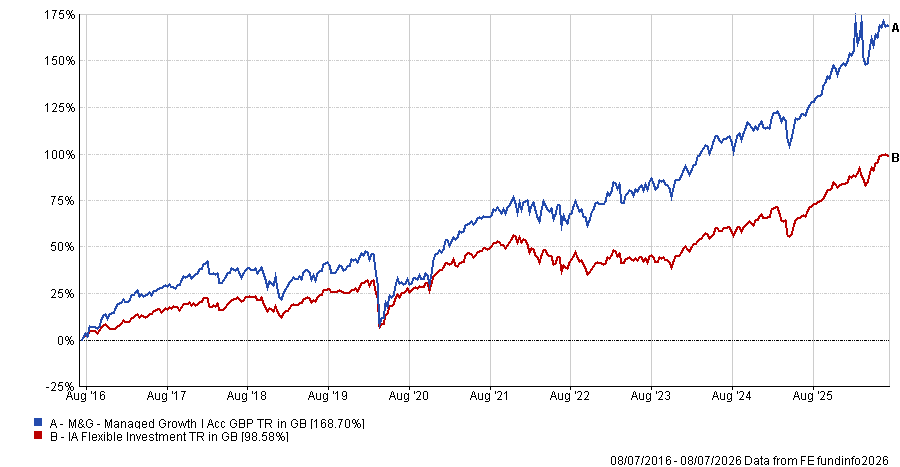
At the opposite end of the table, M&G Managed Growth has the highest OCF of the five funds but is still one of the cheapest in the IA Flexible Investment sector at 0.63%. It also posted the second-strongest return in the table, with a 194.1% gain over the decade.
The £1.2bn fund aims to provide a higher total return – capital growth plus income – than the average sector return over any five-year period.
Managed by Craig Simpson and supported by Tony Finding, the strategy is a fund of funds, with at least 70% of its assets invested in company shares, either directly or via other funds.
Its largest position is the M&G Global Sustain Paris Aligned Fund (10.6%), which targets a higher total return over any five-year period while supporting climate change mitigation by investing in companies contributing to the goals of the Paris Agreement. Other top holdings include M&G Lux Episode Macro Fund (9.3%) and M&G North American Value Fund (9.1%).
Performance of the fund of funds vs sector over 10yrs
Source: FE Analytics
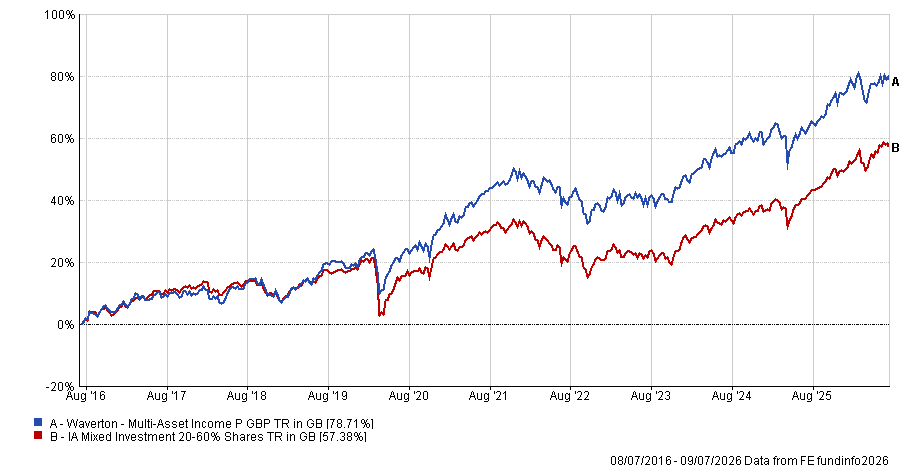
Finally, the only portfolio from the IA Mixed Investment 20-60% Shares sector to meet the criteria is Waverton Multi-Asset Income.
Its 10-year return of 90.8% is notably lower than the other funds in the table, which is likely due to the sector’s lower equity exposure and more cautious positioning.
Managed by James Mee since 2014, the £506m fund aims to achieve three objectives: grow capital in line with or ahead of inflation, pay a consistent level of income and limit capital drawdown in markets.
The strategy has historically maintained a flexible allocation, with around 50% in equities, 20% in bonds and 25% in alternatives, with the remainder held in cash. Top holdings include Amazon, 3i Infrastructure and Shell.
Titan Square Mile analysts said the fund is a “robust option for investors seeking a fund which can deliver a steady natural income as well as capital growth”.
They added: “Whilst the fund has now morphed from its original fund of funds structure, which it followed since launch, to its current approach, which is directly invested, the objectives of the fund have remains consistent. The directly invested nature of the fund means it is competitively priced relative to other actively managed peers.”
Performance of the fund vs sector over 10yrs
Source: FE Analytics