






Consistency is rare in fund management but the funds that have managed it in the IA Global sector over the past three years share a common thread: a conviction in artificial intelligence.
In this Trustnet series, we have been identifying funds that posted top quartile returns consecutively from 2023-2025 and have done so again in the first half of 2026.
Within the IA Global sector, 10 funds have managed the feat, as shown in the table below.
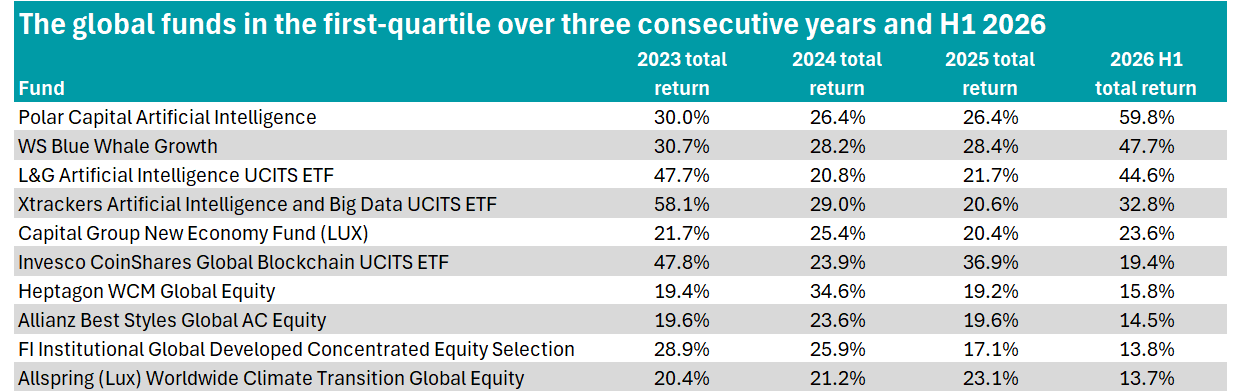
Source: FE Analytics
Of these funds, the strongest performer in the first half of 2026 was Polar Capital Artificial Intelligence, which gained 59.8% over the six-month period.
At $4.1bn, it is a large specialist technology-focused fund. Co-managers Ben Rogoff, Nick Evans and Xuesong Zhao rely on fundamental analysis, supported by a 12-strong specialist team.
Given its focus on AI, 45.1% of the portfolio is allocated to information technology, followed by 23.3% in industrials and 7.1% in materials. The fund has an 80.7% active share and currently holds 68 stocks.
The top position goes to Nvidia at 4.4%, followed by Seagate Technology Holdings at 3.3% and Mitsui Kinzoku at 3%. Alphabet is the only other Magnificent Seven stock in the top 10 alongside Nvidia, with a 2.2% weighting.
Around two-thirds of Polar Capital Artificial Intelligence is invested in mega-cap stocks, with 24.1% in large-caps and just 4.6% in mid-caps.
In May, the managers reflected on the continued strength of technology stocks, driven by accelerating AI-related demand and renewed confidence in sustained capital expenditure.
“The tech-led move higher in broader markets this year has been predominantly driven by earnings as fundamentals continue to improve,” they said, noting that the first quarter reporting season saw a 27% year-on-year earnings growth.
Betting so heavily on AI can prove volatile, however. Indeed, in 2022 – the year before the AI surge really took off – Polar Capital Artificial Intelligence sat in the fourth quartile of the sector, losing 25.1% that year.
While Polar Capital Artificial Intelligence led the table for the first six months of 2026, the WS Blue Whale Growth fund delivered stronger returns in each of the three full years, gaining 30.7%, 28.2% and 28.4% in 2023, 2024 and 2025.
Managed by FE fundinfo Alpha Manager Stephen Yiu, the £2.7bn strategy aims to deliver capital growth over any five-year period through a concentrated, bottom-up stock picking approach.
Nvidia is also this strategy’s largest position, but at a significantly higher 9.9% weighting. The portfolio also includes SK Hynix at 5.5% and TSMC at 5%, reflecting Yiu’s conviction in semiconductor-driven growth.
Last month, Yiu defended investor ambitions to overinvest in AI, despite crowded trades and rising valuations.
RSMR analysts said the fund can be used as a core holding within a global allocation but the position should be sized based on an investor’s risk appetite.
Another fund that has demonstrated consistency is Capital Group New Economy (LUX). It gained at least 20% in each of the three full years and returned 23.6% in the first half of 2026; over the five years to June 2026, it returned 88.9%, underscoring its longer-term consistency.
Managed by a large team, including Matthew Cherian, Richmond Wolf and Tomoko Fortune, the $2bn strategy invests in companies benefiting from innovation, new technologies and evolving global economic trends. It also aims to maintain a carbon footprint at least 30% lower than its index and applies ESG-based negative screening.
The portfolio holds 148 stocks, with technology names again dominating the top 10 – including Micron, Alphabet, TSMC and Microsoft.
Other actively managed funds in the table include Heptagon WCM Global Equity and Allspring (Lux) Worldwide Climate Transition Global Equity.
IA Global Equity Income
Moving into the IA Global Equity Income sector, its more disciplined approach to income generation has driven equivalent consistency, with three funds posting top quartile returns across the three consecutive years and in the first half of 2026.

Source: FE Analytics
Jupiter Merian Global Equity Income logged the strongest return of the funds in the table in 2023 with a 17.4% gain but posted the weakest return for the first half of 2026 at 13.9%.
The small $51.9m strategy is co-managed by Amadeo Alentorn, Yuangao Liu, Matus Mrazik, Sean Storey, James Murray and Tarun Inani. The fund targets a total return greater than the MSCI ACWI index over rolling three-year periods through a systematic process that evaluates companies across several characteristics, including valuation, balance sheet quality, growth prospects, capital efficiency, analyst sentiment and market trends.
Looking at the fund’s longer track record, it was also highlighted for consistency over 10 years, beating the MSCI World index in six of the past 10 years, and as a global equity income fund delivering top-quartile returns over one, three, five and 10 years.
The other two global equity income funds included in the table are Thornburg Equity Income Builder and Allspring (Lux) Worldwide Global Equity Enhanced Income.