






The JOHCM UK Equity Income fund is “under attack” from M&A deals, according to manager James Lowen, who has warned that there could be “not much left” on the domestic market in 10 years’ time if nothing changes.
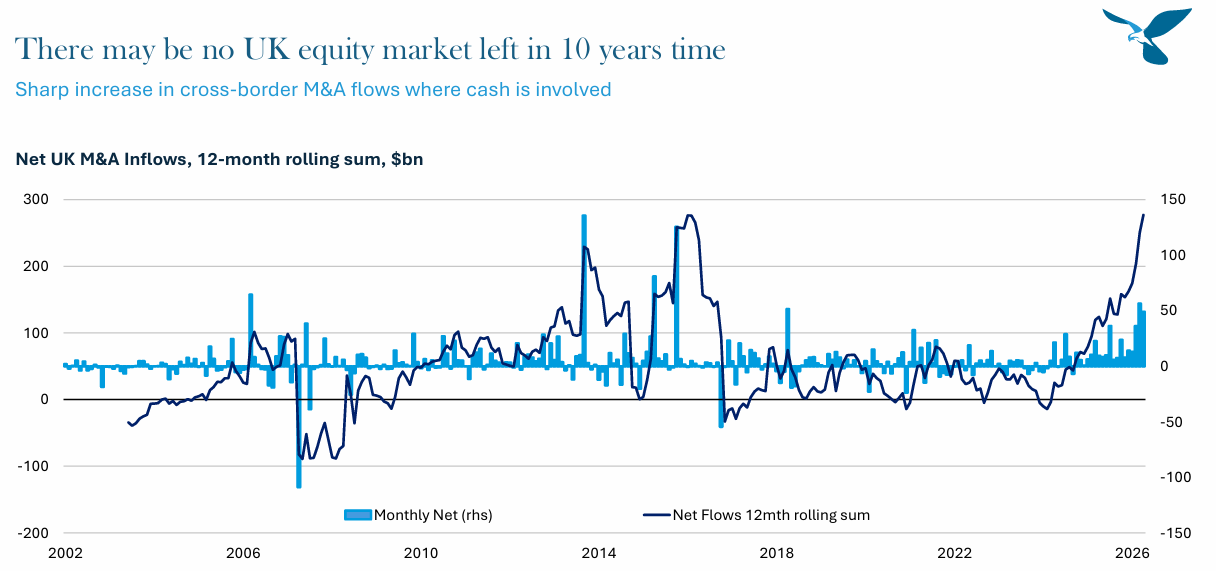
An M&A “frenzy” has taken place in the past 18 months or so, with activity picking up dramatically during this time. The chart below shows the net amount of UK M&A over rolling 12-month periods, with the latest reading at a 25-year high.
Source: JO Hambro Capital Management
JOHCM UK Equity Income has not been immune, watching some of its portfolio holdings leave via takeover, such as Schroders (bought by US asset manager Nuveen) and IPF, which was bought by American specialty finance company BasePoint Capital.
“M&A [activity] was rife in mid- and small-cap, but now it's moved into large-cap,” said Lowen, who said there have been six FTSE 100 bids this year: Segro, Schroders, Beazley, Intertek, DCC and ITV.
“It really is dramatic when you think about it like that. We could end the year with 10, which is 10% of constituents,” he said. “If nothing changes, then there's not going to be much left in 10 years – our fund is under M&A attack.”
The figure rises to seven if including easyJet, which has since dropped to the FTSE 250 but is back hovering around the automatic entry position to be readmitted to the large-cap index at the next rebalance.
“It fell out of the FTSE 100 when the price was £4. The current bid is £6.50 and it looks like shareholders – and hopefully management – will take a £7+ bid. That's a 75% premium,” said Lowen.
This does not include others that have come and gone without success, such as the potential merger of Rio Tinto and Glencore.
“We think that's on ice and will come back because it was so compelling,” said Lowen, who noted that he was disappointed that the talks had ended.
M&A has been one of the fund’s biggest sources of alpha in recent years. The manager has been able to add around 500 basis points of relative performance over the past two years due to takeover activity.
But it does pose a problem, as co-managed Clive Beagles noted last week. Data from AJ Bell showed that the number of potential and confirmed UK takeover approaches across the entire market this year sits at 27, with a combined value of more than $70bn. Nine approaches have been announced in the past month alone.
Beagles said that “while acquisitions deliver short-term premiums, they reinforce a longer-term cycle of decline”.
The reason for this, Lowen explained, is “the London postcode discount”, with companies listed in the UK on much lower valuations than their rivals and therefore inexpensive to buy.
He highlighted three stocks the fund owns: BP, IAG and Standard Chartered. Oil giant BP sits on an 8% free cashflow yield, double that of its US rival Exxon (4%), placing it on a 50% discount to its US peer.
“Put another way: BP would have to double to reach the same valuation as Exxon. That's the degree of difference we're seeing in valuation.”
The example of British Airways owner IAG is even starker. The company sits on a price-to-earnings (P/E) ratio of 5x, some 70% lower than Delta.
“The other thing this shows is absolute valuation. British Airways and Iberia have a dominant market share, over 40%, on transatlantic routes into Latin America and North America, yet IAG is on a P/E of 5x, so it pays for itself in five years. It's ludicrous,” said Lowen.
Banking group Standard Chartered is 40% cheaper than Singaporean equivalent DBS based on the same metric, and a 10x P/E in total.
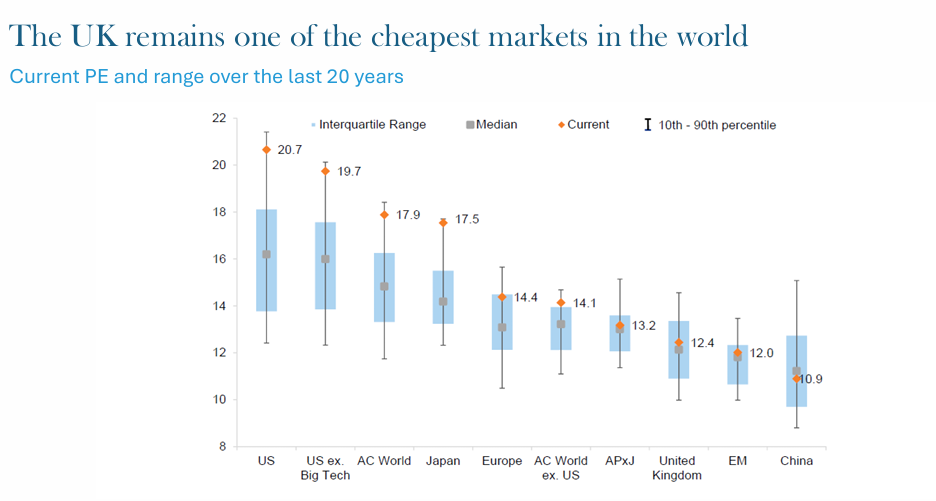
Lowen said there are examples like this across his portfolio due to the unloved nature of UK equities. The UK market is on a P/E of 12.4%, slightly above its historic average but far below the rest of the world, as the below chart shows.
Source: JO Hambro Capital Management
While China and the emerging markets more broadly have become cheaper than the UK, it remains “the cheapest developed market in the world”.
“Strategists who've been around as long as [co-manager] Clive [Beagles] would say the valuation gap is stark – the valuation in the UK is very cheap,” he concluded.