






Investors piled into multi-asset funds in the first half of the year, with Baillie Gifford Monthly Income and Orbis Global Balanced taking in the most new cash.
Some £11.9bn was added to one-stop-shop funds in the first half of the year, a record sum, according to data from Calastone.
The Baillie Gifford and Orbis funds accounted for around £500m each of that total, but it was not good news for all funds, with Baillie Gifford Managed in particular catching the eye as one investors sold out of to start the year.
As part of an ongoing series on fund flows, below Trustnet looks at which mixed-assets unit funds and OEICS attracted the most money in the first half of the year and which shed the most.
Winners
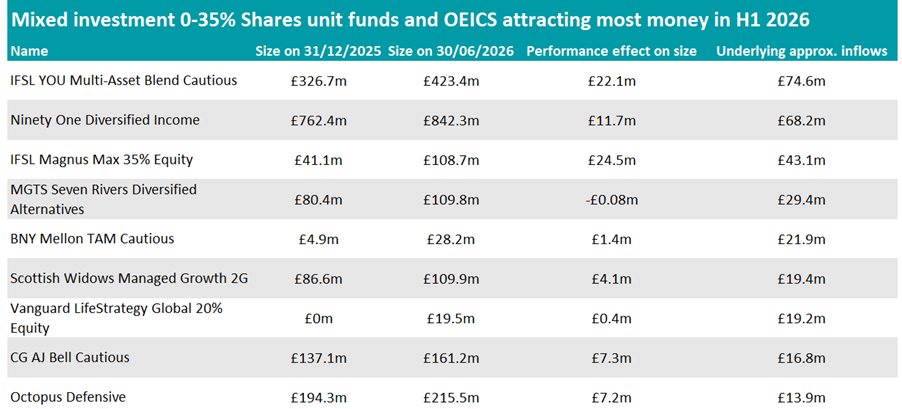
At the lowest level of risk, funds in the IA Mixed Investment 0-35% Shares sector took in the least amount of new money compared to other sectors.
Source: FE Analytics
At £74.6m, IFSL YOU Multi-Asset Blend Cautious came first in the list. It is an actively managed fund targeting capital growth and income over a minimum five-year timeline, with an ongoing charge of 0.96%.
Just below it, the Ninety One Diversified Income fund added £68.2m from inflows. According to FE Investments analysts, this is a “a strong solution to investors with an income target only”.
“Due to its mixed asset – but also defensive – approach, we have been impressed by the capacity of the fund to generate this stream of income, irrespective of the directions of equity and bond markets,” they said. “This is a key differentiator to its peers, which have relied too much on equity markets to generate income and capital returns.”
The recently launched ‘Global’ range of the Vanguard LifeStrategy family, which moves away from the UK bias the original range has, attracted some attention as well, with the 20% Equity version adding about £20m.
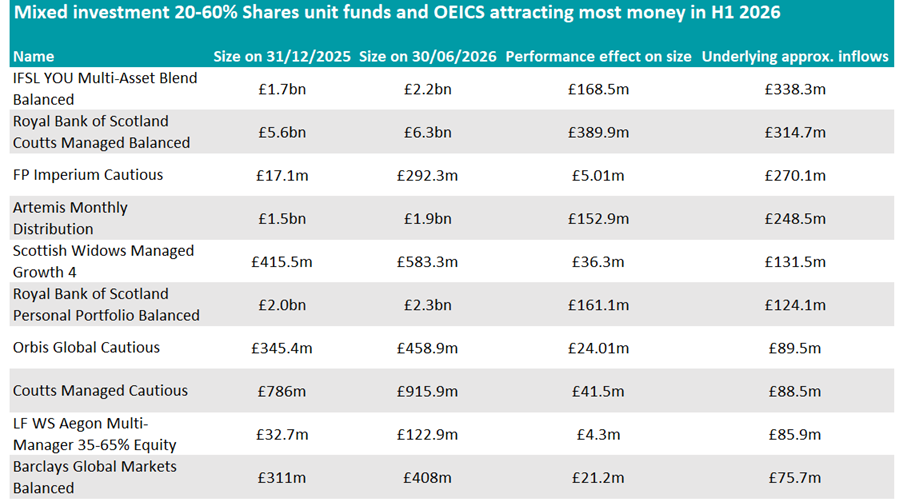
Going up an equity band, IFSL YOU Multi-Asset Blend Balanced topped the list below of funds in the IA Mixed Investment 20-60% Shares sector, adding £338m.
Fund Managers Cormac Nevin and Chris Ayton invest in 37 holdings, with the largest allocations being in fixed income (24%), absolute return strategies (13.9%) and US equities (10.5%).
Their main positive contributors last month were the GSAM Japan Equity Partners fund (up 3.2%), Neuberger Berman US Small Cap Value Fund (up 4.7%) and ClearBridge Global Infrastructure Income Fund (up 2.2%).
Source: FE Analytics
Artemis Monthly Distribution also appeared in the list – it has been a popular choice since last year and it stood out last week in Trustnet’s study on how well the most-bought funds of 2025 did in the first half of this year.
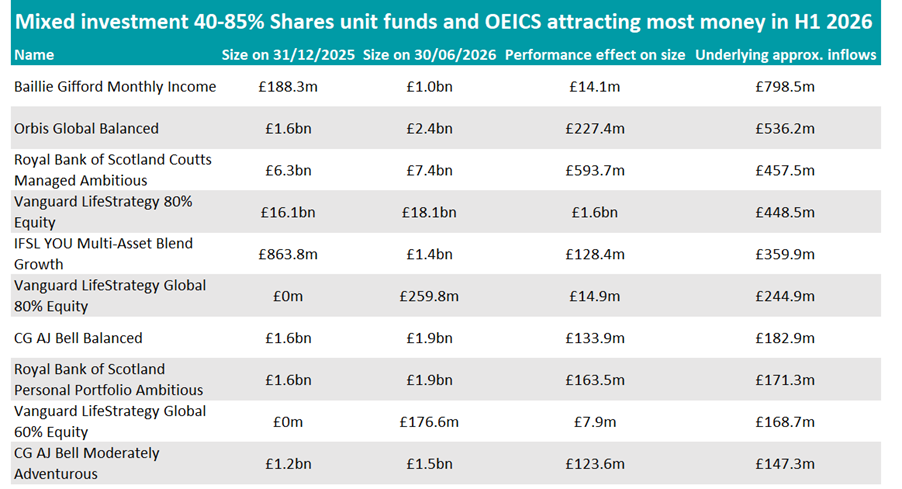
At the 40-85% equity bracket, Baillie Gifford Monthly Income and Orbis Global Balanced, both added more than half a billion.
Source: FE Analytics
Featured on Hargreaves Lansdown's Wealth Shortlist, investors backed the Baillie Gifford fund the most, with £799m in net inflows.
Analysts at the firm noted its focus is on providing a resilient level of income, which means that Baillie Gifford’s growth investment style is less pronounced than in some of the firm’s other multi-asset funds.
“We think this is a good option for diversified exposure to stock and bond markets across the globe, with a focus on income provision,” they said.
The Orbis fund proved popular for the second year in a row, after it was highlighted as one of the most-bought funds of 2025 as well. It returned 11.5% in the first half of 2026 against a 7.6% return for the average peer in the IA Mixed Investment 40-85% Shares sector, as Trustnet recently covered.
It is managed by FE fundinfo Alpha Manager Alec Cutler and Mark Dunley-Owen, who focus on global stocks that trade at a very steep discount to what they are worth, aiming to build concentrated portfolio of best ideas that differs significantly from its benchmark.
According to RSMR analysts, “the firm’s interests are closely aligned with clients” because of the fee structure: Orbis operates under a refundable reserve method, where performance fees are refunded back to clients in periods of underperformance.
Vanguard LifeStrategy 80% Equity, an ever-popular name which attracted £449m in the first half of 2026, grew from £16.1bn to £18.1bn and a further £1.6bn added by performance.
Widely considered a passive choice, the strategy actively allocates to Vanguard trackers, and investors use it as a core allocation which can then be expanded by adding other vehicles alongside it.
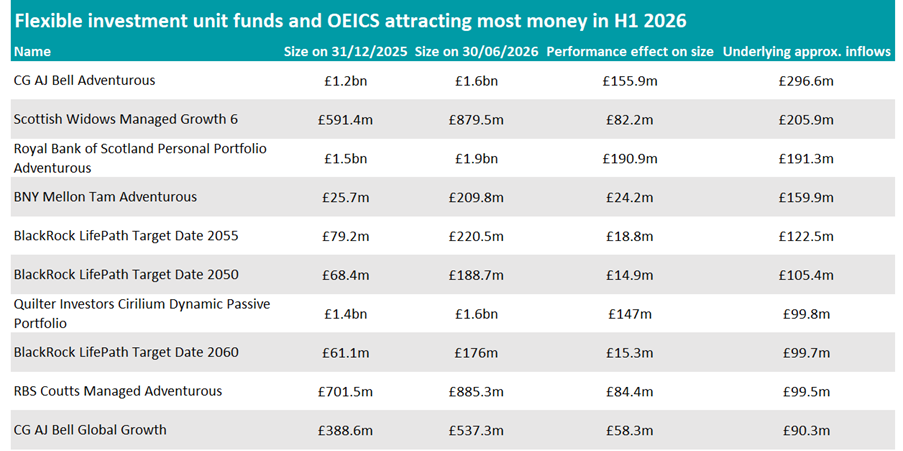
Finally, in the IA Flexible Investment sector, the top places were taken by AJ Bell, Scottish Widows and Royal Bank of Scotland, as illustrated below.
Source: FE Analytics
Losers
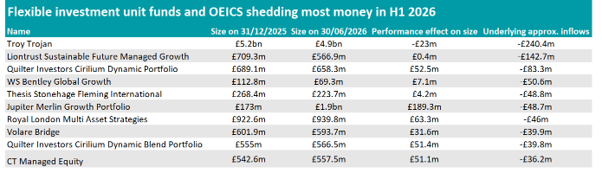
Among the flexible funds suffering the most withdrawals, Troy Asset Management's Trojan stood out, shedding £240m as assets fell from £5.2bn to £4.9bn; performance also detracted a further £23.1m over the period.
Source: FE Analytics
Praised for its simple philosophy, with the potential for long-term growth and a focus on preserving wealth in weaker markets, Trojan features in both Hargreaves Lansdown’s Wealth Shortlist and AJ Bell’s Favourite funds.
Liontrust Sustainable Future Managed Growth came in second, with £143m worth of outflows to June 2026 despite a recommended rating by Titan Square Mile, whose analysts still believe the fund is “a robust option for investors that are looking to grow their capital by investing in companies which are making a positive contribution to the planet and society” and that it “should be able to provide a return ahead of the AI Flexible Investment sector over five rolling years”.
Jupiter Merlin Growth Portfolio and Royal London Multi-Asset Strategies also featured here.
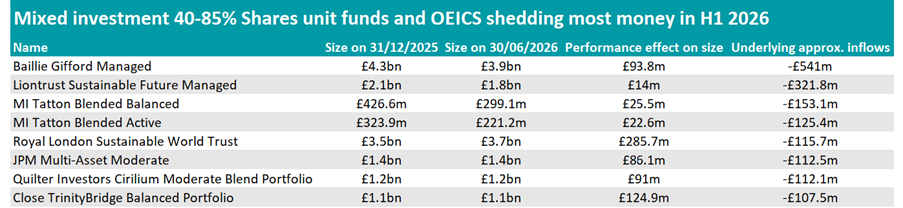
Next up, the most recognisable names suffering outflows within the mixed investment 40-85% Shares sector were Baillie Gifford Managed (-£541m) and Liontrust Sustainable Future Managed (-£321m).
The former, which is also recommended by Hargreaves Lansdown, draws on investment expertise from across Baillie Gifford's equity and fixed income teams and is “a great option for diversified exposure to stock and bond markets across the globe”, Hargreaves analysts said.
While it has a positive absolute and long-term track record, in relation to its Investment Association peer group it has struggled, confined to the fourth quartile of performance over the past five, three, and one years, only rising to the second quartile over a decade.
Source: FE Analytics
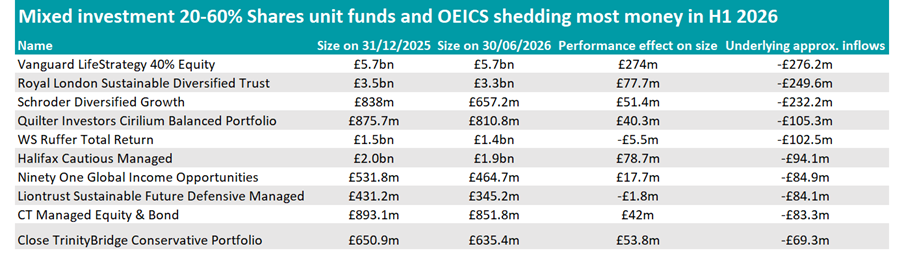
In the IA Mixed Investment 20-60% Shares sector, Vanguard LifeStrategy 40% Equity recorded the largest outflow among well-known names, losing £276m even as a £274m performance gain kept the fund's overall size steady at £5.7bn.
Source: FE Analytics
The Royal London Sustainable Diversified Trust was close behind, as shown in the table above.
RSMR analysts noted that performance over the long term has been good and “testament to the in-depth analysis carried out by the team”.
“Overall, we believe this is a strong proposition, employing a longstanding and proven sustainable investment process with a well-resourced internal team,” they said. “They should be capable of continuing to deliver competitive risk adjusted returns whilst focusing on investments which are helping to make a positive change to society and the environment.”
Schroder Diversified Growth concluded the top three, with Ruffer Total Return also featuring among the sector's outflows.
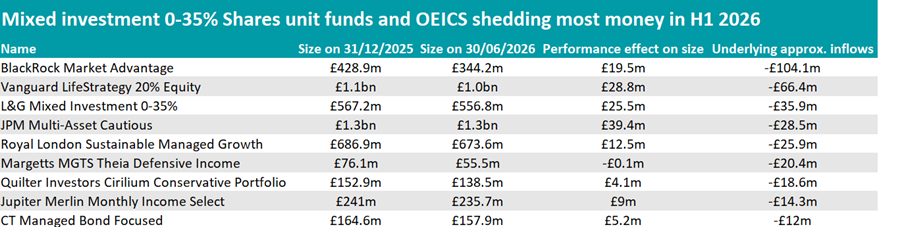
Finally, in the Mixed Investment 0-35% Shares sector, BlackRock Market Advantage lost the most ground.
Source: FE Analytics
Rounding off the list, Vanguard LifeStrategy 20% Equity shed £66m, with assets slipping from £1.1bn to £1bn even as performance added £28.8m.