






Investment companies now account for more than a third of the companies in the FTSE 250, data from Tyndall Investment Management shows, with some 86 trusts situated in the index creating a total market capitalisation of 31.9%.
The figures show the percentage weighting of investment trusts in the FTSE 250 in September of each year. At almost 32%, this is the largest allocation in the past 15 years (all available data) and more than double the 15% a decade ago. Trusts were at their lowest weighting in the index in 2015, at 14%.
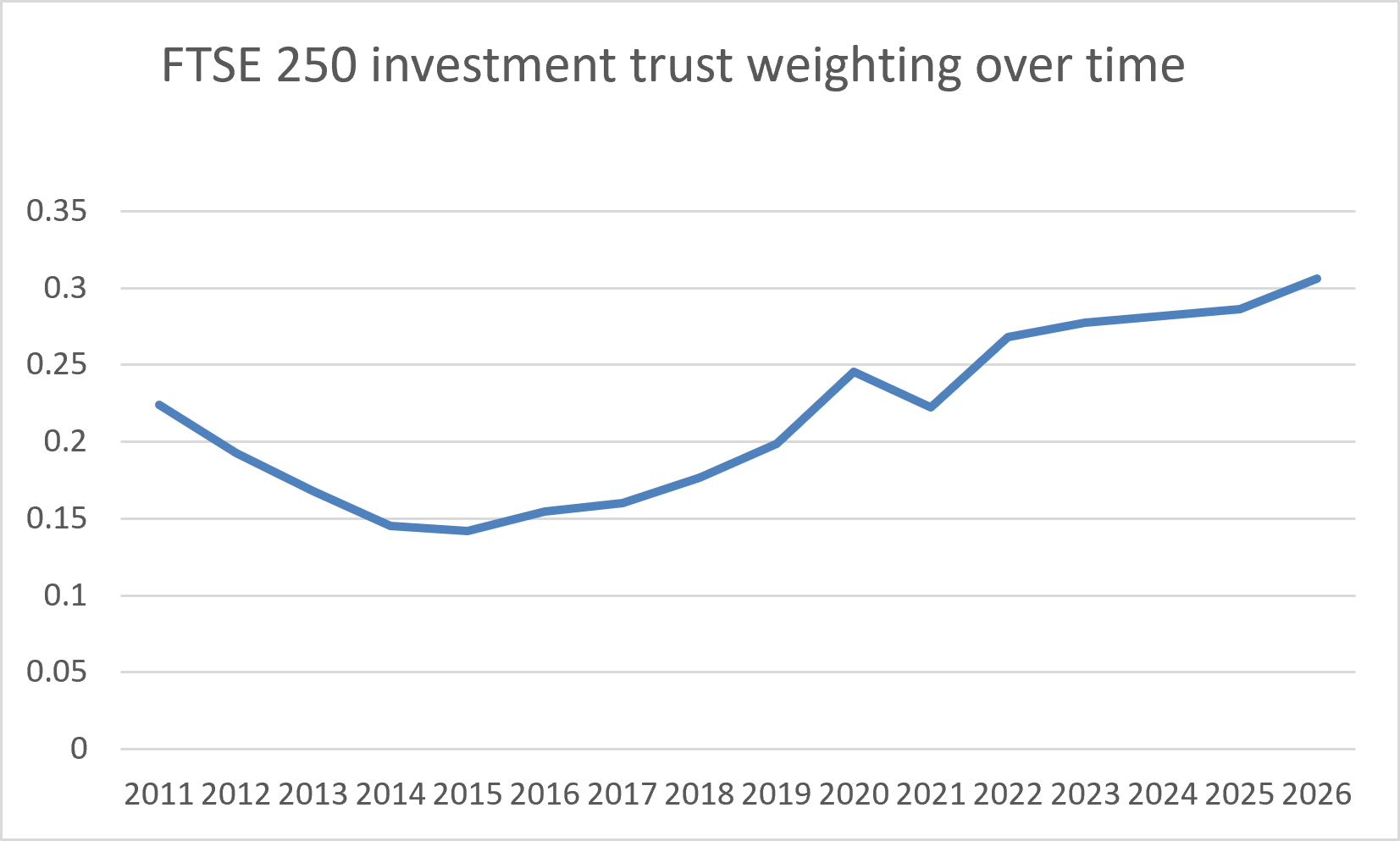
Source: Tyndall Investment Management
Simon Murphy, manager of the VT Tyndall Unconstrained UK Income fund, said the current levels are "relatively high", although noted that the percentage has moved around "quite substantially" since 2011.
There are several reasons for this. For starters, performance has been a big issue.
Gervais Williams, chair of equities at Premier Miton and co-fund manager of the Premier Miton UK Multi Cap Income fund, said large-caps have trounced mid-caps in recent years. Equity-related investment trusts "tend to grow with the market" as they are typically invested in more mainstream stocks and therefore can benefit from one or two large-cap positions.
Adrian Gosden, manager of the Jupiter UK Multi Cap Income fund, added that there are issues around the composition of the index. For example, some investment trusts are in strongly performing areas, such as BlackRock World Mining, which has benefited from the sharp rise in commodity prices.
"There are some significant investment trusts focused on some really high-performing areas," he said, highlighting technology, emerging markets and commodities as "amazing performers".
Mark Ellis, founder and chief investment officer at Nutshell Asset Management, added that the composition of the remaining circa 165 stocks has also been a problem.
"There are very few tech businesses listed here at all. Softcat is the largest technology company left in the FTSE 250 at around £3.7bn. It's closely followed by Rightmove, but there's only 13 companies in the technology sector within mid-caps," he said, adding that Computacenter, previously the biggest name, was promoted to the FTSE 100 earlier this year.
"The problem is that the world is becoming increasingly technology-centric, but it forms a tiny slice of the UK listed market. Information technology is around 2.5% of the FTSE 100 and 2.9% of the FTSE 250," he said, suggesting the index has been left behind by investors as a result.
Alongside performance, mergers and acquisitions have also had a big effect. Guy Anderson, manager of the FTSE 250-listed Mercantile investment trust, noted that over the past year around 10% of the UK mid-cap market has received takeover approaches, with buyers typically willing to pay around 30% above the prevailing share price.
He also said that there has been a "growing number of mergers and acquisitions among investment trusts" which has increased the size of certain vehicles and pushed them into contention for the mid-cap index.
M&A was raised by several managers as an issue for the index. For example, Ellis noted he had owned Alpha Group before it was taken private by Corpay last year.
"That's the pattern playing out across the mid-cap space. Strong UK businesses getting bought out or taken private faster than new ones are coming to market via IPO isn't anything new. EasyJet is another recent example. This is a real concern for the pipeline of future UK large-caps," he said.
Others also highlighted a lack of initial public offerings (IPOs). Murphy said it was a "well-documented" issue that companies are not listing in the UK, either choosing to stay private for longer or looking overseas.
"We are gradually seeing changes to regulation and other aspects to try and improve the competitive position of the UK market for IPOs but we acknowledge that more needs to be done to make the UK a vibrant market for new company listings once more," he said.
Gosden noted that IPOs tend to come from the best-performing sectors at that point in time and said he would expect an influx of defence and financials IPOs going forward.
"Technology would also be an area to look for but the US ratings are too attractive to ignore (i.e. high) so I expect that most would list there rather than London," he said.
Is there hope for a turnaround?
Williams said there are signs that IPOs are picking up, but they are much further down the market capitalisation spectrum in the Aquis stock exchange.
"Further down the market, it's not quite as bleak as it looks. If you look at the AIM market, yes, there've been a lot of companies taken over, some have failed, and so on, but there has also been a number — not a large number — of companies coming to market. So it's not all downhill; there's some uphill too," he said.
"And the Aquis market has had an amazing period of bringing new companies to market. Now, these are tiny companies, but some of those then get relisted on AIM, and some of those, in turn, relist on the main market."
As a result, although the picture "isn't good", he noted that it is not as bad as it looks when focusing on the main market alone.
How to invest in the FTSE 250 today
Fund managers tend not to invest in investment companies, meaning their pool of potential holdings is shrinking. Anderson noted that historically investors have paid a premium for mid-caps, as these stocks have better growth prospects than their large-cap rivals.
"Today, however, many UK mid-cap companies are trading at unusually large discounts compared with their historical valuations," he said.
"Investing successfully requires more than simply finding companies that look cheap. The greatest opportunities often come from identifying high-quality businesses that continue to invest for the future, win market share and strengthen their competitive advantages. We are finding these opportunities across a wide range of sectors, including financials and industrials."
Ellis agreed. He said there are still "quality to be found" in the index, highlighting Games Workshop, Auto Trader, Rightmove and (at the right price) Halma as "genuinely excellent, quality companies".
How to compare mid-cap funds versus the benchmark index
For Ellis, investors should stop using the FTSE 250 as a benchmark and focus on those that exclude investment companies, as this will represent a more accurate comparator.
"Most mid-cap funds don't hold trusts at all, so being measured against a benchmark that increasingly does creates a genuine distortion. In practice, [the FTSE 250] is closer to a FTSE 170. An ex-IT index (FTSE already publishes one) should be the default reference point for judging UK mid-cap stock-pickers, with the full index kept as a secondary, structural reference rather than the primary yardstick," he said.
Murphy said he did not have a particularly strong view but noted it was "definitely something worthy of consideration" given the number and proportion of investment companies currently in the index.
Not all agreed, however. Gosden said he would be wary of "tampering with benchmarks" when there are distortions like we are seeing today.
"I think it is better to understand and explain as you are doing, rather than changing. It can quickly change the other way," he said.