





Semiconductor stocks have driven much of the return in US and global equity portfolios over the past year and there has been little way of avoiding them for Cormac Weldon, manager of Artemis US Select.
Chip designer AMD, fuel cells company Bloom Energy and data storage specialist Seagate accounted for the bulk of his one-year outperformance to the end of June.
But like many, he has been looking for other places to allocate to while selling down the positions that produced those gains.
“We've definitely reduced our weightings in the broad AI complex,” he said. “The fund now holds its lowest weight in the hyperscalers it has had in some time. We don't own Microsoft, for instance.”
That money has funded the fund's new sector trade this year: a move from zero to around 3% in transportation, built around a single stock, JB Hunt.
Below, Weldon explains the process behind that trade, why he passed on house builders and how he decides when to sell.
Performance of fund against index and sector over 5yrs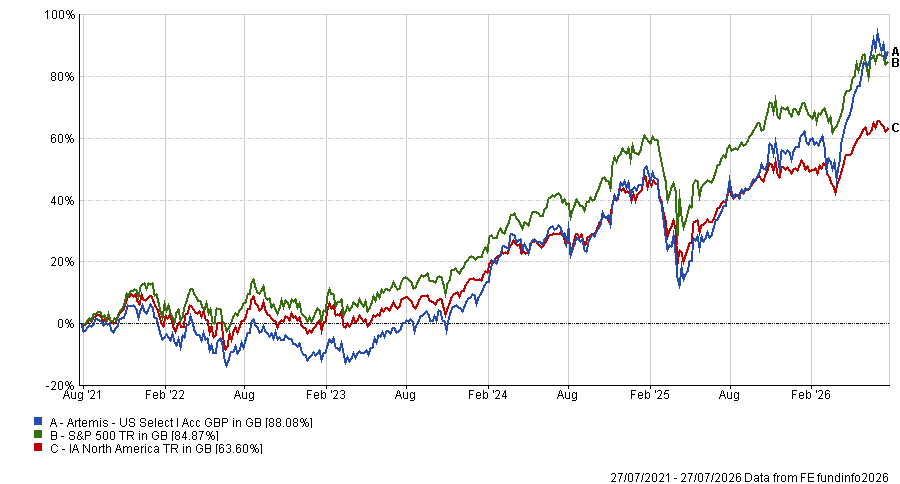
Source: FE Analytics
What is your investment process?
The end point we want to achieve is that we never sit in front of a client and say: ‘It wasn't our type of market, sorry we underperformed’.
It starts at the business level – is this business getting better or worse? We're predisposed to companies where it's getting better, but what we want is for the potential upside to be at least twice the potential downside if we get the stock wrong.
Do you follow any style of investing?
We're style agnostic. We'll analyse the fundamentals of a business and decide whether it offers an asymmetric risk-reward regardless of what box it's supposed to sit in.
We are also macro-aware in the sense of recognising that some things driving a business are purely idiosyncratic – a new drug discovery has almost nothing to do with the economy – while others, like the housing market, are almost entirely a function of interest rates.
We're not making macro calls for their own sake; we're asking whether an economic factor is sustainable enough to actually move the fundamentals of a business we're looking at.
Can you give a recent example of that process at work?
We've recently increased our exposure to transportation. Last year we had the shock over tariffs – companies didn't know what the rate was going to be, so they behaved cautiously.
A year on, we're seeing a pickup in volumes moved by rail and by truck, mostly the recovery from that caution, and the economy is growing nicely. So we've added a trucking stock, JB Hunt.
Most freight moves through brokers, and enforcement is weak, so small operators without proper safety certification win business cheaply but can't pay out when accidents happen.
A Supreme Court ruling decided that brokers also carry liability if they didn't check safety credentials, so they're now much more stringent. That's effectively cutting the supply of truckers. If you're a public company doing things properly, business flows to you. We went from zero exposure to transportation to about 3%.
House builders also seemed to have similar macro tailwinds earlier this year – why didn't you buy?
There was a lot of political noise about housing affordability early in the year and one idea was stopping companies from buying up homes to rent out. That never happened, and we doubted most of the administration's policies would get through Congress anyway. Interest rates weren't low enough and housing wasn't affordable, so we passed.
Then we had the war with Iran and oil went up 40%, which made the case even weaker. We held something close to a home builder in 2023 – Builders First Source, which supplies lumber and doors – but we haven't owned it since early 2024.
Why should investors pick your fund?
We can be up to 5% over- or underweight an individual stock and 10% over- or underweight a sector, so there's plenty of freedom to take a different view to the S&P 500.
Our active share is typically in the 70s. We're not closet indexers – we're happy to be maximum underweight Apple, not own Microsoft, and be overweight something like JB Hunt, which I'm sure almost none of your readers will have heard of.
What were the best and worst calls over the past 12 months?
Our understanding of the beneficiaries of AI spending was the thing we got most right. AMD was our strongest performer, adding around 400 basis points to performance on its own. Bloom Energy added about 270 basis points, and Seagate also contributed.
Thermo Fisher was our weakest holding – we bought in too early, before signs of a post-Covid recovery in life sciences spending began to show through. Its relative contribution to end of June is -0.34 percentage points.
The fund struggled between 2020 and 2022. Was that not your type of market?
There's no excuse for how we did in 2022. We were too accepting of the Fed's narrative that inflation would be transitory and we held portfolios with too many growthy stocks in them, which got punished as rates went up. We didn't go to clients and say it wasn't our type of market – we said we got it wrong.
How disciplined are you about selling?
We run our winners and cut our losers early. We have data showing that when we sell something we've lost money on, it continues to underperform after we exit.
The same is true of our winners – when we sell something that's done well for the portfolio, it also underperforms the market afterwards. That balance, thinking about risk and reward and acting on it rather than hanging on, is central to the process.
What do you do outside of fund management?
I live in London, one of the greatest cities in the world for art, theatre and music – so whenever I can get out for some cultural stimulation away from the markets, that's mostly what I do. And we support Ireland in whatever they're playing. There's not much upside and a lot of downside in that.