






It is never too late to start investing, but knowing where to begin can be daunting. There are myriad questions to answer, from risk tolerance to how long the money will be left alone for.
As such, Trustnet asked fund-pickers to highlight options that would fit in any portfolio – from the 20-year-old just starting out through to those approaching retirement.
The passive plays
Perhaps the most common advice for new investors is to pick a passive equity fund. These track the market and give broad exposure to stocks from around the world.
Dan Caps, investment manager and passives specialist at wealth manager Evelyn Partners, called these funds the "cornerstone" of many investors' and pension-holders' portfolios.
Cheap global trackers have performed well since the financial crisis and, despite a few wobbles from during Covid and more recently due to geopolitical issues caused by US president Donald Trump, performance remains strong in shorter timeframes too.
"Global equities in general have provided returns significantly above inflation, driven higher in large part by the dynamo of the US market," he said.
Whether using an index fund or an exchange-traded fund (ETF), passive options are a "highly effective way for DIY investors to gain exposure to a diversified basket of thousands of worldwide equities at very low cost", he said.
However, this currently comes with the caveat that these portfolios have become increasingly concentrated towards a handful of US mega-cap technology giants.
"This means there is a risk that any major reversal in the optimism and massive earnings expectations around AI could see very rapid drawbacks in global trackers, as they are dragged down by a US correction," he noted.
Still, passives remain Caps' favoured way for new investors to get started, with the UBS Core MSCI World UCITS ETF a good option. With an ongoing charges figure (OCF) of just 0.06%, it is one of the cheapest funds available focusing on developed markets only.
Amundi Prime All Country World UCITS ETF, with an OCF of 0.07%, is his preferred option for both developed and emerging markets.
For Eleanor Ingilby, head of high net worth at Atomos, L&G WTW Global Equity Diversified UCITS ETF is another that fits the bill.
"If you wanted to get engagement with the market and you're looking to start investing, I would recommend [this fund] because it has, built into it, US dollar hedging," she said.
"That's one of our outlooks: we like US equities, but we're less keen on the US dollar. So that's the core one I would start with, just to get that access to the market, get things up and running, but also some protection against the dollar dropping further."
The active option
Darius McDermott, managing director at FundCalibre, also suggested investors should be looking to start with a globally diversified pool of equities, but chose to go for an active option.
"Anchoring your portfolio in global equities, an asset class that has been one of history's great wealth creators, gives you broad diversification from day one," he said.
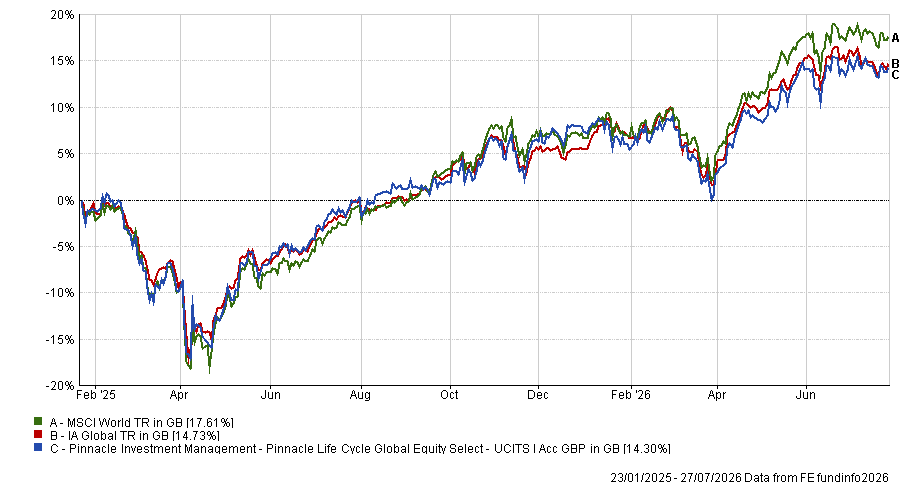
His selection was Pinnacle Life Cycle Global Equity Select, which he noted isn't tied to one style or theme, giving it the flexibility to adapt to a fast-changing world.
Performance of fund vs sector and benchmark since launch
Source: FE Analytics
Launched last year by former Royal London fund managers Peter Rutter, Will Kenney and James Clarke, they will own any type of business, from fast-growing start-ups to deep-value recovery plays.
They categorise companies by where they sit in their business cycle and apply different criteria to each, culminating in a high-conviction portfolio of 25 to 45 stocks.
"The fund therefore has a core, all-weather feel and the team's unique strategy has a long track record of performing consistently over time. It's a great all-rounder for a first fund," said McDermott.
Trust this trust
However, the most-backed option for new investors was RIT Capital Partners, which was highlighted by both Quilter Cheviot head of investment fund research Matt Ennion and Charles Stanley Direct chief investment analyst Rob Morgan, who said while a global tracker is one option, for those who want greater diversification and less volatility a multi-asset approach is more appropriate.
This trust invests across a range of asset classes, combining direct equity positions with allocations to external managers across public and private markets, as well as uncorrelated strategies, liquidity funds and a currency bucket.
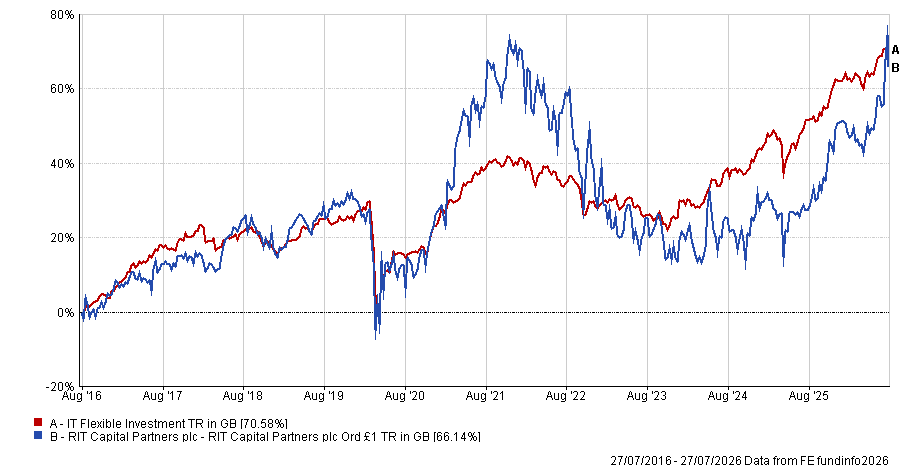
"With multiple drivers of performance, it could work well as a core holding in a variety of market conditions," said Morgan, who noted that the fund has "been through a more difficult period" in recent years but appears to have come through the other side.
Performance of fund vs sector over 10yrs
Source: FE Analytics
Ennion highlighted the team at J Rothschild Capital Management who run the trust, noting RIT Capital has a "rich history and excellent long-term record of delivering equity-like returns with lower volatility".
"RIT utilises its large team of specialists and reputation to access fund managers that are hard to access to implement its strategy. This has proven especially successful in allocating structural themes and accessing private companies," he said.
"The diversified nature of the portfolio and strong risk-adjusted returns it has delivered make it an excellent starting investment for an individual with a long-term horizon."
Morgan added that its shares currently trade on a 20% discount to the underlying net asset value (NAV) of the portfolio, which has impeded returns but could be a boost in the future should the gap narrow.
"A return to form in terms of performance alongside concerted measures to close the discount through tender offers to shareholders stands to win over more investors, reinstating the trust as an attractive proposition in the multi-asset space," he said.