






Technology companies are spearheading the biggest disruption seen in decades, leading to just a handful of them making up most of the top 10 stocks in global equity indices.
Alison Porter, manager of the £2.1bn Janus Henderson Global Technology Leaders fund, expects the disruption to go much further than it already has.
The addressable market for technology is much larger than people estimate and disruption is coming to areas of the market once viewed as "consumer staple-like": a specialist manager can guide investors through it, with Porter saying the aim was to provide "compounding opportunity over time without some of the big drawdowns that you've seen in some other funds".
Janus Henderson Global Technology Leaders has beaten its average IA Technology and Technology Innovation peer over the past three, five and 10 years and holds a maximum FE fundinfo Crown rating of five.
Performance of fund against sector and benchmark over 5yrs
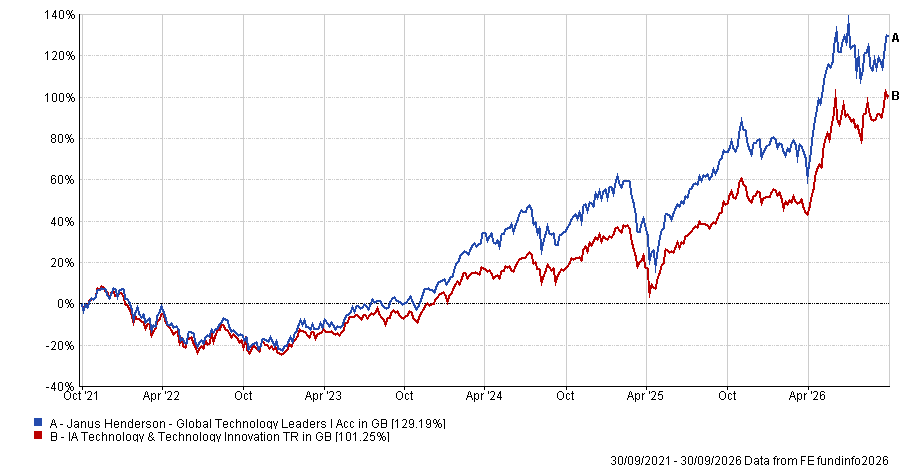
Source: FE Analytics
Below, Porter explains how she picks stocks as that disruption plays out, along with her best and worst calls of the past year.
What's the philosophy behind Janus Henderson Global Technology Leaders?
Looking back over the last 20 years, technology has provided investors with positive returns over 80% of the time, but you want to be able to try and mitigate the downside and the volatility.
The key to that is to be able to navigate the hype cycles that tend to come with technology. Opportunities for innovation and disruption tend to get overhyped in the short term and underestimated in the long term.
How do you apply these principles at portfolio level?
It comes down to kind of experienced stock pickers focusing on underappreciated earnings power. Finding large addressable markets with room to grow, companies that have a new product cycle… because technology's always changing.
A real differentiator versus many of our peers is our focus on valuation discipline. We look for companies where the valuation doesn't reflect the power of earnings, nor the sustainability of growth.
How do you find underappreciated opportunities in an efficient market?
Sometimes that can be an underappreciation of the earnings power. We look at our modelling, we look at our assumptions and we look at the earnings power that consensus has and we think it's underappreciated.
Other times it can be that the earnings growth sustainability is not being reflected in the multiple that's being paid for that company. And we have a saying that PEs [the price-to-earnings ratio] tend to be an opinion and not a fact.
How is that?
A huge example of that in recent years has been Nvidia, which we've owned historically, but we bought that back in January of 2022. At that time, people thought the earnings estimates for 2028 would be under $2.
As we sit here in 2026, for 2028, people expect that they're going to earn over $16, and we expect more than that as well.
Why should investors pick your fund?
When you look at the performance of Global Technology Leaders over the last five years versus, for example, the NASDAQ 100, or even versus some of these narrow thematic ETFs that are launched, generally it's performed better.
If you're owning in areas that you might think are very good, strong thematics in the long term, that doesn't mean to say that they are going to be able to deliver on profitability and underappreciated earnings growth if they don't have what we call a ‘right to win’. Cybersecurity's a great example, where a Microsoft or an Alphabet give away much of their software security for free.
How's the portfolio positioned right now?
Over half of the portfolio is in the semiconductor and physical infrastructure layer of AI. That has been as high as over 70%.
Then there's a significant portion in the platform layer and the least is in the software and application layer.
We're really trying to pick out the best of the large-cap names and broaden out based on that formula of finding growth, ‘right to win’ and product innovation.
What were the best calls over the past 12 to 18 months?
Nvidia contributed 7.6 percentage points over 18 months. Since we purchased it in 2022, the stock is up over seven-fold. That's clearly been the biggest contributor to our portfolio.
[Chip manufacturer] Micron added 10 percentage points over 18 months and was the single largest contributor to our performance over the last year.
[Contract manufacturing company] Flex and [machine vision name] Cognex equally added between half a percent to one and a half percent to performance. Physical infrastructure has been the single largest contributor to the performance.
Palo Alto, which is a cybersecurity play, also contributed significantly.
And the worst?
Meta (about 90 basis points detractor over 18 months) and Microsoft have been very additive to the performance of the fund over the last 10 years, but over the last year, they've accelerated capex. The platform layer has been a drag on the relative performance of the fund.
Other names which have dragged have included Netflix, which took about 1% off the performance. Again, a company that we owned for the long term, we sold out about three months ago.
It attempted to make the acquisition of Warner Bros and price that they were willing to pay in that period helped us understand the competitive dynamic was changing, with some of their competitors consolidating and with YouTube enhancing its position.
On cybersecurity, a name we sold out of quite early was [cloud security company] Zscaler (-65 basis points over 18 months). We felt margins were going to be under pressure as we saw some of their peers consolidate. So whilst we benefited on Palo Alto and cybersecurity there, that was time for us to exit Zscaler.
What do you do outside of fund management?
I watch a lot of field hockey because my daughter plays in that. My son's at university and plays football but it's too embarrassing for his mom to come and watch now.
I'm also a big football fan as well. I have a season ticket, so I go along there too.