






US treasury yields have surged to their highest level since the global financial crisis but a small number of bond funds have avoided the losses by taking a different approach to the asset class, Trustnet research shows.
Bond markets have had a rough few months. The US 10-year treasury yield reached 5.33% on 30 September, its highest level since 2002, as investors reacted to resilient economic data, a robust labour market and the Federal Reserve's first interest rate rise in three years.
With bonds selling off, Trustnet finds out which fixed income funds have made the highest returns since US treasury yields started climbing higher at the end of June.
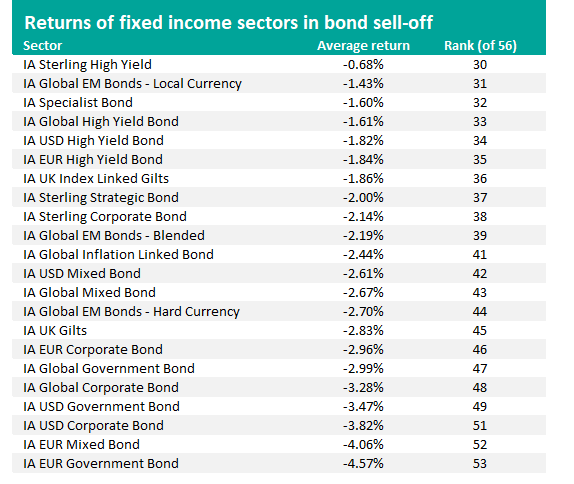
Source: Finxl. Average return in sterling between 29 Jun and 29 Sep 2026
Every fixed income fund sector has made a loss, on average, since the US treasury yield started rising. IA EUR Government Bond has come off worse, with an average loss of 4.6%, followed by IA EUR Mixed Bond (down 4.1%) and IA USD Corporate Bond (3.8%).
These three sectors are towards the bottom of the Investment Association universe, beating only the IA Listed Property, IA North American Smaller Companies and IA Infrastructure peer groups.
The best-performing fixed income sector has been IA Sterling High Yield, where the average fund has lost just 0.7%; this ranks it 30th of 56 peer groups. IA Global EM Bonds - Local Currency is 31st place with a 1.4% fall, followed by IA Specialist Bond’s average loss of 1.6%.
Some fixed income funds have made positive returns in the sell-off, however. Of the 1,100 funds in the Investment Association universe that focus on bonds, just 68 – or 6.2% – have made a positive return since 29 June.
However, not many of the funds that avoided losses focus on conventional, fixed-coupon government or corporate bonds. Nearly all take on either currency and geographic diversification, a floating-rate or short-duration structure, illiquidity or an equity-linked or otherwise uncorrelated pay-off, which have allowed them to mitigate the interest rate risk that hit the rest of the fixed income universe.
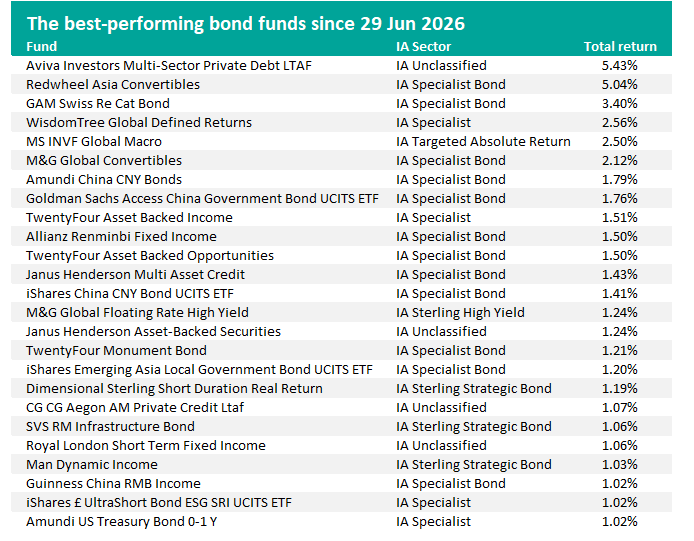
Source: Finxl. Total return in sterling between 29 Jun and 29 Sep 2026
Aviva Investors Multi-Sector Private Debt LTAF is the fixed income fund with the highest return over the three months under consideration, making 5.4%. As its name suggests, the fund invests across private debt sectors including infrastructure debt, real estate debt, private corporate debt and structured finance.
CG Aegon AM Private Credit LTAF is also among the highest-returning bond funds, although it is up just 1.1%. Both funds reside in the IA Unclassified sector, so comparisons with peers are not relevant.
Long-Term Asset Funds like these price less frequently and less directly against public market yields, which insulates their returns from the daily moves affecting listed bonds. They are also primarily aimed at institutional investors such as DC pension funds looking to diversify returns from traditional asset classes.
Redwheel Asia Convertibles is the second-best bond fund since US treasury yields started to climb, making a total return of just over 5%. M&G Global Convertibles is in sixth place, rising 2.1%.
Convertible bonds are corporate bonds that give the holder the option to convert them into a set number of shares in the issuing company, usually at a specified price and by a specified date. They therefore carry two separate return drivers: a fixed income component sensitive to interest rates and an embedded option linked to the issuer's share price.
Rising treasury yields will have weighed on the bond component, in the same way they have hit conventional fixed income. But equity markets have stayed resilient over the same period, with strength concentrated in sectors such as AI and semiconductors, lifting the value of the conversion option.
Convertible bonds also tend to carry shorter duration than government bonds, which reduces their sensitivity to rate rises. This mix of equity participation and lower duration explains why they have held up better than most other fixed income sectors during the sell-off.
GAM Swiss Re Cat Bond invests in catastrophe bonds, where returns depend on insurance losses rather than interest rates. It is in third place with a 3.4% total return.
Three funds with flexible, unconstrained mandates have also been successful in tackling challenging fixed income markets over the past three months: MS INVF Global Macro (up 2.5%), Janus Henderson Multi Asset Credit (up 1.4%) and Man Dynamic Income (up 1%).
Five funds that invest in floating rate or securitised credit have also done well: TwentyFour Asset Backed Income, TwentyFour Asset Backed Opportunities, TwentyFour Monument Bond, Janus Henderson Asset-Backed Securities and M&G Global Floating Rate High Yield.
Floating rate bonds pay a coupon that resets periodically in line with short-term interest rates, rather than staying fixed for the life of the bond. This means their prices barely move when yields rise, unlike conventional bonds, whose fixed coupons become less attractive as rates climb and whose prices fall as a result.
Asset-backed bonds are also secured against a pool of underlying loans, such as mortgages or auto loans, rather than a company's general credit. This gives them a different risk profile from conventional corporate or government debt, one that depends more on the performance of the underlying loans than on interest rate moves.
Amundi US Treasury Bond 0-1Y, iShares £ UltraShort Bond ESG SRI UCITS ETF, Dimensional Sterling Short Duration Real Return and Royal London Short Term Fixed Income are examples of fixed income funds with short duration strategies. Short maturities limit the price impact of rising yields.
China and Asia local currency bonds are the largest theme, with six funds in the top 25 – Amundi China CNY Bonds, Goldman Sachs Access China Government Bond UCITS ETF, Allianz Renminbi Fixed Income, iShares China CNY Bond UCITS ETF, Guinness China RMB Income and iShares Emerging Asia Local Government Bond UCITS ETF – fitting this theme.
China's bond market has moved on a different cycle from the US treasury sell-off, with domestic monetary policy in Beijing pulling in a different direction from the Federal Reserve's. The yield on the Chinese 10-year government bond has fallen since June.