






Quality investing is typically defined as buying companies with strong, reliable earnings, healthy balance sheets and durable competitive advantages that set them up to outperform over the long term.
But the investment style has struggled in the 2020s. In the wake of the Covid-19 pandemic, the subsequent sharp rise in inflation and interest rates that followed compressed the valuations of quality stocks.
They have struggled to recover since, as investors have focused on ends of an extreme market either by chasing the explosive momentum and growth of AI-driven tech names or turning to cheap value stocks to navigate ongoing volatility.
This has left some high-profile quality-growth funds out in the cold, such as Fundsmith Equity, which has languished in the bottom quartile of the IA Global sector over one, three and five years.
Yet the characteristics of quality stocks are traits that have historically rewarded patient investors over the long run. As such, Trustnet asked fund selectors which quality-focused funds and trusts they would back.
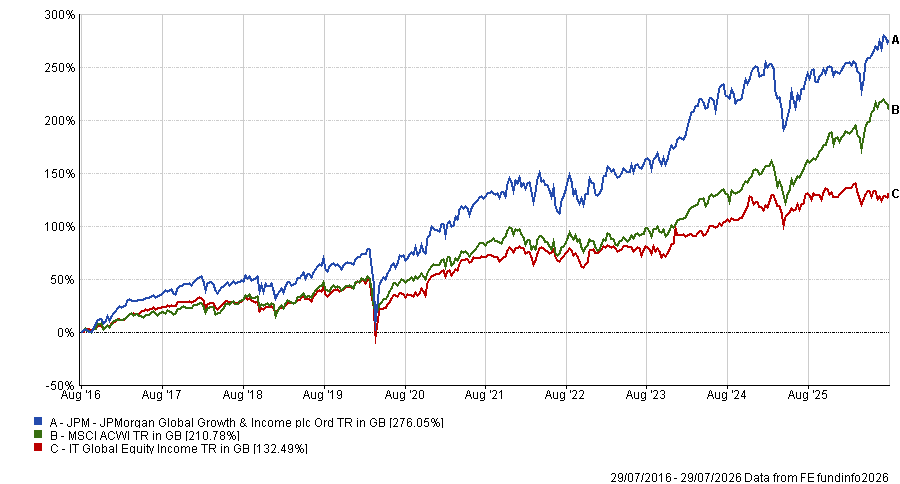
Starting with investment trusts, Emma Bird, head of investment trusts research at Winterflood, suggested JPMorgan Global Growth & Income.
The management team classifies all potential investments as either premium, quality, standard or challenged, with the top two categories having the lowest predicted likelihood of earnings revisions – together accounting for 75% of the portfolio as at 31 March 2026.
“The unconstrained nature of the investment approach is enabled by the fund’s enhanced dividend policy, which aims to pay an annual dividend equivalent to at least 4% of the prior financial year-end net asset value (NAV), partially funded by capital reserves,” Bird explained.
The trust is targeting a dividend of 24.8p per share for the financial year to 30 June 2027 – representing a prospective dividend yield of 4.1% on the share price as at 15 July, she added.
Bird acknowledged the trust’s recent period of underperformance – it was in the fourth quartile for returns in the IT Global Equity Income sector in 2025, gaining 1.9% – but argued that its “disciplined investment process has proven robust over time”.
Indeed, the trust is in the first quartile for its 10-year return to the end of June 2026, gaining 326.8%. Shares currently trade at a 1.7% discount to NAV.
Performance of the trust vs sector and benchmark over 10yrs
Source: FE Analytics
Alex Trett, research analyst at Winterflood, then highlighted Schroder Asian Total Return, noting that it “offers a compelling approach to quality investing in Asia-Pacific”.
Co-managers Robin Parbrook and King Fuei Lee invest across the region on an unconstrained, index-agnostic basis, identifying companies with durable competitive advantages and resilient earnings streams trading below their assessment of fair value.
“A distinguishing feature of the strategy is its use of derivatives to manage market and country exposures, enabling the managers to express their philosophy as well as isolate stock selection and highest conviction ideas without taking unintended macro or thematic risks,” Trett said.
He noted that such flexibility is important in a region where volatility can often dominate short-term returns.
A proposed merger with Pacific Assets Trust, announced in June, should be beneficial for shareholders of both vehicles, Trett added.
Turning away from investment trusts, Rob Morgan, chief analyst at Charles Stanley, picked BlackRock Global Unconstrained Equity – a high-conviction global fund seeking high-quality, durable growth companies. Valuation is a secondary consideration versus these attributes.
“Few managers are empowered to invest with this level of conviction,” said Morgan of lead manager Alistair Hibbert, who has built a strong record across unconstrained global and European equity mandates.
The manager is prepared to shun entire sectors if they don’t offer stocks that fit in with the overarching philosophy, he added.
Given the fund’s extremely concentrated nature, Morgan warned that it is “not for the faint hearted” but is capable of very strong long-term returns – albeit likely a bumpy ride along the way. The fund logged a second-quartile five-year return to the end of June 2026, gaining 70.7%.
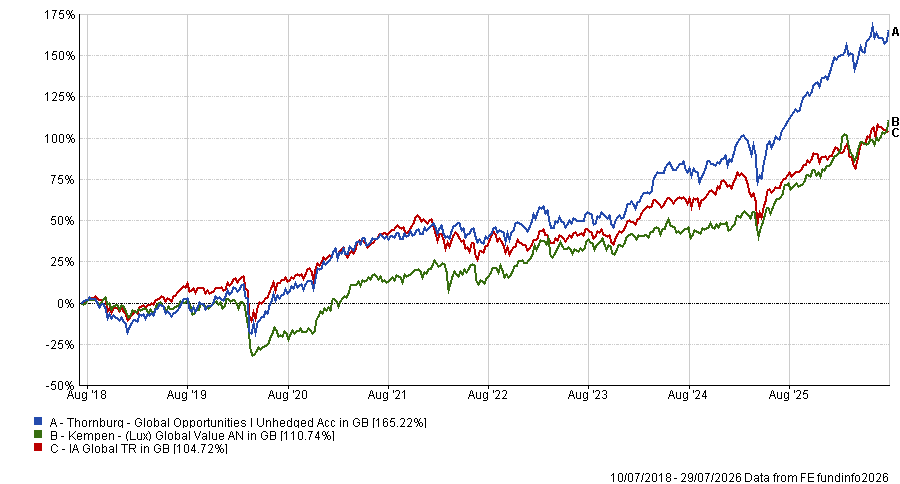
Sheridan Admans, founder of Infundly, pointed to both Thornburg Global Opportunities and Kempen Global Value as quality-oriented funds.
“What makes both strategies stand out is that neither relies on simply owning the market’s most highly rated compounders,” he said, noting that many global quality portfolios have become concentrated in expensive US mega-cap businesses with strong historic profitability and predictable earnings.
In contrast, these strategies apply a more valuation-sensitive interpretation of quality and are prepared to look where the market’s confidence is lower.
“Thornburg Global Opportunities stands out through its combination of business quality, valuation discipline and a clearly identified catalyst for change,” Admans said.
Co-managers Brian McMahon – who has managed the fund since its 2006 inception – and Miguel Oleaga run the strategy as a concentrated, benchmark-agnostic portfolio with a high active share and structural underweight to US mega-caps.
Meanwhile, Kempen Global Value is differentiated by targeting quality businesses that are insufficiently recognised, rather than restricting its investable universe to businesses that already display premium-quality characteristics.
“Its emphasis on free cashflow, returns on capital, improving fundamentals and better capital allocation provides protection against traditional value traps, while its valuation discipline means investors are not paying quality-style multiples for those attributes,” Admans said.
Portfolio holdings currently include Universal Music Group, Sanofi and Hana Financial.
Performance of the funds vs sector over 10yrs
Source: FE Analytics
Next, Benjamin Chambers, investment analyst at One Four Nine Portfolio Management, highlighted the £2bn Latitude Global strategy, managed by Alpha Manager Freddie Lait since 2020.
“We like the fund’s focus on owning high-quality compounders with attractive long-term growth prospects, while maintaining a strong emphasis on valuation and capital preservation,” Chambers said.
“Lait has built a portfolio that has historically delivered attractive returns with notably lower volatility and strong downside protection.”
Indeed, Trustnet research identified Latitude Global as one of 16 funds in the IA Global sector in the top decile for five-year downside capture ratio to the end of 2025 and top decile for Sortino ratio.
Chambers suggested that Latitude Global can work well as a defensive global equity allocation, either as a core holding for investors seeking lower volatility or as a satellite position alongside higher-growth strategies.
“The strategy’s resilience in weaker, or riskier, markets make it a strong diversifier within a broader global equity portfolio, particularly relevant in today’s market,” he said.
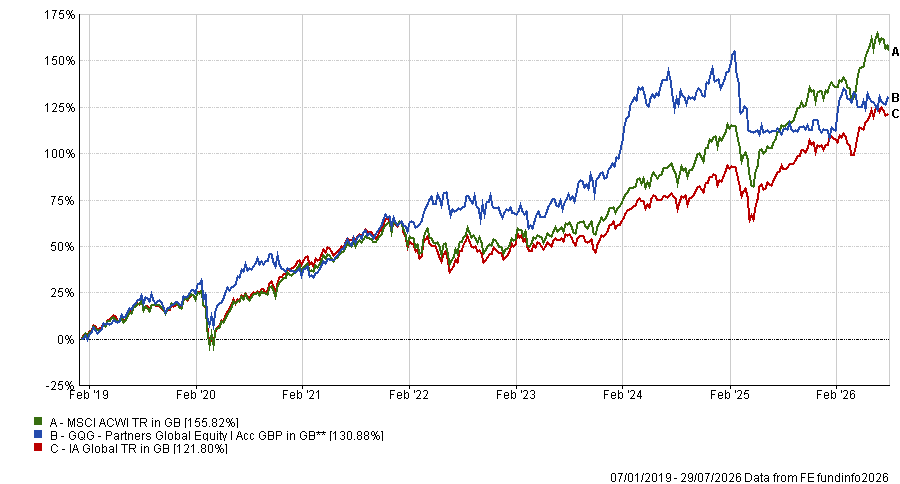
Finally, Samir Shah, senior research analyst at JM Finn, suggested GQG Partners Global Equity, which has been managed by Alpha Manager Rajiv Jain since 2017. He has been joined by co-managers Brian Kersmanc, Sudarshan Murthy and Sid Jain.
Shah cited Jain’s long track record across different market environments as a key reason for confidence in the strategy’s consistency.
The fund invests in high-quality, attractively priced companies with competitive advantages, evaluated on financial strength, earnings growth and management quality.
“The manager is also willing to shift the portfolio’s style, sector and regional exposures as conditions change,” Shah noted.
“The team adapts the portfolio to reflect where it sees the best balance of quality, valuation and risk – for example, having taken a defensive stance for some time, we note that the portfolio has recently been selectively buying some technology names due to recent de-rating across the sector.”
Performance of the fund vs sector over 10yrs
Source: FE Analytics