






Investors expecting a quiet August are likely to be "disappointed", according to BlackRock Investment Institute's Michel Dilmanian, because AI investment, oil markets and government bond yields are all being driven by the same underlying supply scarcity.
Markets have just gone through a volatile month: a spike in the oil price revived worries about higher inflation and investors dumped semiconductor stocks on concerns about earnings in the AI-led investment cycle, before going risk-on again in the month's final days.
While the MSCI AC World index ended the month just 1.1% down (in sterling terms), there were some significant movements below the surface, most notably the 10.5% fall in the momentum index as investors rotated away from recent winners. Meanwhile, energy stocks jumped 11.5% while the information technology index lost 5.5%.
Performance of global equities in July 2026
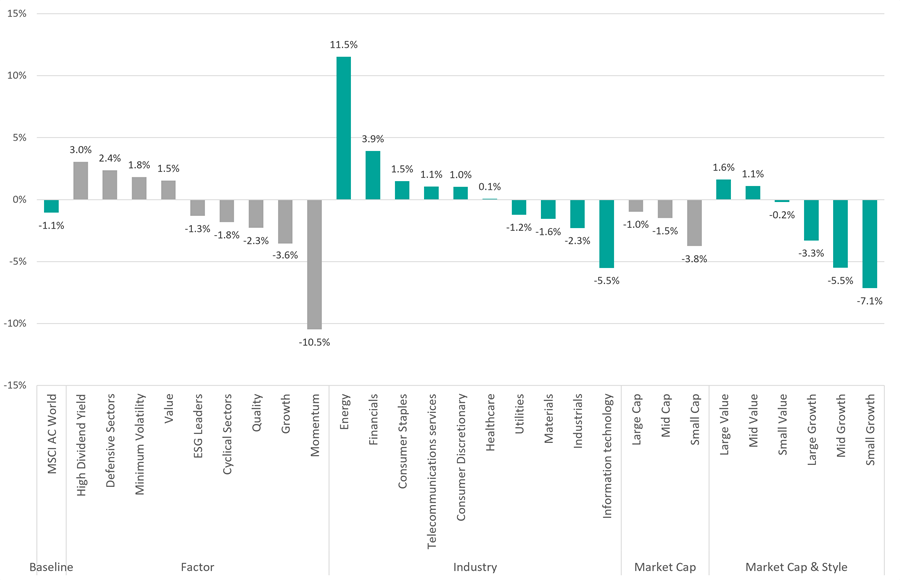
Source: Finxl. Total return in sterling between 1 and 31 Jul 2026.
In July's final week, the 30-year US treasury yield reached a 19-year high of 5.28% after the Federal Reserve held rates steady, while the two-year yield fell to 4.29%, steepening the two-year/30-year curve. The Nasdaq rose 1.6% over the same week, as investors weighed hyperscaler earnings against a fresh wave of AI capital spending.
BlackRock Investment Institute sees these moves as part of a pattern it has tracked for several years, rather than a one-off summer disruption.
Dilmanian, portfolio strategist at BlackRock Investment Institute, said: "Investors hoping August will bring a summer lull may be disappointed. Oil prices are swinging with every twist in the Middle East conflict, while AI earnings and spending plans are driving sharp moves in stocks.
"Alongside the repricing in government bond yields, these developments underscore our long-held view of a world shaped by supply scarcity keeping inflation and borrowing costs higher. For investors, the role of government bonds has shifted: less ballast, more income."
The steepening of the two-year/30-year treasury yield curve after the Fed's meeting reflected growing concerns around inflation combined with uncertainty over how the Fed will respond, he added. New Fed chair Kevin Warsh has proved reluctant to offer forward guidance on the central bank's future monetary policy moves.
Dilmanian continued: "We see this not as new but as a continuation of the broader macro regime we have described for several years. The fastest AI investment buildout in history is unfolding in a world shaped by supply scarcity, where energy constraints, tight labour markets and geopolitical fragmentation are shifting the focus from efficiency to resilience.
"Meanwhile, governments and hyperscalers are drawing on the same pool of savings, intensifying competition for capital. These forces are pushing investors to demand higher returns to lend for longer, lifting real yields across developed markets."
The scale of the repricing becomes clearer over a longer timeframe, he added. The US 10-year treasury yield has climbed from under 1% six years ago to nearly 5% today. German 10-year yields recently hit a 15-year high, and Japanese 10-year yields have approached 3% for the first time since the mid-1990s.
10-year real government bond yields across major developed markets, 2010-2026
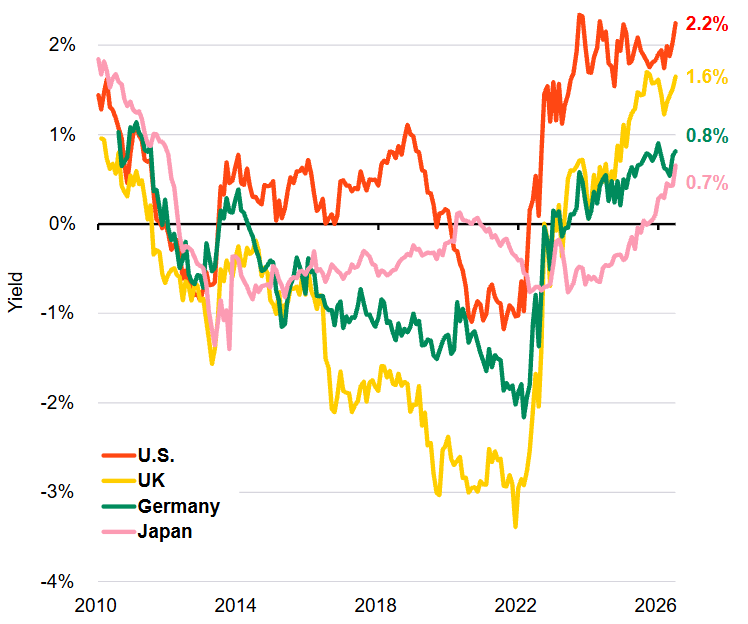
Source: BlackRock Investment Institute, with data from LSEG Datastream, July 2026. Chart shows 10-year inflation-adjusted government bond yields for the US, UK, Germany and Japan.
Dilmanian attributed the acceleration to several forces building at once.
Hyperscaler capital spending forecasts for 2026 have climbed roughly 30% in six months, to $720bn, extending what was already the largest AI investment boom on record, Dilmanian wrote.
Governments are borrowing more against a backdrop of persistent fiscal deficits, while Middle Eastern investors increasingly redirect capital toward domestic priorities rather than overseas markets. Together, these shifts have tightened the global pool of available capital and sharpened competition for it.
The energy and commodity shock stemming from the Middle East conflict has added to inflation driven by supply scarcity, Dilmanian said. Markets have responded by repricing Fed expectations from anticipated rate cuts to possible tightening, driving bond yields higher across the globe.
More recently, the term premium has risen further amid fresh uncertainty about how the Fed will act under Warsh.
These shifts have changed what government bonds actually do inside a portfolio. The correlation between daily US equity returns and 10-year treasury returns has averaged just 7% over the past five years, compared with -43% in the decade before the pandemic. Bonds, in other words, are no longer moving reliably against equities the way they once did.
The trade-off, in BlackRock Investment Institute's view, is income. More than 80% of the global bond universe now yields above 4%, against roughly 20% in the decade before the pandemic. Rather than extending further along the yield curve to capture that income, the firm favours short- and medium-term treasuries, local-currency emerging market debt, short-maturity euro area bonds, agency mortgage-backed securities and selected public and private credit with resilient cash flows.
Higher borrowing costs raise the bar for equities too, though Dilmanian argued that companies able to grow earnings faster than their borrowing costs rise can still outperform. It expects greater dispersion between companies as a result, which it says strengthens the case for active investing over passive approaches.
Attention now turns to US nonfarm payrolls data, which the portfolio strategist said will carry extra weight given the Fed has offered less forward guidance since its last meeting. The report should provide fresh detail on labour market conditions, wage growth and whether inflation is tracking consistently with BlackRock Investment Institute's expectation that rates stay higher for longer.