






The AI initial public offering (IPO) boom may reverse a decade-long tailwind for US equity returns – and emerging markets could stand to benefit.
This is according to recent research published by Ninety One, which mapped different scenarios for how the current wave of AI company public listings – led by SpaceX and expected to soon be followed by OpenAI and Anthropic – could affect US equity returns over the next 10 years.
For the decade ending in 2025, US companies bought back so much of their own stock that shares became scarce and that scarcity pushed prices up, explained Sahil Mahtani, director of Ninety One’s Investment Institute, and Daniel Morgan, an analyst within the firm’s multi-asset team.
The buyback tailwind added around 0.7% a year to returns, according to their analysis.
But with big AI players going public – and established tech giants like Alphabet and Oracle also raising funds across both equity and debt markets to fund the AI build-out – the market could see this reversing, as new share issuance floods the market instead, diluting returns unless earnings grow fast enough to keep pace.
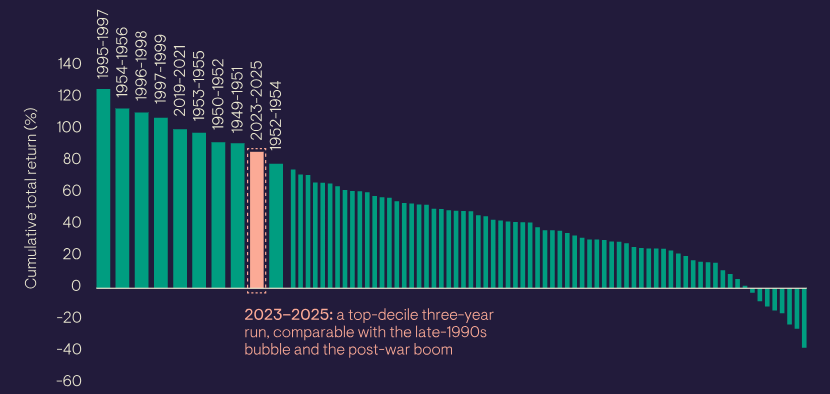
This could become a headwind for the US equity market, which has just had one of its strongest three-year runs in modern history.
How the 2023-2026 US equity rally compares to previous years
Source: Ninety One, Bloomberg, S&P
This wave of AI company public listings will not, on its own, end the bull market in the short-term, Mahtani and Morgan maintained.
“SpaceX, OpenAI and Anthropic raising $200bn-$250bn at listing is around 0.3% of an around $75trn market: real money, but not enough to move it,” they said.
The bigger risk lies further out. This is because companies typically only float a small slice of their shares at IPO, often around a quarter of the total. Within the first two years, Ninety One’s analysis suggests that share tends to grow to around 70%.
Applied to SpaceX, Anthropic and OpenAI, that could mean close to $4trn in additional shares reaching the market – a 4% expansion of US public equity.
“So the real question is what a sustained reversal of de-equitisation does to a decade of compounding,” Mahtani and Morgan said.
The research modelled three possible scenarios built using Ninety One’s Capital Markets Assumptions framework, which is based four components: income (the dividend yield the index pays today), growth (how much corporate earnings are expected to expand), revaluation (whether today’s valuations are likely to rise, fall or stay flat versus history) and market composition (the effect of shares entering or leaving the market).
As of April 2026, these four components combined to produce a 2.7% return over the next 10 years, according to the analysis.
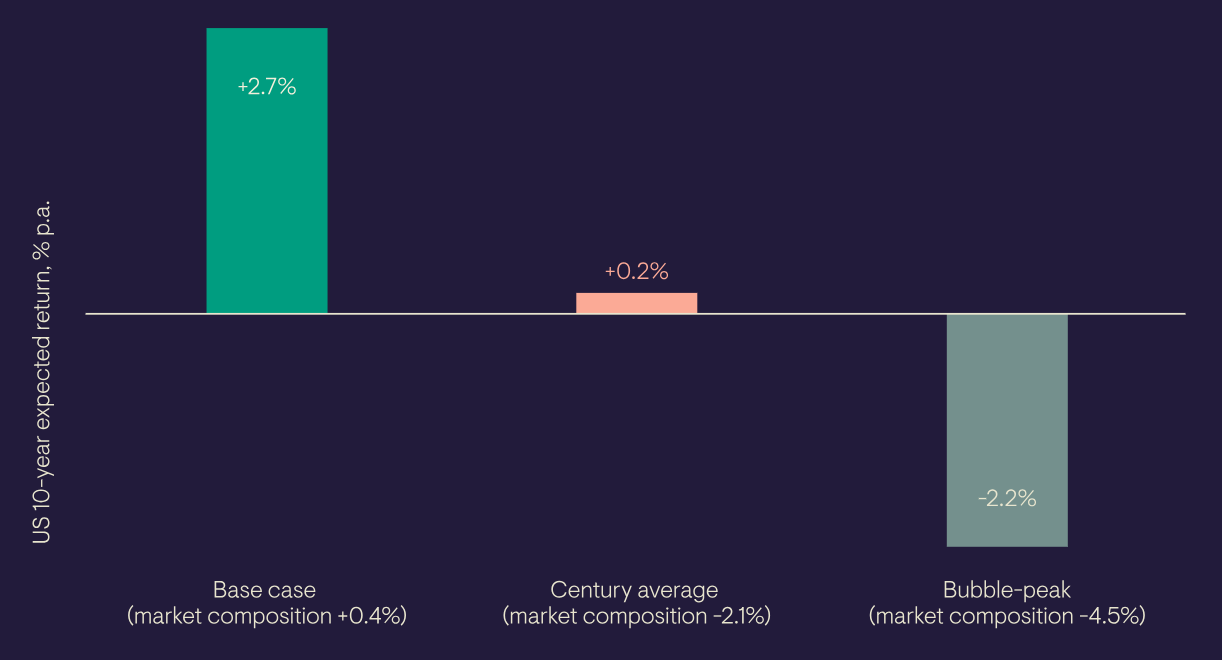
In the base case, Mahtani and Morgan assumed recent trends continue as buybacks persist, the IPO wave is absorbed without major disruption and market composition adds 0.4% a year to returns, keeping the 10-year return assumption at 2.7%.
The second scenario assumes the past two decades of shrinking share count were an anomaly. Instead, it assumes a century average for market composition of -2.1%, which pulls the 10-year US returns down to 0.2%.
The third scenario assumes market composition mirrors levels last seen during the dot-com bubble, when it detracted around 4.5% a year from returns. Under this scenario, Mahtani and Morgan suggested 10-year US returns could fall to around a 2.2% loss.
US equities 10-year expected return under Ninety One’s three market composition scenarios
Source: Ninety One Capital Market Assumptions
However, a potential ‘overhang’ could arrive before 2027, according to the research, due to two features.
The first is that index providers are loosening their own rules to admit these big AI names more quickly into their products. Nasdaq implemented rule changes that allowed SpaceX to join the Nasdaq 100 index just 15 trading days after its IPO, with relaxed float and market cap requirements.
The second is that some of these deals are being structured to grow the tradeable float more quickly than usual.
“SpaceX, for one, replaced the standard 180-day lock-up with a staggered schedule of releases,” Mahtani and Morgan said.
“Index inclusion obliges passive funds to buy at whatever weight the float dictates, and a rising float means rising forced demand.”
Whatever scenario is the one to play out, Mahtani and Morgan said the de-equitisation (shrinking share count) that underwrote the bull market is ending.
“Over the next ten years, US equity returns are going to have to come from elsewhere,” they said.
The two experts pointed out that the same mechanism now threatening US returns has already played out in emerging markets – particularly China – over the past decade.
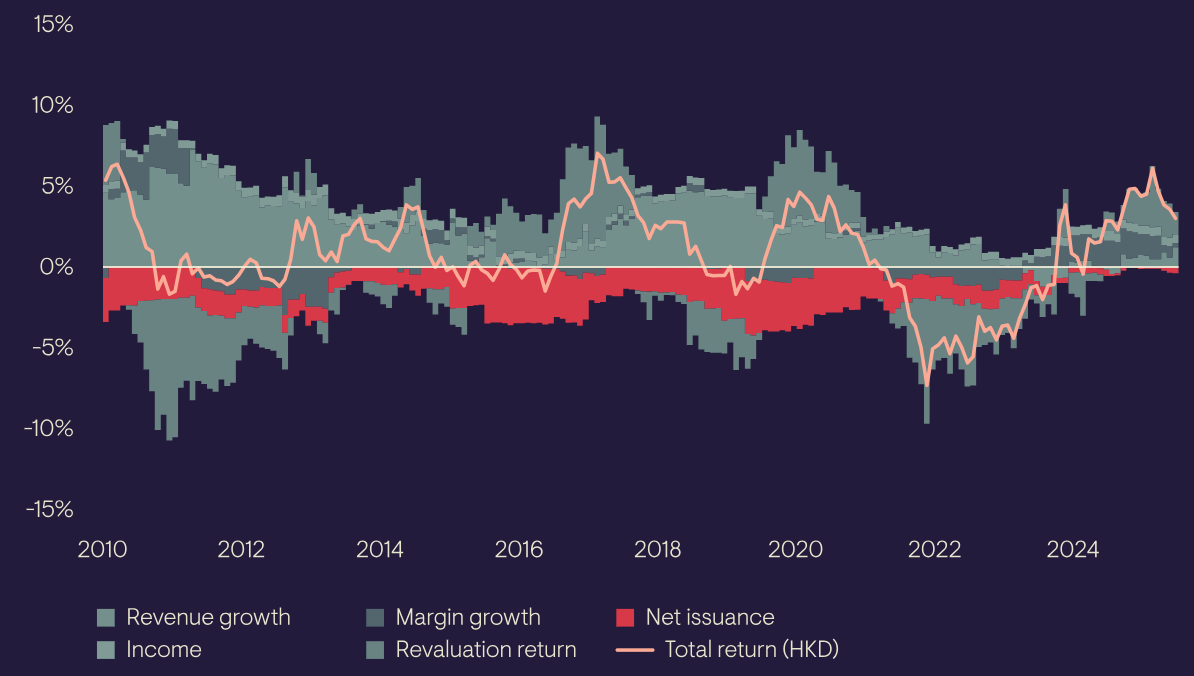
“In the 2010s, index investors were obliged to absorb a decade of dilutive inclusions, much of it Chinese and often at cyclical valuation peaks: stocks entering MSCI China were typically added at a premium averaging close to 78% in the years after 2011, up from around 15% before then,” they said.
Market composition drag in China, 2010-2024
Source: Ninety One, Bloomberg
This market composition drag that held emerging markets back during that time is now fading, Mahtani and Morgan argued, noting that this could mean the region is an attractive alternative for investors over the next 10 years.