






Forvis Mazars has cut equity exposure to UK stocks and mega-cap US technology names while increasing allocations to gilts and gold in the latest rebalance of its model portfolios.
The wealth manager said the move reflected profit-taking after a period of strong equity performance, alongside a continuation of a strategy begun in January to tilt away from the largest US technology companies.
It reduced equity weightings across most of its model portfolios, funded mainly by trimming its global equity index tracker fund and its UK index tracker fund. The Defensive and Equity Risk models, whose mandates cap tactical equity positioning, were not included in this change.
Ben Seager-Scott, chief investment officer at Forvis Mazars, said: "Equity markets have delivered strong returns so far this year, supported by underlying earnings growth. Our portfolios have benefited from maintaining a positive tactical equity stance throughout this period and we are now taking some profits from those positions.
"At the same time, we are continuing the trade initiated at the start of the year by tilting away from mega-cap US technology names and reinvesting across the broader US market, which we believe will be among the principal beneficiaries of AI-enabled productivity gains."
In the firm's Balanced portfolio, this involved trimming iShares Developed World Index from 14% to 12.25% and lowering iShares UK Equity Index from 2.5% to 1.75%.
Within US equities, the firm continued shifting from market-capitalisation-weighted trackers such as State Street SPDR S&P 500 into L&G S&P 500 US Equal Weight Index. This reduced exposure to the so-called Magnificent Seven while keeping the portfolios overweight the US market overall.
In the Balanced model, L&G S&P 500 US Equal Weight Index's allocation rose by 4.25 percentage points, from 3.50% to 7.75%, while the market-capitalisation-weighted tracker was taken from 2.75% to zero.
Forvis Mazars' Cautious, Balanced, Capital Growth and Adventurous models increased allocations to the Baillie Gifford Pacific fund, partly to address a South Korea underweight following a recent pullback in that market. This was funded by reducing its emerging market tracker "to focus more assets into a high conviction fund manager".
Elsewhere, the Cautious and Balanced models switched out of the BlackRock Continental European fund into a tracker fund: iShares Continental European Equity Index. "In these portfolios we prefer broad market exposure to control portfolio risk budgets," Seager-Scott said.
Proceeds from the equity reductions funded two further changes: gold moved from an underweight to a neutral position after a period of weakness and government bond exposure increased. This included higher allocations to US treasury inflation-protected securities and conventional UK gilts.
Forvis Mazars' models remain "marginally overweight" equities, Seager-Scott added.
The rebalance follows a period of strong performance across equity markets. Developed market equities have risen by 13.6% so far this year in sterling terms, with Japan up close to 20% and the other main developed markets gaining between 12% and 13.5%; emerging market returns are also nearing 20% for the year.
Performance of global stocks in 2026
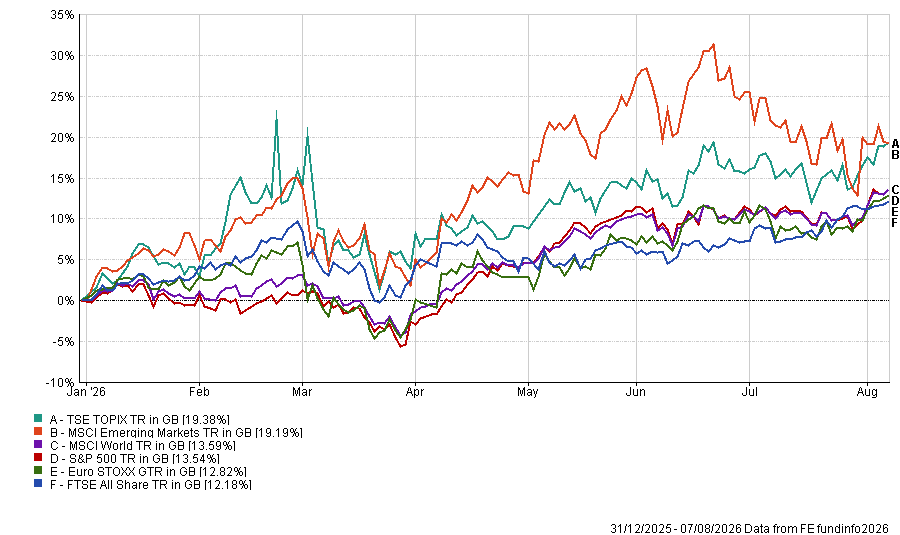
Source: FE Analytics. Total return in sterling between 1 Jan and 7 Aug 2026
As a group, the Magnificent Seven (Alphabet, Amazon, Apple, Meta, Microsoft, Nvidia and Tesla) have underperformed the MSCI World in 2026, having dominated market returns in recent years. While Nvidia and Amazon are up almost 20% in sterling terms, Tesla has shed 27.1% and Meta is down 10.6%.
Seager-Scott noted that global equity valuations have become less stretched over the past 18 months, as corporate earnings growth has outpaced share price gains, even though shares remain expensive by traditional measures.
"We are also seeing signs of strain in parts of the AI investment theme, particularly among the mega-cap technology companies. Our view remains that this is not a speculative bubble waiting to burst," he said.
"Rather, that the technology has a lot of potential but earnings growth will need to catch up with still-lofty valuations. Investor fatigue may also begin to build as big technology companies shift from returning cash to shareholders each year through share buybacks towards funding enormous capital expenditure programmes to fund AI rollout plans, with relatively limited tangible returns so far.
"However, we believe the AI opportunity will continue to broaden beyond the technology sector and increasingly benefit the wider economy, as has typically been the case with productivity-enhancing innovations throughout history."
On the case for increasing UK gilt exposure, the chief investment officer said prevailing yields on the benchmark 10-year government bond, at around 5%, "more than compensates for the political and inflation risks".