






Professional investors have a preference for active funds in emerging markets and corporate bonds, data from Rathbones has shown.
Some 42% of respondents said they used only active funds for the two investment areas above. The study interviewed 100 UK IFAs, discretionary fund managers and private bankers, and investment fund selectors at large banks running more than £234bn on behalf of retail clients.
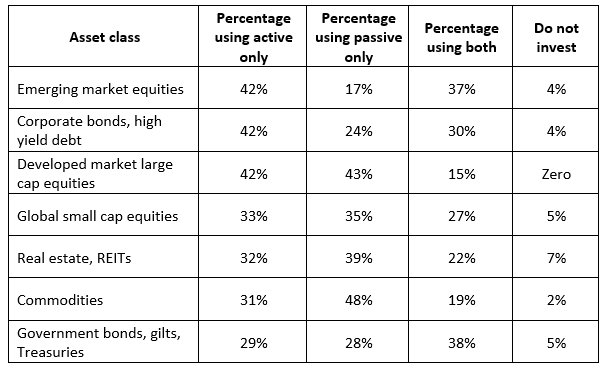
For emerging market equities, this compared with 37% who use a combination of both active and passive strategies, 17% who use passives only and 4% who do not invest in the region.
Meanwhile, 24% of respondents use passives only for their corporate bond allocations, with 30% blending both together.
Some 42% also used only active funds when investing in large-cap developed-market equities, although this was slightly overshadowed by the 43% who use passives only. Here, just 15% combine both, as the table below shows.
Conversely, professionals use passives most often for commodities, where 48% of respondents said they used index trackers only. Around a third (31%) were active only, with 19% choosing to use both.
How professional investors allocate between active and passive funds
Source: FE Analytics
More than half (53%) of those surveyed said they were moving significantly towards active strategies while maintaining core holdings, with almost all (95%) noting they expect to increase their allocation to active funds next year.
Tom Carroll, chief executive of Rathbones Asset Management, said: “Current macroeconomic conditions, the geopolitical environment and extreme market concentration within equity indices are part of the reason for the switch to active management, but fund selectors working for retail clients also recognise the attraction of being able to pick sectors and winners within sectors.
“That is driving growing interest in active strategies, which is likely to continue into next year no matter what happens with current global issues.”