






Invesco Global Emerging Markets (UK) is a £1.4bn strategy in the IA Global Emerging Markets sector, run by a seasoned team that includes FE fundinfo Alpha Managers Charles Bond and William Lam.
Their unconstrained, contrarian philosophy centres on finding companies trading below intrinsic value, blending financial analysis with qualitative assessments of competitive strength, management quality and key risks.
It is a process that has delivered strong results, with Invesco Global Emerging Markets (UK) sitting in the top quartile among its peers over three, five and 10 years, gaining 209.5% over the decade to the end of July 2026.
Yet, the picture has looked very different in 2026 as, in the first six months of the year, the strategy fell into the fourth quartile, returning 18.7% versus a 25.5% average for the sector.
The fund vs sector over six months vs 10yrs
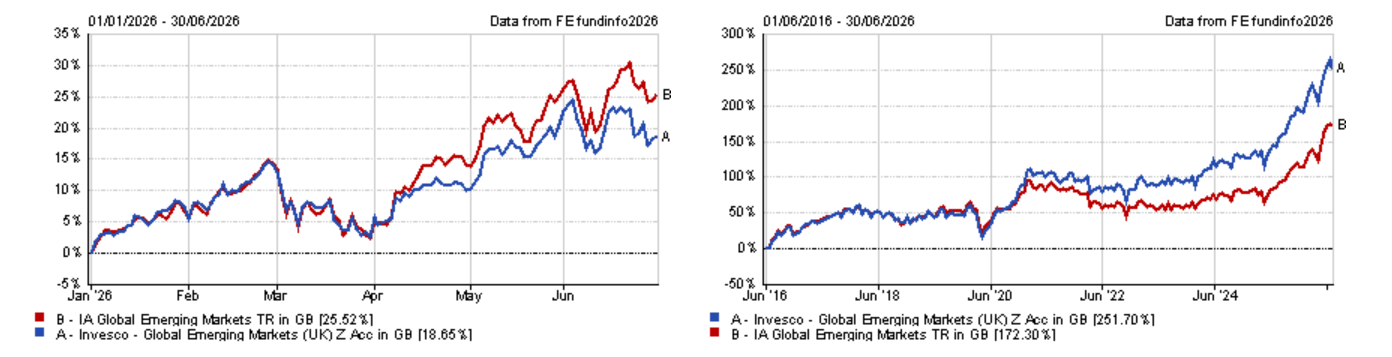
Source: FE Analytics
Despite the short-term wobble, the fund retains backing from Hargreaves Lansdown, featuring in its Wealth Shortlist.
Acting head of fund research Kate Marshall said this support is “based on the fund’s long-term performance, as well as the management team’s disciplined investment process, the depth and experience of the wider Invesco emerging markets team and the strong stock-picking record”.
This recent run of underperformance likely ties back to the fund’s philosophy, according to Chris Metcalfe, chief investment officer at iBoss. Specifically, he attributed it to the strategy’s limited exposure to the AI build-out.
“The word ‘unprecedented’ is often overused in investment but we believe the countries and, more importantly, the small number of stocks dictating relative performance within global emerging markets in the first half of the year were truly unprecedented,” Metcalfe said.
It is specifically investment in the AI build-out that has buoyed market performance over the past several months, he explained, with high-profile winners across emerging markets including Taiwanese and South Korean stocks Samsung, TSMC and SK Hynix.
“This was fuelled by extreme levels of retail buying, often involving leveraged positions,” Metcalfe noted.
“To outperform in the first half of the year, the Invesco managers would have effectively needed to be heavily overweight Korea and Taiwan, underweight Latin America and even more underweight China and India – in other words, a highly concentrated portfolio of momentum plays.”
Instead, the fund carries a significant underweight position in AI-focused stocks across Taiwan and Korea, particularly TSMC and SK Hynix.
As AI-driven momentum began to reverse at the end of June, the fund has moved to the third quartile for its return between January to 18 August with a 19.4% gain versus the IA Global Emerging Markets sector average return of 21.4%.
“The managers have been rewarded for maintaining properly diversified exposure across geographies and sectors,” Metcalfe said.
“There are times when investors simply have to watch a market, geography or sector go on a tear. We would not want our managers to feel compelled to chase potentially short-lived gains simply to keep pace with a benchmark.”
On balance, Metcalfe said he would choose to ‘hold’ the fund at this time.
Tom Bigley, fund analyst at interactive investor, also said ‘hold’, despite the fund’s more limited exposure to AI plays across emerging markets.
“When viewed over a longer investment horizon, the fund has delivered an excellent track record, outperforming both the MSCI Emerging Markets Index and its IA sector by an annualised 3 and 3.9 percentage points, respectively, over the past 10 years,” Bigley said.
He added that the fund’s country positioning, with Brazil remaining the fund’s largest overweight, reflects its more defensive exposure across the energy, financials, consumer and materials sectors.
The fund’s lack of AI can therefore be seen as a point of diversification. “The MSCI Emerging Markets index has become increasingly concentrated in a small number of technology companies, making a differentiated active approach more compelling,” Bigley said.
“As such, this fund could complement a passive emerging markets allocation by providing broader exposure across the asset class.”
Ben Yearsley, director at Fairview Investing, rounds out the trio who said ‘hold’.
“It’s done a decent job over the long-term and the more value-oriented approach can blend well with a more usual growth emerging market fund,” he said.
However, if buying today, he said he would prefer Artemis SmartGARP Global Emerging Markets Equity, which has logged first quartile returns in the sector over one, three, five and 10 years.
Meanwhile, James Yardley, head of investments at Chelsea Financial Services, said now would be a good time to buy the fund.
“The Invesco Asia and GEM team is one of the best in the market in our opinion,” Yardley said, adding that he also “isn’t too concerned about the shorter-term picture”.
“The fund's value tilt has been beneficial in recent years, but the managers aren’t as fundamental as some value investors and are willing to buy growth at the right price too.”
However, he highlighted Invesco Global Emerging Market’s underweight (5%) to India as a potential weakness.
“With minimal tech exposure, India also acts as something of an anti-AI play, offering useful ballast,” he said, suggesting that a fund like Chikara Indian Subcontinent could therefore be held alongside the Invesco strategy.