






You’re not an amazing investor. I am not sure who needs to hear it, but I fear too many people may need this reality check.
For anyone who started investing after 2008 (as I did), the sad reality is that we are not as gifted, brilliant or visionary as we might think we are, we are just the product of an exceptionally lucky period in markets.
Investors have had an easy time of it since the financial crisis, with most people able to triple their money over 10 years.
Looking at the rolling 10-year returns of the MSCI World from the end of every month, since the end of 2010 investors would have made more than 200% in 50 of the 68 periods, or 74% of the time.
The best returns were from October 2009-2019, when investors would have made 281.2%, while the worst performance came from November 2013-2023. Even then, however, investors made an impressive 173.7% from investing in global equities.
So, to put it mildly, you have not needed to be the second coming of Warren Buffett or Charlie Munger to make extraordinary returns over the past 10 years.
After such a long time basking in a world where almost everything you touched turned to gold, it can be easy to forget what the tough times look like.
After all, even the down times – such as Covid or the inflation and interest rate-driven sell-off of 2022 – have been incredibly short-lived.
But there will be prolonged tough times again, at least if history is anything to go by.
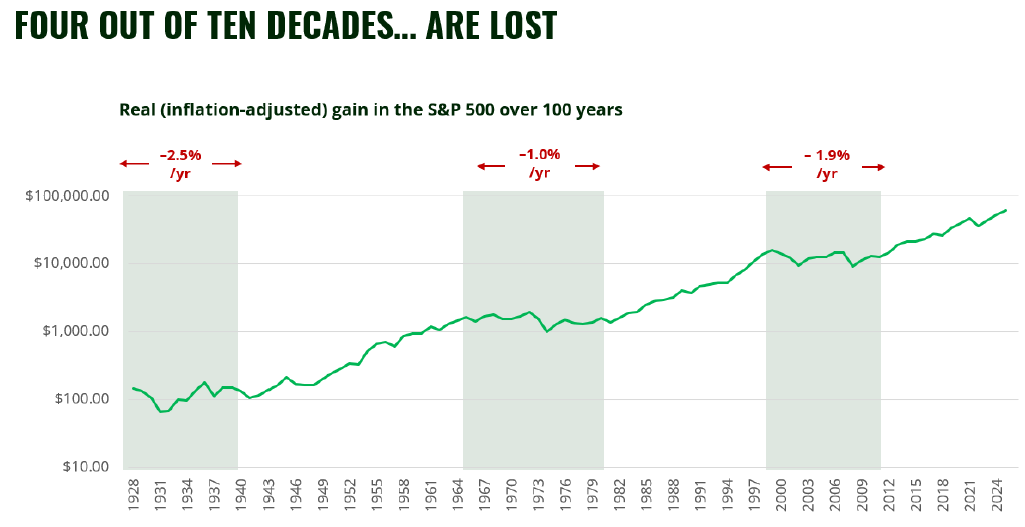
Recent data from French asset manager Carmignac shows that four in 10 decades are “lost”, meaning that investors made next to nothing during these periods.
“Many people believe that holding an investment for the long term will always generate good returns, but this view overlooks an important fact: since 1928, US stocks have spent one out of every four years in periods of low to negative returns, including so-called ‘lost decades’ – periods of structural decline characterised by stagnation and low to negative real returns,” the report read.
Source: Carmignac
It used the S&P 500 in the chart above to illustrate its point. On a real basis (which compares the amount of money made against real-world inflation), there have been three periods when investors lost money.
These are the great depression, the 1970s oil crisis and the double whammy of the tech bubble of the late 90s and great financial crisis in 2008.
Looking again at the MSCI World, more precisely at the 10-year returns from the start of each year going back to 1975, the most recent 10-year period in which investors would have only made double-digit returns was between 2005 and 2015.
You have to go back to between 1999 and 2009 to find a period where investors would have made a loss (2.9%) in sterling terms.
Still, this research shows making a loss is entirely possible.
We could be in for more decades like the ones we have experienced in recent times, but statistically we are overdue some tougher times. When they come is anyone’s guess, but don’t misplace seeing the arrows next to your portfolios pointing upwards for some innate ability to play the markets.
And don’t be overconfident. Because there is no guarantee that the next drop will be a flash in the pan – it could be the start of the next lost decade.