






After years of lacklustre returns, clean energy stocks are having a strong 2026 – but one fund manager says the real problem is how investors are measuring success in the first place.
David Harrison, head of sustainability at Rathbones and manager of Rathbone Greenbank Global Sustainability, said: “Investors are judging the energy transition on the wrong timeframe.”
The route to net zero will play out over decades rather than one or two market cycles, he said, making short- to medium-term price performance a misleading measure of progress.
“Thinking back to 2020/2021, there were plenty of companies that were offering great clean technologies, but they had volatile share price returns,” noted Harrison. “People looked at them and questioned the role these companies could play in the long-term.”
It highlights the nature of short-termism in the market today, Harrison said.
“People expect returns quickly today – but when it comes to the energy transition, it’s really important to recognise that everything, from investment cycles on grid infrastructure to a big clean energy project, has a political angle – it all requires a very long-term view.”
However, looking decades ahead is easier said than done, particularly when the short- and medium-term numbers have given investors little reason for patience.
Trustnet compared the one-, five- and 10-year annualised returns (to 19 August 2026) of the broad S&P World, and specialist benchmarks S&P Global Clean Energy Select index and S&P Global Clean Energy Transition index.
The clean energy index focuses on a narrow universe of the world’s largest companies that derive most of their business from clean energy. In contrast, the transition-focused index expands inclusion to businesses from carbon-intensive industries that are transitioning to more sustainable practices.
As shown in the graph below, over one year S&P Global Clean Energy Select logged a 41% annualised return, followed by S&P Global Clean Energy Transition (26%) and then the S&P World (21.5%).
The energy-tilted indices both see a noticeable uptick around April 2026, shortly after the outbreak of war in Iran, which likely boosted investment in other sources of energy.
Annualised 1yr return of the S&P World, S&P Global Clean Energy Select index and S&P Global Clean Energy Transition (in USD)
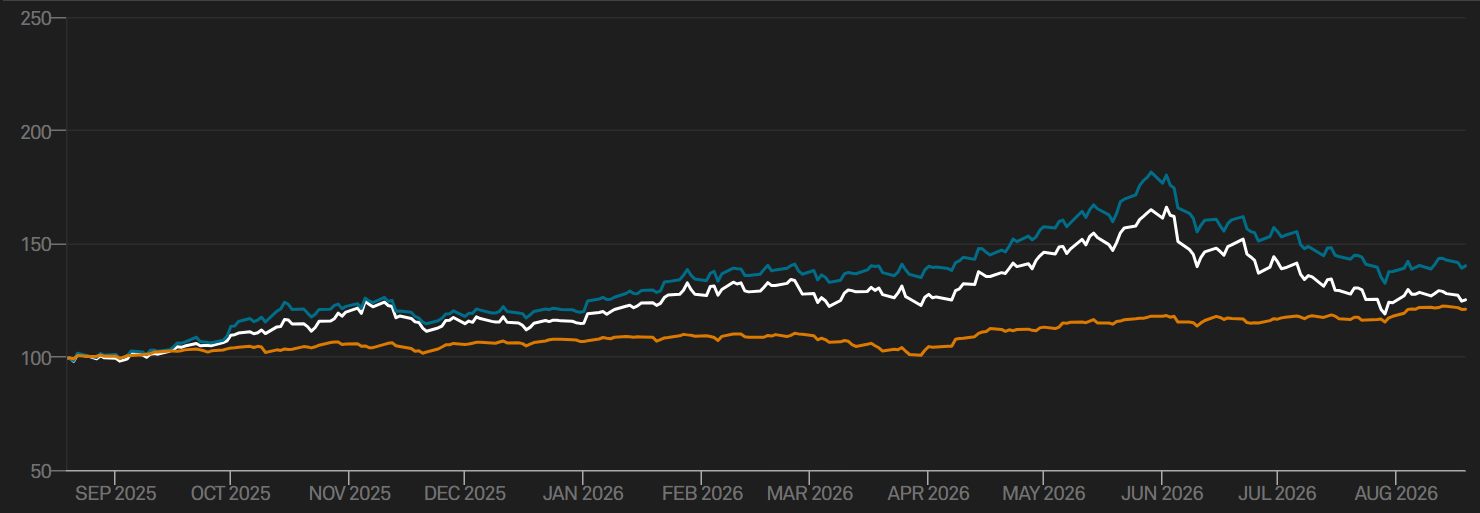
Source: S&P Global. S&P World (orange), S&P Global Clean Energy Select Index (blue), S&P Global Clean Energy Transition Index (white).
This also highlights how stocks supporting the transition to lower-carbon energy sources are being boosted by demand for energy independence and diversified energy supply to power AI data centres, Harrison said.
However, extend the view out to five years and S&P Global Clean Energy Select lost 1.2% annualised while the transition index lost 2.7% as S&P World gained 12.3% – showcasing the souring of sentiment towards climate-related action and investment.
Investors typically consider 10 years to be long-term, yet even the decade-long picture has not been long enough to prove the case for investing in clean energy stocks, as shown in the graph below.
It should be noted that the S&P Global Clean Energy Select index was launched in mid-2021.
Annualised 10yr return of the S&P World, S&P Global Clean Energy Select index and S&P Global Clean Energy Transition (in USD)
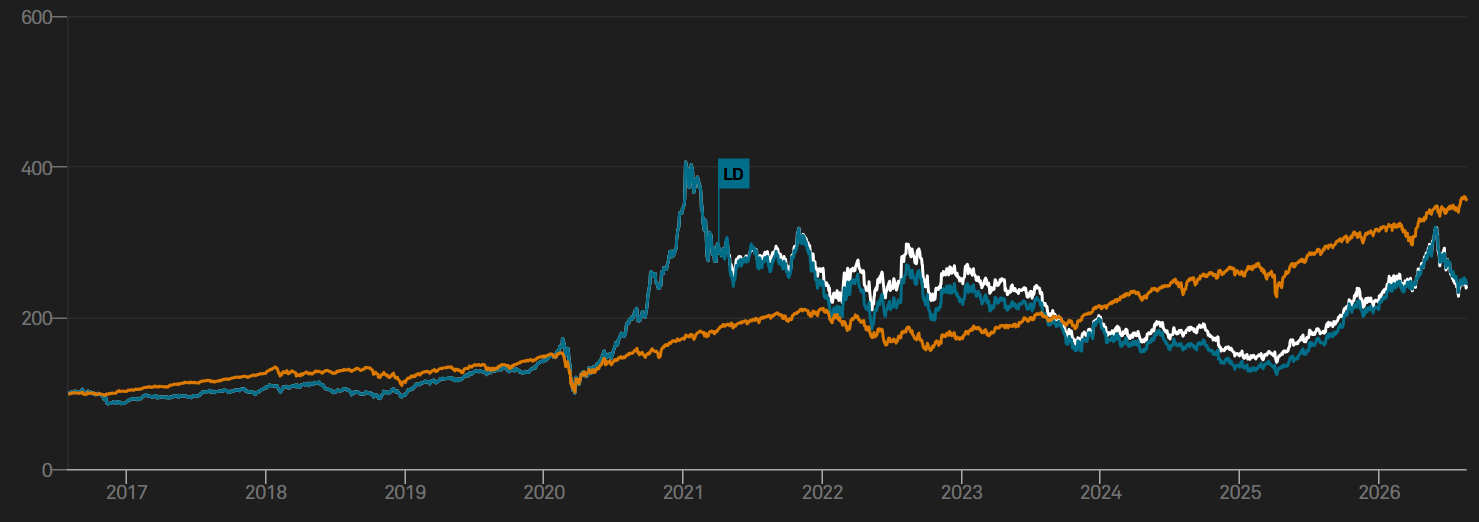
Source: S&P Global. S&P World (orange), S&P Global Clean Energy Select Index (blue), S&P Global Clean Energy Transition Index (white).
Rebuilding investor trust
The sustainable fund universe as a whole has suffered from weaker sentiment from retail investors over the past few years.
This shift largely originated from an ‘anti-ESG’ movement in the US – in which US asset managers and asset owners came under pressure from political figures over their ESG versus financial objectives.
When compounded with the fact it often takes time to see a return on investment when investing with sustainable objectives in mind, there has been increasing pragmatism across global markets.
“Sustainable investing has to prove itself to investors, and we are seeing that now in terms of performance,” Harrison acknowledged.
“Sustainable investing has definitely matured and, as time goes on, investors will see everything from increasing regulation – such as the Sustainability Disclosure Requirements in the UK – to more steady returns over time.”
Sentiment may well be improving. Recent research published by LSEG Lipper highlighted money is trickling back into sustainable funds, with fund flows returning to positive territory in the second quarter of 2026 for the first time since 2024, attracting £173m in inflows.
This is a swing of £783m from the £610m of outflows recorded in the first quarter of 2026.
5yr sustainable asset flows to Q2 2026 (£bn)
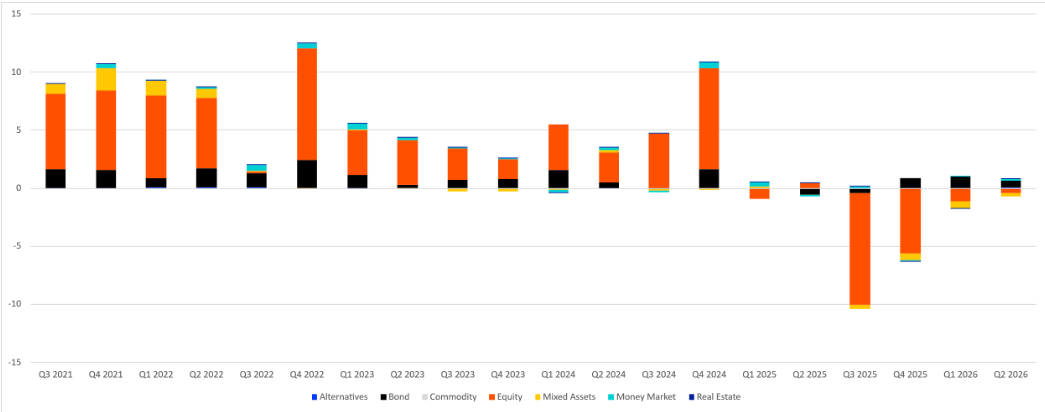
Source: LSEG Lipper
Bond funds led the recovery, pulling in £604m, while equity funds remained the largest drag, shedding £452m – this nonetheless marks an improvement from the £1.1bn in outflows recorded in the first quarter.
However, retail investors still withdrew £860m in the first half of this year, with most of the inflows coming from institutional investors, who allocated £1.3bn.
“Sustainable investing is not ill-suited to the retail market, retail investors just first need to see that it is a good long-term place for their money,” Harrison said.
“For example, it cannot just be about a sustainable company having new technology but rather about the earnings it makes, how strong the moat is, all the things that run the business. The one thing that will encourage investment above all else is the return profile – and we cannot lose sight of that.”
This pragmatism has influenced Harrison’s own stock-picking, as he has shifted the portfolio away from pure-play clean energy stocks to the most carbon-intensive energy stocks that are investing part of their capital expenditure in clean energies or decarbonisation efforts, such as Schneider Electric.
According to the International Energy Agency (IEA), total global energy investment reached $2.7trn by the end of 2015 – the body expects capital flows to reach $3.4trn by the end of 2026, with a growing portion funnelled into renewables, electrification and grids.
Global energy investment, 2016-2026 (estimated)
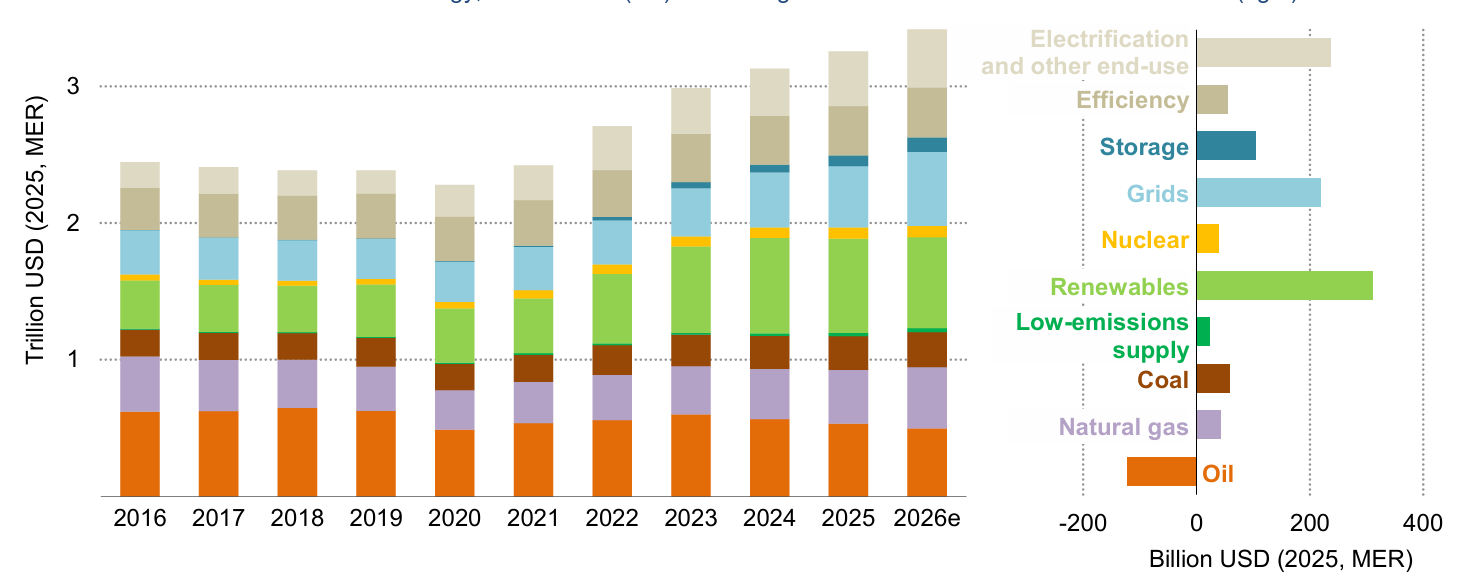
Source: International Energy Agency