






Half of professional investors (49%) believe the world is headed for a stagflationary scenario, as below-trend economic growth is coupled with above-trend inflation, according to the latest Bank of America survey.
Under normal economic conditions, inflation and growth tend to move together but stagflation breaks this pattern, leading to the erosion of purchasing power and the squeezing of corporate and household finances.
A term first coined in the 1960s, stagflation is ultimately uncommon but can be damaging to both the economy and people's investments.
Central banks are left between a rock and a hard place, deciding whether to respond to inflation by raising interest rates, which in turn would risk weakening economic growth and pushing businesses into decline, likely leading to higher unemployment.
For governments, increasing public spending or cutting taxes to stimulate growth can exacerbate inflation. Businesses tend to struggle with weaker corporate profitability as rising costs are coupled with declining consumer demand, making it difficult to pass on higher prices to the end customer.
Below, fund pickers highlight some options for investors that should be able to weather this economic anomaly.
Commodities
For Rob Morgan, chief investment analyst at Charles Stanley Direct, commodities represent one of the "classic stagflation hedges" as oil, natural gas, industrial metals and agricultural commodities tend to rise when inflation is being driven by shortages.
"Gold can also perform well if interest rates are kept lower than they otherwise would to help prop up the economy despite the environment of rising prices," he said.
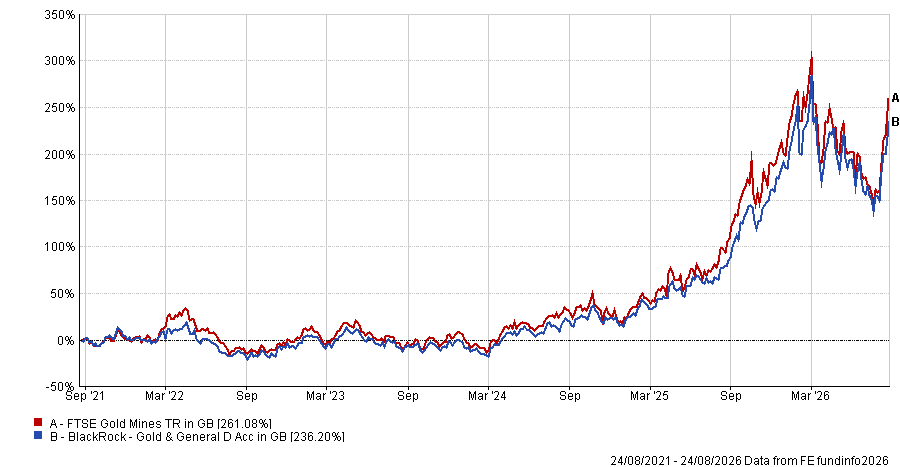
As a result, he chose the £1.7bn BlackRock Gold and General fund, managed by Evy Hambro and FE fundinfo Alpha Manager Tom Holl. Benchmarked against the FTSE Gold Mining index, it invests in the shares of gold miners listed around the world.
Gold has been a top-performing asset over the past five years, with the spot price up around 160% over half a decade. During this time the fund rose 236% while its benchmark is up 261%.
Performance of fund vs benchmark over 5yrs
Source: FE Analytics
Despite the strong gains, Morgan said "gold equities are far from over owned," adding that the fund "should leverage the upside of bullion and provide diversification benefits to other areas of a portfolio".
"The quality and experience of the BlackRock team is impressive, but it is not for the faint-hearted given the significant volatility involved in such a niche area."
Three flexible multi-asset trusts
Matthew Read, senior analyst at QuotedData, said stagflation is an awkward environment for most investors, but noted that Global Opportunities Trust looks to be in a better place than many to navigate the tough economic conditions.
"The portfolio targets attractive long-term real returns, with a strong focus on absolute returns and limiting drawdowns," he said, noting that the trust has a flexible mandate that allows manager Sandy Nairn to go anywhere he wishes. This includes both public and private markets around the world, other investment companies, funds, debt instruments, cash, short-term deposits and derivatives.
"Currently, that means avoiding expensive, economically sensitive growth stocks in favour of businesses with defensive revenues, pricing power and strong balance sheets," said Read.
At the end of June, almost 30% of the portfolio was in cash and a further 13% in fixed income, which Read noted provide the trust with "substantial dry powder" as conditions evolve.
"This should offer resilience if growth weakens while inflation remains stubbornly high," he said. "With no benchmark constraints, Global Opportunities Trust can vary its market exposure as opportunities change. In an environment where returns may be harder won and valuation discipline matters more, that flexibility could prove particularly valuable," he said.
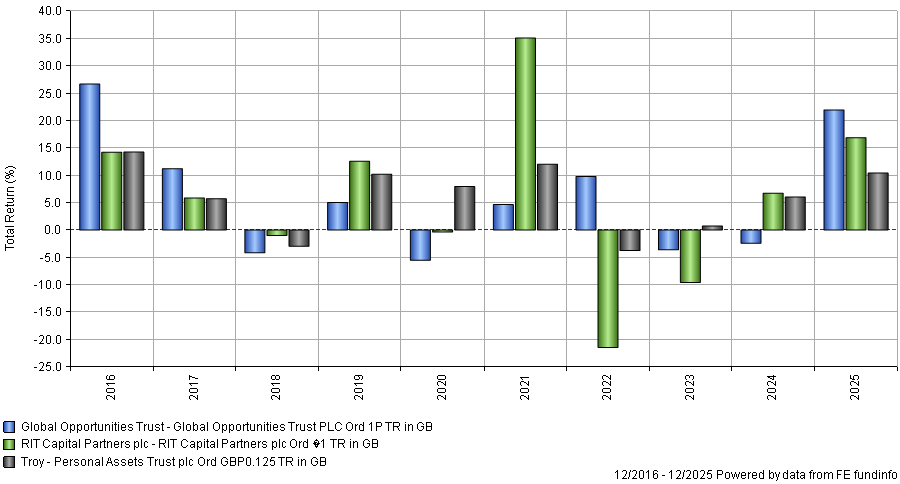
The trust has been the worst performer of the three IT Flexible trusts highlighted over one, three and 10 years, but is the best of the three over five years with a particularly strong year in 2022 amid rising interest rates, and again in 2025 when markets were volatile due to US president Donald Trump's 'Liberation Day' tariffs.
Performance of funds over 10 calendar years
Source: FE Analytics
For Sheridan Admans, founder of Infundly, in a stagflationary environment, the priority should be preserving purchasing power rather than maximising exposure to economic growth, and Personal Assets Trust is well suited to that role.
It combines carefully selected equities with inflation-linked bonds, gold and short-dated government debt, with each component serving a specific purpose.
"Inflation-linked bonds provide some direct protection against rising prices, while gold can offer diversification during periods of monetary or geopolitical uncertainty. The equity portfolio concentrates on durable, cash-generative businesses with strong balance sheets and the ability to pass higher costs on to customers," said Admans.
"The managers have also kept the portfolio's interest-rate sensitivity relatively low, recognising that persistent inflation could keep bond yields elevated."
The trust performed particularly well in 2020 but has shown remarkable consistency over the past decade, never dropping to the bottom quartile of the IT Flexible sector in a calendar year – although rarely shooting the lights out either.
"Personal Assets is unlikely to lead during a powerful equity rally, but its emphasis on avoiding permanent capital loss makes it a credible choice if weak growth and stubborn inflation occur together," said Admans.
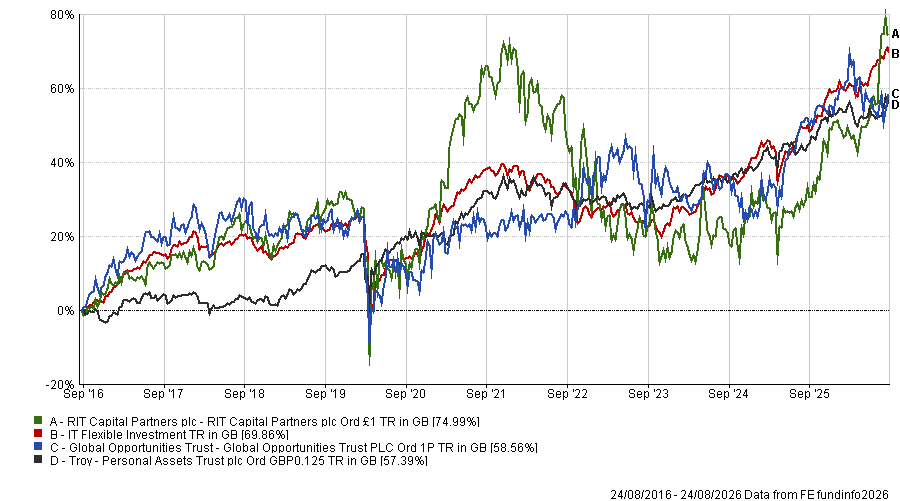
Performance of funds vs sector over 10yrs
Source: FE Analytics
Lastly, Matt Ennion, head of fund research at Quilter Cheviot, highlighted RIT Capital investment trust, a diversified multi-asset portfolio invested across equity markets, private markets and alternative strategies.
It has a return target of inflation (measured by the consumer prices index) +3%, which he said it has achieved over the long term, proving it has worked in a number of difficult environments.
"RIT Capital invests across asset classes both directly and through funds and has built its strong reputation by accessing high-quality investment managers, which are unavailable to retail investors, from around the world to gain exposure to investment themes," he noted.
"In particular, access to private markets has added significant value over the company's life," he said, although this has added volatility. Indeed, the fund has been one of the more volatile options in the peer group over the past 10 years.
"The final 'bucket' is uncorrelated or alternative assets where emphasis is placed on providing downside protection and return diversification. Investments include gold, fixed income and hedge funds," said Ennion.
The trust has been the best performer of the three over the past decade, up 75%, with particularly strong years in 2021 and so far in 2026. However, none of the funds have achieved a second-quartile return during this period.