






More people are saving into stocks and shares ISAs than ever before but cash remains the go-to option for most, according to the latest figures from HMRC.
There were 802,000 more stocks and shares ISAs being paid into in 2024-25, data released this week revealed, with the total number of ISAs subscribed to rising to 16.8 million from 15 million the year before.
However, cash continues to be the preferred option for many, with cash ISAs attracting the bulk of all money put into the tax-free wrapper.
Some £95.6bn was added to cash ISAs in the 2024-25 tax year, up 38% (or £26.1bn) on the previous year and more than two-and-a-half times the £37.2bn added to stocks and shares ISAs – which in turn was up 20% (or £6.1bn).
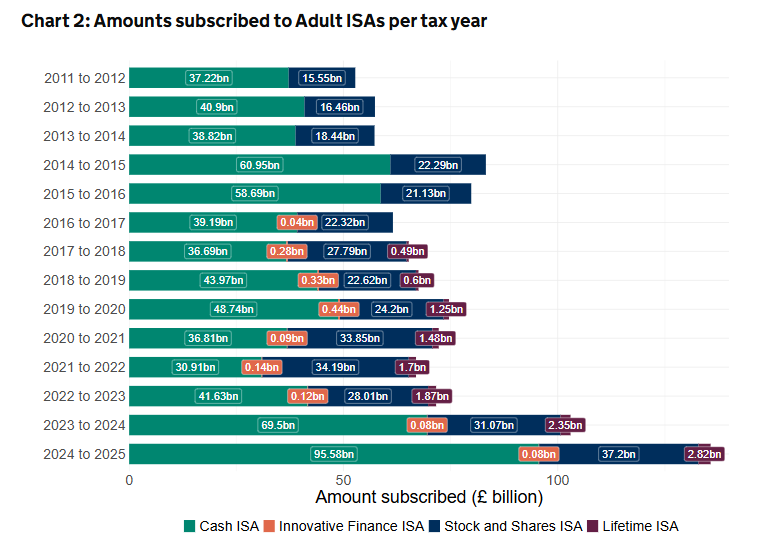
Source: HMRC
Marianna Hunt, personal finance specialist at Fidelity International, said: “Higher interest rates have made cash more attractive in recent years, with HMRC pointing to increased returns on savings as one factor behind the rise in cash ISA subscriptions.”
But there are other reasons people turn towards cash first. Rachael Griffin, tax and financial planning expert at Quilter, said there is a culture in the UK that “encourages people to save, but not necessarily to invest”.
“While cash has an important role for emergency funds and short-term goals, too many people miss out on the long-term wealth creation that investing can provide,” she said.
Hunt agreed, noting that although “everyone should have an accessible cash buffer for emergencies”, anyone with money that won’t be needed for five years or more should consider investing it as it has the “greater potential for long-term growth, albeit with more risk along the way”.
Adrian Murphy, chief executive officer of Murphy Wealth, said it was “highly encouraging” that more people were saving into stocks and shares ISAs, noting that the figures suggest “efforts from both the government and the financial advice sector to shift savers towards investing are beginning to bear fruit”.
However, he said there is “undoubtedly more to be done” as cash ISAs still represent nearly two-thirds of all accounts.
“Billions sitting in cash is not only bad for individuals’ financial prospects – it is also bad for the economy. If money is not being spent, it should at least be invested in companies that can help boost economic growth. The fact that the vast majority of the money subscribed to ISAs in the 2024-25 tax year was held in cash shows that we still have much further to go on that front,” he said.
From next April the ISA allowance limits are set to change, barring a change in policy at the upcoming Budget. Savers under the age of 65 will only be allowed to put £12,000 in cash ISAs, down from the current £20,000. People will still have a £20,000 ISA allowance, but the remaining £8,000 must be placed in a stocks and shares ISA.
Isabella Galliers-Pratt, senior investment director at Rathbones, said these changes could “help nudge some savers towards investing” but questioned whether it would materially change people’s behaviour.
“Cash remains hugely popular and our research suggests that confidence and understanding, rather than tax incentives alone, are often the biggest barriers to investing,” she said.
The firm’s study found that more than a quarter of people believe stocks and shares are too risky, while a similar proportion say they lack the know-how to manage investments themselves.
“Yet almost a third are willing to take higher levels of risk in pursuit of stronger returns. That suggests the issue is often not a lack of appetite, but a lack of understanding,” she said.
Similar research by Hargreaves Lansdown also showed people are nervous about investing and are looking to capitalise on the cash allowance before the rules change in April.
Around 12% of Britons are looking to open and contribute to a cash ISA before the changes take effect, while 11% plan to prioritise using their full cash ISA allowance, said Alice Haine, head of personal finance at the firm.
“Those figures rise markedly among younger adults, rising to 24% and 15%, respectively, among 18- to 34-year-olds. By contrast, they fall to 5% and 8% among the over 55s, reflecting the fact that over 65s are unaffected by the cash ISA cap,” she noted.
Angeline Ong, senior analyst at IG, added that the latest HMRC numbers show Britain “still has a long way to go to become a nation of investors”.
“The upcoming Budget is an opportunity to support that ambition, provided the government resists the temptation to pull further levers on investment taxes that could make investing less attractive,” she said.
“Investors need stability and certainty around the rules. Constantly changing the tax treatment of investing risks undermining confidence just as we are trying to encourage more people to invest for the long term.”
Lauren Gradys, investment specialist at Scottish Widows, added that although investing carries risk, history shows that markets have delivered stronger long-term returns than cash.
“You don't need to be an expert or have thousands of pounds to invest; it is all about getting started and remaining consistent. And with growing focus from the government on encouraging long-term investing, there's a real opportunity to help people take that first step and make more of their money,” she said.