






Investors have spent much of 2026 grappling with an energy price shock resulting from conflict in the Middle East. However, more extreme weather patterns over the next 12 months are expected to add further volatility across markets.
El Niño is a recurring climate phenomenon characterised by abnormally warm Pacific Ocean temperatures that disrupts weather patterns globally. It has a knock-on impact on food price inflation and commodity supply chains.
The ‘super’ El Niño now unfolding is expected to last into next year, adding downward pressure to growth and upward pressure to inflation through much of 2027.
The Peterson Institute for International Economics estimates the 2026 to 2027 El Niño will cause global losses of around $686bn, with cumulative losses reaching $3.1trn over five years.
With the effects setting in and lingering over the coming months, fund managers are considering how to position their portfolios to limit the damage – and where opportunities may lie.
Commodities: Go broad
For investors looking to protect themselves against a weather-driven price shock, commodities are arguably the most obvious place to start.
With key crop yields disrupted, a wave of food inflation is expected to hit the global economy. According to the International Monetary Fund, El Niño typically causes global food prices to rise by between 5-8% year-on-year, with the full impact felt six to 12 months after the climatic peak.
Food inflation across G7 countries
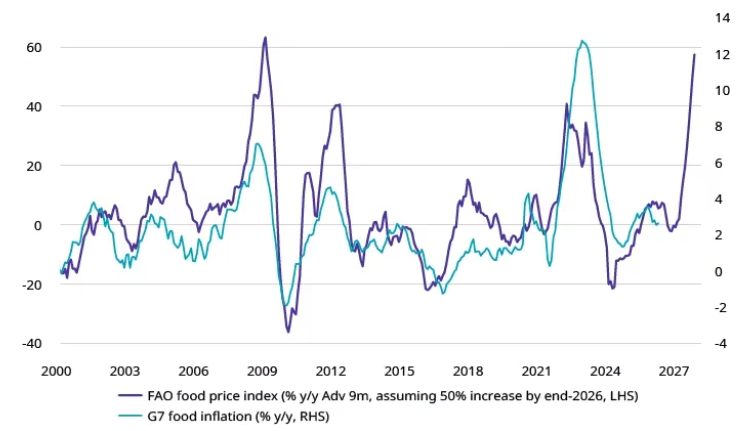
Source: Schroders, LSEG Datestream
But crop yields will be impacted in different ways. Droughts could affect harvests and push up prices for goods such as cocoa in West Africa and coffee and rice in India and Southeast Asia; conversely in southern Brazil and Argentina, heavy rainfall are expected to boost soya and maize production, putting downward pressure on prices.
Summary of potential impact on commodity prices
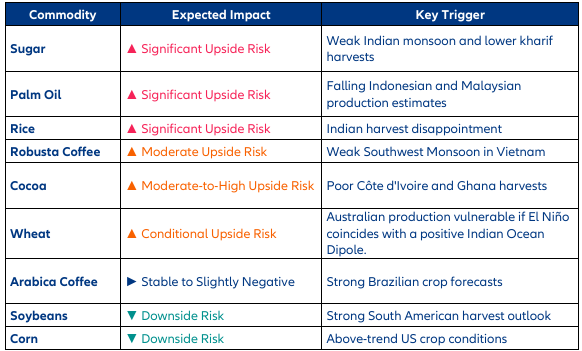
Source: Allianz
Agricultural commodities are also not the only products likely to be impacted. For example, copper output could be disrupted as copper-producing regions like Chile and Zambia could see infrastructure affected by flooding or drought respectively. Shifting weather patterns could also affect hydropower output and energy demand more broadly.
Key commodity prices over time
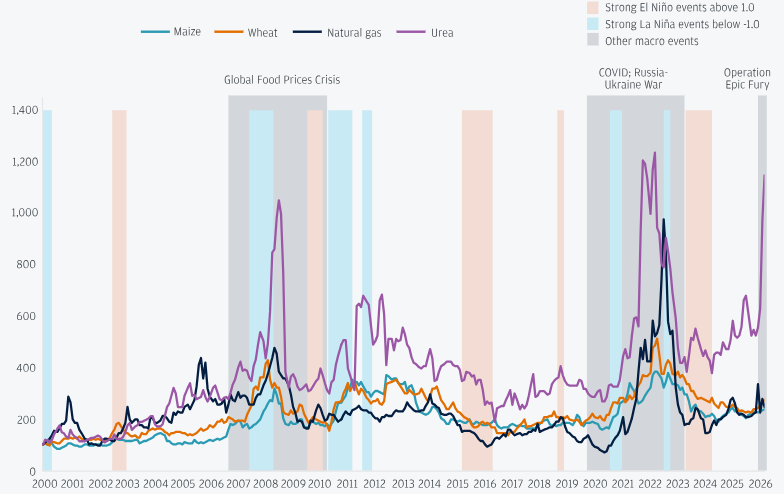
Source: JPMorgan, World Bank Commodities Price Data
George Cotton, manager of JSS Commodity – Transition Enhanced, said the path forward is clear: stay broadly exposed across the commodity complex to capture disruption wherever it lands.
“Many consequences of the current cycle will only become visible next year, so that makes a structural exposure to commodities more valuable than a tactical reaction now,” he said.
“The biggest risk of getting it wrong is under-diversification. Chasing one or two stories concentrates idiosyncratic risk in a single market. It also forfeits the diversification benefit, which is the very reason to hold commodities in the first place.”
Agne Rackauskaite, manager of Impax Asset Management’s Sustainable Food Strategy, agreed that El Niño does not mean investors should bank on a straightforward commodity trade.
“Sugar, cocoa, palm oil, coffee and rice are relatively small and volatile markets and much of that El Niño narrative is already well understood – prices can reverse very quickly if the weather event proves less severe than expected,” she said.
The wider agricultural value chain
Beyond the crops themselves, managers see opportunities across the wider agricultural value chain.
Rackauskaite said she is looking at businesses benefiting from tighter agricultural supply without relying on commodity prices remaining elevated.
“That means looking at areas where farmers tend to increase investment when yields are under pressure, including seed genetics, crop protection, irrigation and precision agriculture,” she said.
Higher crop prices can also support farm incomes, which has historically been positive for demand for agricultural equipment, Rackauskaite added.
Jeneiv Shah, global equities portfolio manager at Sarasin & Partners, also said the ongoing El Niño “supports the case for increasing an allocation to some agricultural companies that will benefit from rising prices, and particularly those companies that provide equipment, fertiliser and other inputs to farmers who may have greater discretionary spending available to them”.
Following the recent pullback in its share price, Shah flagged CF Industries as an attractive business on a risk-adjusted basis. It is a global manufacturer and distributor of nitrogen- and hydrogen-based products, such as fertiliser.
Further along the value chain, Rackauskaite is finding opportunities among second-order beneficiaries.
“Rail operators, for example, can benefit if higher diesel costs encourage freight to move from road to rail, while agricultural traders, processors and crushers can benefit from supply dislocations,” she said.
Companies with pricing power
With food costs rising, supply chains disrupted and the energy crisis still unresolved, managers are also seeking companies that can withstand sustained inflation and higher-for-longer interest rates.
In particular, Shah noted there is a growing argument for owning grocery retailers and contract caterers.
While these companies may face renewed input-cost pressure from sugar, palm oil, rice and cocoa, because demand for staples holds up better, many can pass higher prices on, Shah explained.
However, as well as identifying companies with the pricing power to perform during El Niño-linked inflation, it is also important to know which companies are more at risk during this time.
Rackauskaite said the likelihood of higher-for-longer interest rates and inflation “makes us more cautious about high-growth, longer-duration companies whose valuations are particularly dependent on lower interest rates”.
This is because persistent pressure on headline inflation could delay rate cuts in affected economies, even as weaker production and household spending weigh on growth.
Allianz research flagged consumer goods companies in emerging markets as a risk group. With food more likely to take up a larger share of household budgets, rising food prices leave lower-income shoppers with less to spend on everything else.
Emerging market debt
Yet El Niño will not hit all emerging markets equally. Guillaume Tresca, emerging market strategist at Generali Investments, said this could create selective opportunities for investors in emerging market debt who can tell the most exposed countries apart from the more resilient ones.
“The impact [of El Niño] will vary significantly between emerging economies, depending on their exposure to affected crops, reliance on food imports and the importance of food in local inflation,” Tresca said.
“For investors, the greatest pressure is likely to fall on short-term local debt in the most exposed countries, particularly where higher food inflation forces central banks to adopt a more hawkish stance, [while] countries with weaker credit ratings or greater fiscal vulnerability could also come under pressure if governments respond with support measures.”
This creates scope for investors to distinguish between countries that are highly exposed to food price shocks and those with stronger fundamentals, lower inflation sensitivity and more policy flexibility, Tresca suggested.
For example, as noted by T. Rowe Price, in 2023, there was an extreme coastal El Niño which caused huge floods in northern Peru that damaged infrastructure and disrupted agriculture, fisheries and other economic activity. However, while the macroeconomic effect was material, Peru’s low public debt, substantial international reserves and established policy frameworks ensured a less severe sovereign financing shock.
In addition, long-term external debt in emerging markets “should also be relatively less affected”, he added.
“We therefore see El Niño as a potential source of dispersion and selective opportunities within emerging market debt, rather than something that changes our positive view on the asset class as a whole,” Tresca said.