






BlackRock strategists have upgraded US treasuries, ending a six-year underweight position, and downgraded US equities to neutral to manage potential volatility around the artificial intelligence (AI) buildout.
In its latest update, the BlackRock Investment Institute moved short-term treasuries from underweight to overweight and shifted long-term treasuries to neutral. It also trimmed its underweight in Japanese government bonds, a position held since July 2023, when 10-year Japanese yields stood at 0.4% to 0.5%; those yields are now more than 3%.
Wei Li, global chief investment strategist at BlackRock, said: “Higher yields and potentially excessive Fed tightening expectations create room to unwind our US treasury underweight – a mainstay for most of the past six years.”
The asset management house first took that position in October 2020, when the 10-year yield was near 0.9%. Over recent months, the 10-year yield has jumped to a 24-year high.
“Now, yields have reset toward our long-held higher-rates view and we want to lock in some attractive income,” Li added.
The 10-year yield has risen 110 basis points this year to around 5.25%, which strategists attribute mainly to higher real interest rates rather than inflation expectations. It points to two drivers: intensifying competition for capital, and Middle East tensions and higher oil prices reversing market expectations for Federal Reserve rate cuts.
10-year US treasury yield decomposition, 2005 to 2026
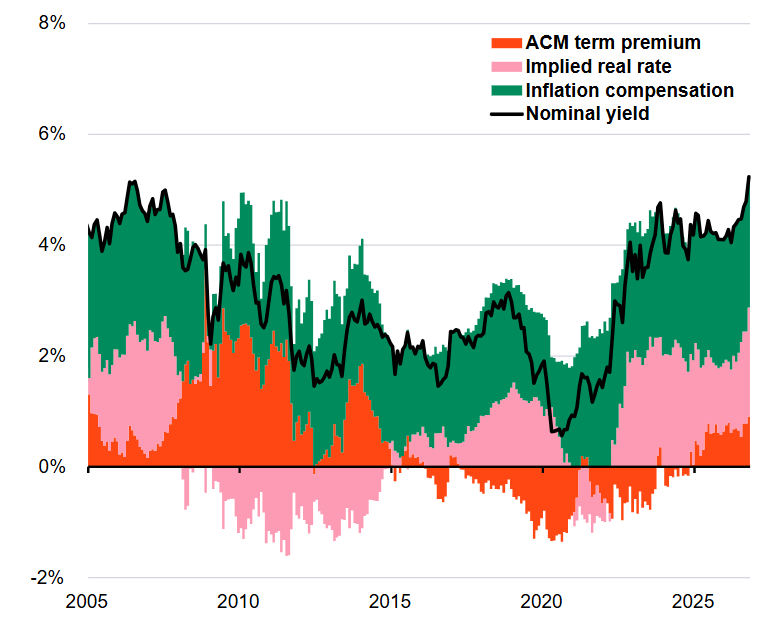
Source: BlackRock Investment Institute, with data from LSEG Datastream and the Federal Reserve Bank of New York, October 2026. Notes: Inflation compensation is based on 10-year breakeven inflation
Treasury yields hit their highest level since 2002 last week before retreating after strong bond auctions. European bonds, led by France, also sold off amid fiscal concerns, while oil prices rose on continued Middle East tensions.
Li said: “We see the bond sell-off as reinforcing our competition-for-capital thesis, while higher yields improve the case for owning treasuries.”
Markets have priced in 160 basis points of additional Fed tightening over the next 12 months since January.
“We think that is overdone,” Li said. “With term premium averaging around 75 basis points since September, higher yields offer a more attractive entry point.”
BlackRock’s analysis suggests that, at current yields, there is a 75-basis-point cushion against further yield increases over 12 months before total returns turn negative.
On how the position is funded, Li said: “We fund the treasury upgrades partly from US agency mortgage-backed securities that have been a stable source of income in portfolios and we are now neutral.”
As well as US agency mortgage-backed securities, BlackRock funded the treasury overweight by downgrading its long-held US equity overweight to neutral.
Li said the US equities downgrade is “a short-term risk-management move, reflecting our belief that investors must be more dynamic in today’s volatile macro and market regime”.
“We are also monitoring growing focus on AI policy and the AI buildout in jurisdictions across the country,” she added.
The firm still favours AI-related companies and listed infrastructure, as it believes attractive returns will be created in these sectors by growing demand and scarcity in critical infrastructure support.
BlackRock has maintained its emerging market equity overweight, citing strong earnings and cheaper valuations, including AI-related themes in Asia and Latin America.
“We are managing near-term risk, not changing our core convictions. We remain constructive on AI and stand ready to add risk again as visibility improves and attractive entry points emerge,” Li said.